
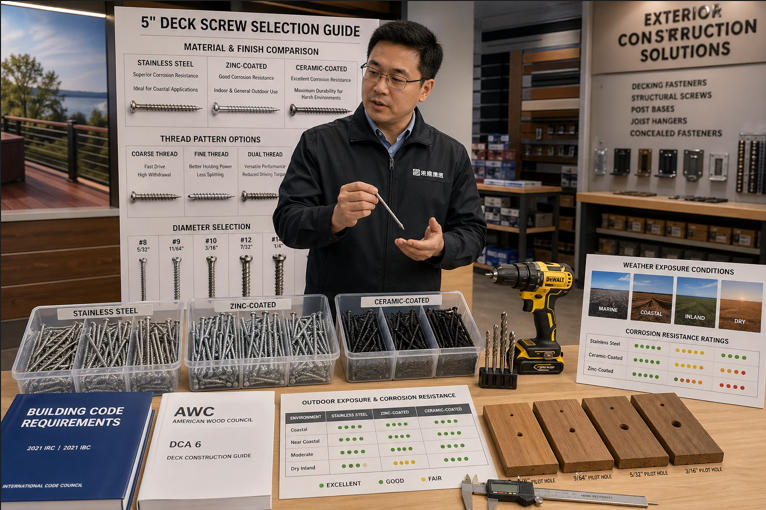
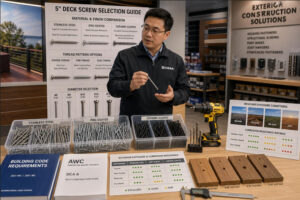
5-inch screws are not standard deck-board screws. They are long outdoor fasteners used when a connection needs deeper embedment, stronger clamping, or better holding power across thick lumber, blocking, posts, beams, landscape timbers, or other exterior assemblies. Choosing them correctly means looking beyond length. Material, coating, diameter, thread design, pilot hole size, drive system, wood species, and local code all affect whether the connection performs well after years of rain, heat, shrinkage, and seasonal movement.
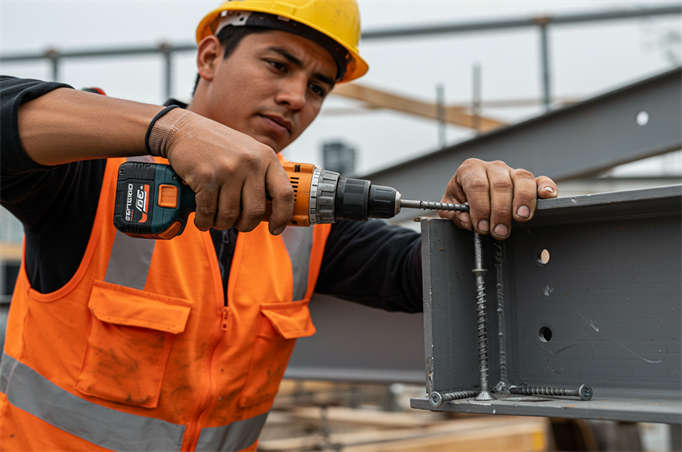
Why selecting the right 5-inch screws matters for durability, safety, and project longevity
Outdoor fasteners work harder than indoor screws. Decks and exterior structures are exposed to rain, humidity, UV cycles, wood movement, preservative chemicals, tannins, and sometimes salt air. A screw that performs well inside a dry framing wall may corrode, stain, loosen, or snap when used outside.
The most expensive screw problem is rarely the cost of the screw itself. It is the repair: replacing stained boards, backing out stripped fasteners, fixing split joists, or rebuilding a railing detail that failed inspection. A correct 5-inch screw should provide enough embedment, resist corrosion in the local environment, drive cleanly without damaging the wood, and match the structural role of the connection.
Quick overview of common scenarios: decks, railing, fasteners for treated lumber, composites
5-inch screws are commonly used in outdoor work such as deck blocking, heavy framing, rail post reinforcement, pergola construction, landscape timbers, exterior benches, and some thick trim or fascia build-outs. They are usually not the right choice for standard 5/4 deck boards, where shorter deck screws or hidden fasteners are normally more appropriate.
For pressure-treated lumber, corrosion resistance is critical because many preservatives contain copper-based chemicals that can accelerate corrosion in incompatible fasteners. For composite and PVC decking, the screw must also respect manufacturer rules for movement, spacing, and surface finish.
What readers will learn and how to use this guide
This guide explains when a 5-inch screw makes sense, how to compare stainless steel and coated screws, how thread and shank design affect clamping, when predrilling is needed, and how code or warranty requirements influence fastener selection. Use it as a practical checklist before buying or specifying long screws for outdoor projects.
Understanding the Role of 5-Inch Screws in Outdoor Projects
When a 5-inch length is appropriate
A 5-inch screw is appropriate when the screw must pass through a thick top member and still leave enough threaded embedment in the receiving member. For example, fastening 2x blocking into a post, attaching thick framing components, or pulling together landscape timbers may justify the extra length.
The key question is not simply, “Is 5 inches strong?” The better question is, “After the screw passes through the first piece, how much thread is actually engaged in solid wood?” If the receiving member only gets a shallow bite, the screw length is not being used effectively.
Common deck scenarios where 5-inch screws are favored
- Fastening blocking into 4x or larger posts.
- Attaching thick stair framing components.
- Pulling bowed deck framing into alignment before final fastening.
- Building pergolas, outdoor benches, or heavy timber features.
- Securing landscape timbers in above-ground outdoor structures.

Materials and Corrosion Resistance
Stainless steel grades: 304 vs 316 and their implications
Acero inoxidable 304 is widely used for general exterior applications. It offers strong corrosion resistance in normal outdoor moisture conditions. Acero inoxidable 316 contains molybdenum, which improves resistance to chloride corrosion. That makes 316 a better choice for coastal decks, docks, pool areas, and projects exposed to salt spray.
For buyers comparing stainless fasteners, Prince Fastener’s guide to tornillos de acero inoxidable and its article on choosing stainless steel screws are useful references when matching screw grade to outdoor exposure.
Coated vs bare steel: pros and cons for outdoor use
Bare carbon steel should not be used for exposed deck or outdoor applications. It can rust quickly, stain wood, lose cross-section strength, and become difficult to remove. Coated steel screws can work well in many above-ground deck projects, but the coating must be rated for exterior use and compatible with pressure-treated lumber.
One industry insight: coating color is not a specification. A green, tan, bronze, or black screw may look like an outdoor fastener, but the label and technical data must confirm treated-lumber compatibility, corrosion resistance, and intended use.
Galvanized considerations and salt exposure impact
Hot-dip galvanized fasteners are commonly used with treated lumber, but salt exposure changes the risk level. In coastal or poolside environments, stainless steel is usually the safer long-term option. Simpson Strong-Tie provides helpful guidance on stainless-steel fastener solutions for wet and treated-wood applications.
Code language in many jurisdictions also requires corrosion-resistant fasteners for pressure-preservative-treated wood. UpCodes summarizes common requirements for fasteners used with pressure-preservative-treated wood, including hot-dipped galvanized steel, stainless steel, silicon bronze, or copper.
Bar Chart: Relative Corrosion Protection

Pie Chart: Screw Selection Decision Factors
Thread Types and Shank Design
Full-thread vs partial-thread and when to choose
A full-thread screw has threads along most of the shank. It is useful when both members need continuous grip. A partial-thread screw has a smooth section below the head and threads near the tip. In thick wood-to-wood connections, partial-thread screws often pull the top member tightly against the receiving member because the unthreaded shank allows clamping instead of forcing the two members apart.
Fine vs coarse thread and wood engagement
Coarse threads are generally better for softwoods such as pressure-treated pine, cedar, spruce, and fir. They bite aggressively and resist pull-out well. Fine threads are more common in metal or dense material applications and may not provide the same holding power in soft lumber.
Dense hardwoods require a different approach. The problem is often not screw strength but installation torque. Without correct pilot holes, long screws can overheat, bind, or break before seating properly.
Shank length, pilot requirements, and impact on surface finish
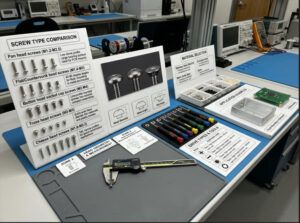
The shank design affects both clamping and appearance. Reaming ribs, knurled sections, and under-head nibs can reduce driving torque and improve seating. However, aggressive head features can damage soft cedar or composite caps if overdriven. Always test the screw in an offcut before installing hundreds of fasteners across a visible deck surface.
Length vs Diameter Considerations
Matching screw diameter to deck boards and joists
Length and diameter must be selected together. A 5-inch screw that is too thin may bend, snap, or lack enough shear capacity for a heavy connection. A screw that is too thick may split the lumber, require larger pilot holes, and slow installation. Long outdoor screws often fall into #10, #12, #14, 1/4-inch, or structural screw categories depending on the manufacturer.
Consequences of undersize or oversize screws
Undersized screws can strip, loosen, or fail to hold as wood shrinks. Oversized screws can split joists, create surface defects, or reduce edge-distance safety. For structural connections, do not guess based on length. Use screws with published load data or fasteners specified by the project drawings.
Practical sizing tips for common wood species
Pressure-treated pine usually accepts coarse-thread exterior screws well, but wet lumber can shrink after installation. Cedar and redwood are softer and can crush under the head if the screw is overdriven. Dense hardwoods need accurate pilot holes and slower driving speed. The USDA Forest Products Laboratory’s Wood Handbook chapter on fastenings is a useful technical reference for understanding how wood density affects fastener holding power.
Excel-Ready Table: 5-Inch Screw Selection Matrix
The table below can be copied directly into Excel or Google Sheets for project review.
| Solicitud | Typical Material | Suggested Screw Type | Corrosion Choice | Pilot Hole Guidance | Installer Note |
|---|---|---|---|---|---|
| Blocking into post or beam | Pressure-treated pine | #12 to 1/4-inch exterior or structural screw, often partial-thread | Rated exterior coating, 304 stainless, or 316 stainless near salt | Pilot near ends, edges, or in dry lumber | Confirm if the detail requires a structural-rated fastener |
| Landscape timber fastening | 4x treated timber | Long timber screw or heavy exterior wood screw | Hot-dip galvanized or stainless depending on exposure | Pilot recommended for dense or dry timbers | Avoid trapped water pockets around screw heads |
| Deck rail blocking | Treated framing lumber | Code-approved structural screw where permitted | Approved coating, 304 stainless, or 316 stainless | Follow manufacturer instructions exactly | Guard loads are safety-critical; do not improvise |
| Pergola or outdoor bench | Cedar, redwood, or treated lumber | Coarse-thread exterior screw with suitable head style | 304 stainless for most exterior use; 316 near coast or pools | Pilot cedar and redwood near ends | Test for staining and surface finish before full installation |
| Composite fascia build-out | PVC or composite over wood framing | Manufacturer-approved composite or trim screw | Stainless or approved coated screw | Often required; follow board manufacturer spacing | Do not overdrive or restrict board movement |
Driving Performance and Predrilling
Pre-drilling guidelines by wood type
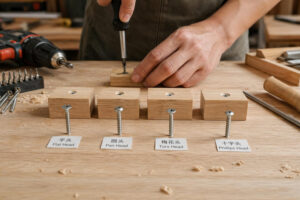
Predrilling is a control method, not a sign of poor screw quality. With 5-inch screws, pilot holes reduce splitting, lower torque, improve alignment, and protect the drive recess from stripping. Predrilling is especially useful in dry treated lumber, hardwood, cedar, redwood, end-grain fastening, and stainless steel applications.
Recommended pilot hole sizes for treated lumber and composites
Exact pilot hole size depends on the screw’s root diameter, thread design, wood density, and manufacturer recommendations. For thick wood-to-wood connections, many installers use a clearance hole through the top member and a pilot close to the screw root diameter in the receiving member. Composite and PVC decking should follow the board maker’s own installation guide. Trex, for example, publishes a detailed decking installation guide covering fastener and spacing requirements.
Tips for avoiding cam-out and stripping
Use the correct bit size, keep the driver aligned, and replace worn bits early. Star or Torx-style drives usually perform better than Phillips drives for long exterior screws. Impact drivers are fast, but excessive torque can snap stainless screws or overdrive the head. Slow down during the final inch of driving.

Recommended YouTube video: fastening pressure-treated decking
The video below gives a practical visual reference for fastening pressure-treated decking. Use the method as a starting point, but always match the screw to your own lumber, exposure, and code requirements.
Load and Structural Considerations
Shear strength vs withdrawal strength in outdoor fasteners
Outdoor screws are judged by more than pull-out resistance. Withdrawal strength measures resistance to being pulled out along the screw axis. Shear strength measures resistance to sliding forces across the connection. A longer screw can improve withdrawal if it has enough thread engagement, but shear capacity also depends on diameter, steel strength, connection geometry, and loading direction.
The American Wood Council’s Prescriptive Residential Wood Deck Construction Guide is a useful reference for understanding why deck fasteners, spacing, and connection details must be selected carefully.
How wood species and stress areas influence screw choice
Softwoods are easier to drive into but can crush under the head. Dense hardwoods hold well but require more careful pilot holes. High-stress areas such as ledgers, rail posts, stair stringers, beam splices, and cantilever zones need more than a generic long screw. They need approved fasteners and tested installation patterns.
Compatibility with Deck Material
Fastening treated lumber and preservative-treated references
Pressure-treated lumber can be corrosive to the wrong fastener. Choose screws specifically rated for the treatment type and service condition. Above-ground treated lumber, ground-contact treated lumber, and marine-use lumber do not present the same corrosion risk.
For a broader primer, Prince Fastener’s article on deck screw selection explains common deck screw types and outdoor applications. For projects requiring non-standard dimensions, coatings, or head designs, custom fastener manufacturing can help align the screw specification with the actual jobsite requirement.
Composite and PVC considerations for 5-inch screws
Composite and PVC boards expand and contract differently from wood. Most standard composite deck boards are installed with hidden fasteners or approved shorter screws. A 5-inch screw may be relevant for substructure or fascia build-out details, but it should not be driven through composite decking unless the board manufacturer allows it.
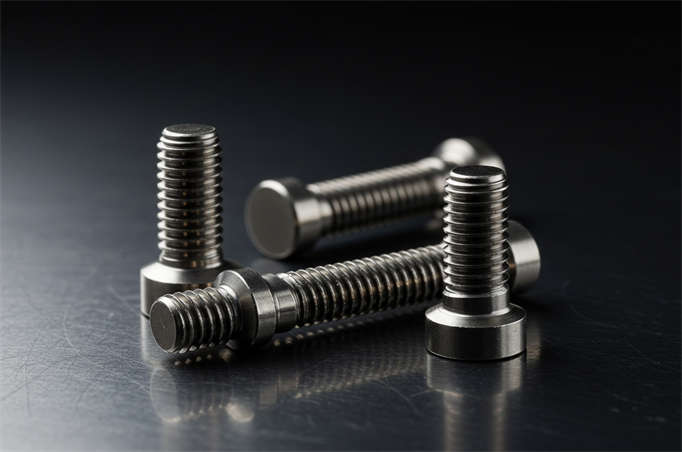
Installation Efficiency and Tool Compatibility
Bit types, drive systems, and bit longevity
Long screws generate more torque than short deck screws. Star, Torx, and external hex drives usually provide better engagement than Phillips drives. Use impact-rated bits when using an impact driver and replace bits before they begin damaging recesses. A worn bit can turn a fast installation into a sequence of stripped heads and wasted fasteners.
Quick-start tips for faster, cleaner installs
- Mark screw locations before driving to maintain consistent spacing.
- Clamp bowed lumber instead of using the screw as the only alignment tool.
- Predrill near board ends, edges, hardwood, and dry treated lumber.
- Drive slowly during the final inch to avoid head snap or overdrive.
- Test one complete connection before committing to bulk installation.
- Keep stainless, galvanized, and coated screws separated on site.
Common mistakes to avoid during installation
Common mistakes include using 5-inch screws for ordinary deck boards, choosing coatings that are not treated-lumber compatible, driving too close to board ends, skipping pilot holes in dense lumber, and using a general exterior screw where a listed structural screw is required.
Code and Warranty Considerations
Building codes and fastener requirements for decks
Deck codes exist because decks carry people, furniture, snow loads, wind loads, and guardrail loads while exposed to weather. Local code may specify fastener material, diameter, spacing, and connector type. Ledger boards, stairs, guards, beams, and posts should never be fastened based only on a general rule of thumb.
Manufacturer specs, certifications, and warranty implications
Fastener packaging should identify material, coating, size, drive type, approved use, and installation limits. Structural screws should have published load data or evaluation documentation. Deck board warranties may also require approved fasteners.
Prince Fastener often works with buyers who need to match screw material, coating, head style, thread length, point design, packaging, and project specifications. For construction-related fastener background, see Prince Fastener’s guide to tornillos de construcción.
Practical Selection Checklist
Quick decision flow for project type and environment
- Identify the application: decking surface, blocking, rail support, landscape timber, trim, or structural connection.
- Confirm whether 5 inches is actually needed based on top-member thickness and required embedment.
- Identify exposure: normal exterior, wet service, coastal air, poolside, ground contact, or marine condition.
- Select corrosion resistance: approved coating, hot-dip galvanized, 304 stainless, or 316 stainless.
- Choose diameter based on load, wood species, edge distance, and splitting risk.
- Choose thread and shank style: partial-thread for clamping, full-thread for continuous grip.
- Plan pilot holes for hardwood, dry lumber, stainless screws, and composite materials.
- Check code, warranty, and manufacturer instructions before installation.
Sample screw guides by application
| Tipo de proyecto | Recommended Direction | Avoid |
|---|---|---|
| Coastal deck blocking | 316 stainless exterior or structural screw where approved | Unrated coated screws or bare steel |
| General backyard deck framing | Approved coated structural screw or 304 stainless depending on exposure | Using long deck screws for ledger attachment without code approval |
| Cedar pergola detail | 304 stainless screw with pilot holes | Fasteners that stain cedar or split board ends |
| Composite fascia build-out | Manufacturer-approved trim or composite screw | Overdriven long wood screws through moving composite boards |
| Landscape timber | Exterior timber screw with suitable coating or stainless material | Interior construction screws |
How to read product labels and certifications
A reliable product label should answer these questions: What is the screw made of? What coating or stainless grade is used? Is it approved for treated lumber? Is it structural or non-structural? What drive bit is required? What installation limits apply?
If a box only says “outdoor screw” without clear compatibility or performance information, treat it as incomplete for serious deck work.
Maintenance and Long-Term Care
Inspecting for corrosion and wear over time
Inspect deck fasteners at least once per year. Focus on stairs, railings, ledgers, shaded areas, poolside zones, planters, and places where water collects. Look for rust bleeding, black staining, raised screw heads, cracked wood, loose boards, and damaged drive recesses.
Replacement strategies and upgrades for aging decks
When replacing failed screws, do not automatically use the same type. The original fastener may have been the problem. If the hole is enlarged, use an approved larger fastener, shift the location where allowed, or consult a professional for structural areas.
Storage and handling tips to extend screw life
Store screws in dry containers and keep labels with the boxes. Do not mix stainless, galvanized, and coated screws in the same bin. On larger jobs, label boxes by use: “deck boards,” “rail blocking,” “fascia,” or “temporary alignment.” This reduces wrong-fastener installation.
The right 5-inch deck screw is selected by application, not length alone. Start with the connection: material thickness, required embedment, structural role, and exposure. Then choose corrosion protection, diameter, thread design, shank style, drive type, and pilot hole method.
Final quick-reference checklist before purchase
- Is 5 inches actually required?
- Is the screw approved for treated lumber or the specific deck material?
- Is the material suitable for moisture, salt, or pool exposure?
- Does the diameter match the connection?
- Are pilot holes required?
- Is the screw structural or only a general exterior fastener?
- Does the board or fastener manufacturer provide installation instructions?
Encouragement to align screw choice with local conditions and wood type
Outdoor fastener performance is local. Salt air, shaded moisture, treated-lumber chemistry, wood density, and installer habits all change the result. Before buying 5-inch screws in bulk, test the fastener in the actual lumber, read the technical data, and confirm code requirements. When specifications are clear, suppliers such as Sujetador Príncipe can help align material, coating, head style, drive system, and packaging with real project requirements.
FAQs
What is the minimum corrosion resistance needed for coastal environments?
For coastal decks, docks, pool areas, and salt-air exposure, 316 stainless steel is usually the preferred choice because it resists chloride corrosion better than 304 stainless or standard exterior coatings.
Can I use 5-inch screws with composite decking?
Usually not for standard surface fastening. Composite boards often require hidden fasteners or approved shorter screws. A 5-inch screw may be used in substructure or fascia build-out details only when the board manufacturer allows it.
How do I determine the right screw diameter for joists and boards?
Match diameter to the load, wood species, edge distance, and splitting risk. For structural connections, use screws with published load data rather than selecting by length alone.
Are 5-inch deck screws structural screws?
Not automatically. Some 5-inch screws are structural-rated, while others are general exterior wood screws. Check the label, evaluation data, and manufacturer instructions before using them in safety-critical connections.
Should I predrill for 5-inch screws in pressure-treated lumber?
Predrilling is recommended near board ends, in dry treated lumber, with larger screw diameters, and when using stainless steel screws. It reduces splitting and lowers driving torque.
Is 304 stainless steel enough for outdoor decks?
304 stainless steel works well for many normal exterior applications. For coastal, marine, poolside, or high-chloride environments, 316 stainless steel is usually the safer choice.
Why do long screws sometimes break during installation?
Breakage often comes from excessive torque, no pilot hole, dense or dry lumber, worn bits, or driver misalignment. Stainless screws require controlled driving because they are corrosion-resistant but can be less tolerant of torsional abuse.
Can coated screws be used in pressure-treated lumber?
Yes, but only if the coating is specifically rated for the preservative-treated lumber being used. Do not rely on coating color alone.
How often should outdoor deck screws be inspected?
Inspect visible screws and critical connections at least once a year. In coastal, wet, shaded, or poolside areas, inspect more often for rust bleeding, raised heads, loose boards, and cracked wood.





 Español
  English
  Português do Brasil
  Русский
  日本語
日本語  العربية