Why Certain Metric Screw Sizes Dominate Every Industry
The global industrial fasteners market reached an estimated USD 93.12 billion in 2025, according to Fortune Business Insights, and is projected to grow at a 4.3% CAGR through 2034. Within that enormous market, metric screws — designated by the “M” prefix followed by the nominal diameter in millimeters — have become the universal language of mechanical fastening. Over 95% of countries worldwide operate under the metric system, and even industries in the United States are accelerating their shift toward metric specifications to simplify global supply chains.
Yet not all metric sizes are created equal. Walk into any fastener warehouse in Guangzhou, Stuttgart, or Detroit, and you’ll find that a handful of sizes dominate the shelves: M3, M4, M5, M6, M8, M10, and M12 move in massive volumes, while others like M14 or M22 gather dust until a specific project calls for them. Understanding which sizes to stock, which pitches to specify, and which head types to select for a given application is the difference between an assembly that holds together for decades and one that fails in the field.
This guide covers the 15 most commonly specified metric screw sizes — from the tiny M2.5 found inside laptops and medical devices to the heavy-duty M24 anchoring structural steel columns. For each size, you’ll find pitch data, head style recommendations, and real-world applications backed by industry usage patterns.
How to Read Metric Screw Specifications: Diameter, Pitch, Length, Head Type
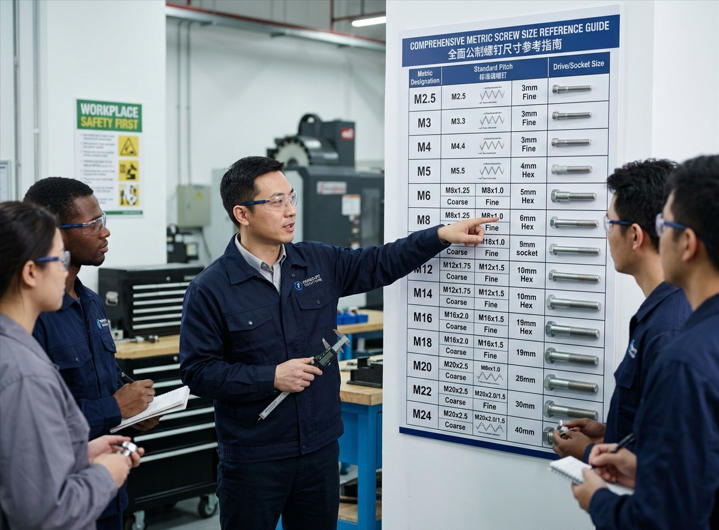
Every metric screw callout follows a simple formula: M[Diameter] × [Pitch] × [Length], all in millimeters. For example, M8 × 1.25 × 30 means 8 mm major diameter, 1.25 mm thread pitch (the distance from one thread peak to the next), and 30 mm length. When a callout shows only two numbers — e.g., M8 × 30 — the pitch defaults to the ISO coarse standard (1.25 mm for M8). Fine pitches are always written explicitly.
Beyond these three dimensions, two more specifications shape performance: the head style (pan, countersunk, button, hex, etc.) and the drive type (Phillips, hex socket, Torx, slotted). A countersunk M6 Phillips screw performs very differently from a pan-head M6 Torx screw, even though both share the same thread. We’ll address head styles in detail later in this article.
Watch: How Metric Screws & Bolts Are Measured
For a visual walkthrough of how metric fastener sizing works — including how to use calipers and thread pitch gauges — watch this practical guide:
Master Reference: 15 Key Metric Screw Sizes at a Glance
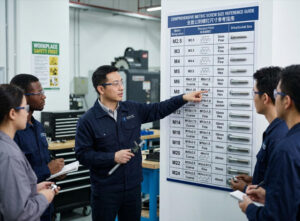
Below is a consolidated specification table for all 15 sizes covered in this guide. Engineers at companies like Bosch, Toyota, and Siemens reference charts like this when writing BOMs for new product lines. Bookmark it — you’ll come back to it often.
| Size | Diameter (mm) | Coarse Pitch (mm) | Fine Pitch (mm) | Common Lengths (mm) | Primary Applications |
|---|---|---|---|---|---|
| M2.5 | 2.5 | 0.45 | 0.35 | 3 – 20 | Electronics, eyewear, precision instruments |
| M3 | 3.0 | 0.50 | 0.35 | 4 – 30 | PCBs, laptops, hobby robotics, 3D printers |
| M4 | 4.0 | 0.70 | 0.50 | 5 – 50 | Chassis, consumer electronics, junction boxes |
| M4.2 | 4.2 | 0.70 | — | 6 – 50 | Sheet metal, self-tapping applications |
| M4.5 | 4.5 | 0.75 | — | 6 – 60 | Drywall, light-gauge steel framing |
| M5 | 5.0 | 0.80 | 0.50 | 6 – 60 | Furniture, appliances, bicycle components |
| M6 | 6.0 | 1.00 | 0.75 | 8 – 80 | Automotive trim, machinery guards, motor mounts |
| M6.3 | 6.3 | 1.00 | — | 10 – 80 | Self-drilling roofing, HVAC ductwork |
| M8 | 8.0 | 1.25 | 1.00 / 0.75 | 10 – 120 | Power tools, bike frames, equipment mounts |
| M10 | 10.0 | 1.50 | 1.25 / 1.00 | 12 – 150 | Brackets, panels, motor assemblies |
| M12 | 12.0 | 1.75 | 1.50 / 1.25 | 16 – 200 | Automotive suspension, industrial frames |
| M14 | 14.0 | 2.00 | 1.50 | 20 – 200 | Wheel lugs, construction brackets |
| M16 | 16.0 | 2.00 | 1.50 | 25 – 300 | Structural steel, bridge assemblies |
| M20 | 20.0 | 2.50 | 2.00 / 1.50 | 30 – 300 | Heavy frames, fencing, crane assemblies |
| M24 | 24.0 | 3.00 | 2.00 | 40 – 300 | Anchor bolts, infrastructure, mining equipment |
Pitch values per ISO 261 / ISO 262 standards. Length ranges reflect commonly stocked inventory, including Prince Fastener’s standard catalog.
Industry Demand Distribution by Metric Screw Size
Not all 15 sizes sell equally. Aggregated order data from fastener distributors in Europe, Asia-Pacific, and North America consistently shows that M6 and M8 together account for roughly 30% of all metric screw orders. Smaller sizes (M2.5–M4) dominate the electronics vertical, while M12 and above spike in construction and heavy-equipment procurement cycles.
Chart 1 — Estimated Share of Global Metric Screw Orders by Size
% of Total Orders
18%
14%
10%
6%
2%
0%
M2.53%
M36%
M48%
M4.22%
M4.52%
M510%
M616%
M6.32%
M814%
M1011%
M129%
M144%
M164%
M203%
M242%
Data based on aggregated distributor order volumes from Europe, Asia-Pacific, and North America (2023-2024). M6 and M8 dominate due to cross-industry versatility.
Smallest Metric Screws (Roughly M2.5–M3 Range) and Common Roles
M2.5–M3 Overview
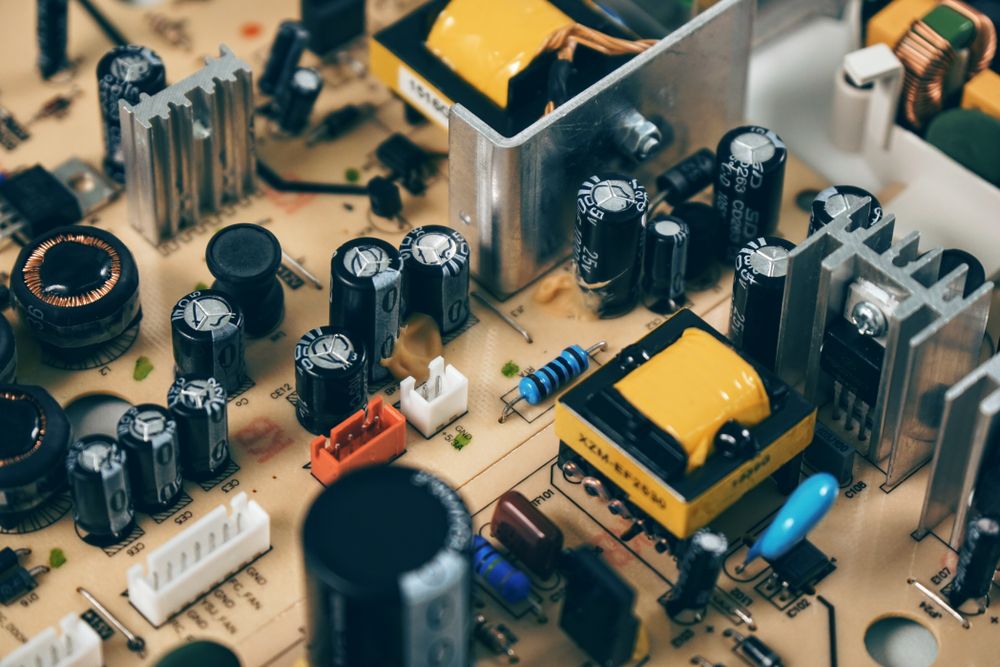
The M2.5 (2.5 mm diameter, 0.45 mm coarse pitch) and M3 (3.0 mm, 0.50 mm) are the backbone of the electronics and precision-instrument world. They’re small enough to fit inside a smartphone chassis but robust enough to secure PCB standoffs, sensor housings, and optical assemblies. A laptop hard drive bay, for example, almost universally uses M3×5 pan-head screws. Raspberry Pi mounting holes are drilled for M2.5. Drone frames, 3D printer hot-end assemblies, and medical glucose monitors all rely on these two sizes.
An engineering manager at a European telecom OEM reported that switching from M3 to M2.5 in their 5G antenna modules shaved 12 grams per unit — trivial in isolation, but across 50,000 units per quarter it reduced annual shipping costs by over €8,000 and eased compliance with weight-restricted rack installations.
Typical Uses in Electronics, Precision Assemblies, and Lightweight Brackets
M2.5 appears in laptop internal mounts, wearable medical devices, scientific instruments, and miniature robotics. M3 covers slightly heavier-duty electronics: server rack rail screws, small motor mounts, 3D printer extruder assemblies, and wireless router enclosures. If you’ve ever disassembled a gaming console, power supply, or network switch, the screws inside were almost certainly M2.5 or M3.
Material and Head Style Considerations
At the M2.5–M3 scale, material selection has a disproportionate effect on reliability. Stainless steel (A2-70 or A4-80) delivers long-term corrosion resistance for consumer electronics exposed to humidity. Black oxide carbon steel works for cost-sensitive applications like toy assemblies. For RF-sensitive environments — antenna housings, shielded enclosures — brass or nylon M3 screws avoid signal interference.
Head styles at this range are predominantly pan-head Phillips and countersunk Phillips, with hex-socket (Allen) heads increasingly specified in premium electronics where consistent torque application is critical. Suppliers that invest in tight-tolerance thread rolling — like Prince Fastener’s machine screw production line — deliver the dimensional consistency needed to prevent cross-threading, a persistent problem when cheaper micro fasteners are used at production scale.
M4 Family and Its Electronics / Consumer-Use Applications
M4, M4.2, M4.5 Details
The M4 marks the crossover point from purely electronics-grade fastening into general consumer hardware. At 4.0 mm diameter and 0.7 mm coarse pitch, the M4 sits in the overlap zone between electronic enclosures and light mechanical assemblies. The M4.2 (a self-tapping variant, also 0.70 mm pitch) is optimized for sheet-metal applications, while the M4.5 (0.75 mm pitch) dominates the drywall screw category for gypsum board attachment to light-gauge steel framing.
Uses in PCBs, Chassis, and Small Enclosures
If you’ve ever built a desktop PC, you’ve handled M4 screws — they’re the standard for securing case side panels. Server chassis from Dell, HPE, and Lenovo standardize on M4 for drive-cage mounting. Outside IT, M4 fasteners show up in electrical junction boxes, small-appliance housings (blenders, coffee grinders), and industrial sensor enclosures on automation lines.
A Shenzhen contract manufacturer documented that their M4 screw rejection rate dropped from 3.2% to 0.4% after switching to a supplier running ISO 9001-certified thread-rolling processes — a direct reminder that dimensional consistency at the M4 level impacts production-line throughput. Prince Fastener, with ISO-certified cold-heading and thread-rolling lines, supports OEM runs from 10,000 to 10,000,000 pieces with that kind of batch-to-batch repeatability.
Common Pitches and Threading Notes
M4 × 0.7 (coarse) dominates, but M4 × 0.5 (fine) appears in vibration-prone environments — automotive dashboard assemblies, for instance. Fine-pitch threads resist loosening because the shallower helix angle generates more friction per unit of clamping force. For engine-compartment or moving-platform applications, specify fine pitch and pair with a lock washer or thread-locking compound.
M5 Family: General-Purpose Fasteners for Furniture and Appliances
M5, M5.0–M5.5 Variations
The M5 occupies a sweet spot: strong enough for structural furniture joints, light enough for hand-tightening without power tools. At 5.0 mm diameter and 0.80 mm coarse pitch, it delivers roughly twice the tensile load capacity of an M3 (cross-sectional area scales with the square of the diameter). The M5.5 variant mainly appears as a self-drilling roofing screw used to fasten corrugated metal panels to purlins.
Typical Uses in Consumer Products and DIY Projects
Three of IKEA’s all-time best-selling furniture products — the BILLY bookcase, PAX wardrobe, and KALLAX shelf unit — use M5 cam bolts and M5 hex-socket screws as primary structural fasteners. Beyond flat-pack furniture, M5 screws secure motor housings in kitchen stand mixers, adjustment mechanisms in gym equipment, and bracket connections in deck railings and gate hinges.
For DIY builders, the M5×20 pan-head Phillips is arguably the single most versatile screw to keep on hand. It works with standard M5 hex nuts and is compatible with M5 T-nuts for CNC router-table jigs and workbench fixtures.
M6 Family: Mechanical Assemblies and Mounting Applications

M6, M6.3, M6.5 Variants
By many accounts, the M6 is the single most widely used metric screw size in the world. Its 6.0 mm diameter and 1.0 mm coarse pitch strike a balance that works across automotive, industrial, consumer-electronics, and construction applications. The M6.3 is a self-drilling/self-tapping variant heavily used in roofing and HVAC ductwork. The M6.5 appears in specialized curtain-wall and solar-panel mounting systems.
Industry insight: Mordor Intelligence’s 2026 North American fastener market report noted that Tesla’s Texas Gigafactory alone consumed approximately 80 million fasteners in one year, with M6 and M8 aluminum bolts topping the volume list. That statistic illustrates why distributors keep M6 in deeper stock than any other single size.
Use Cases in Automotive Trim, Machinery, and Fixtures
A single passenger vehicle contains an estimated 300–500 M6 screws: interior trim panels, headlamp assemblies, license-plate brackets, engine covers, and more. In industrial settings, M6 socket-head cap screws (per ISO 4762) are the default for mounting linear guides, stepper motors, and pneumatic cylinders to machine frames.
M8 Family: Robust Yet Compact Fasteners for Machinery
M8, M8.0–M8.5 Options
At 8.0 mm diameter and 1.25 mm coarse pitch, the M8 is the first size most engineers consider “structural” for light-duty applications. In Grade 8.8 (the most common property class for medium-carbon steel metric bolts), an M8 bolt reaches a proof load of approximately 22.1 kN — enough to support roughly 2,250 kg in pure tension before yielding.
Common Uses in Power Tools, Bikes, and Equipment Frames
Mountain-bike disc-brake calipers mount with M6, but the stem clamp — handlebars to steerer tube — typically uses M8 because rider safety demands higher clamping margins. Bench grinders, drill presses, and table saws bolt to their bases with M8 fasteners. In HVAC, M8 threaded rods suspend ductwork from ceiling decks: a single M8 Grade 8.8 rod safely supports over 1,000 kg in static loading.
When sourcing M8 fasteners in volume for equipment-frame assembly lines, working with a vertically integrated manufacturer ensures batch consistency. Prince Fastener’s bolts and nuts are produced on automated cold-heading and thread-rolling lines holding ±0.02 mm dimensional tolerances — a detail that matters when you’re assembling hundreds of identical frames per shift and can’t afford thread-fit variation slowing down torque drivers.
M10 Family: Mid-Size Fasteners for Assemblies and Brackets
M10, M10.0–M10.5 Variants
The M10 marks the transition into unambiguously heavy-duty territory. At 10.0 mm diameter with 1.5 mm coarse pitch, it’s the go-to when loads exceed the M8’s comfortable working range. Fine-pitch variants (1.25 mm, 1.0 mm) serve vibration-critical joints — motorcycle engine mounts, for example, commonly specify M10 × 1.25.
Structural Mounting, Panels, and Hardware Connections
M10 hex bolts are the default for steel-to-steel bracket connections in light commercial construction: handrail posts, mezzanine supports, and equipment pads. In renewable energy, M10 stainless-steel bolts attach solar-panel rail sections to roof brackets — the size provides an adequate strength margin while remaining hand-installable with a 17 mm ratchet socket. In manufacturing, M10 screws mount servo motors and gearboxes to machine bases.
M12 Family: Heavier-Duty Applications and Reliability
M12, M12.0–M12.5 Variants
The M12 (12.0 mm diameter, 1.75 mm coarse pitch) is a staple in automotive, agricultural, and general industrial engineering. Its tensile strength in Grade 10.9 exceeds 53 kN, giving it the capacity to handle serious structural loads without over-specifying the connection. Fine-pitch M12 × 1.5 and M12 × 1.25 are heavily used in automotive suspension and engine applications.
Uses in Machinery, Automotive Components, and Industrial Frames
Suspension control arms, wheel-hub assemblies, and exhaust-manifold studs are typically M10 or M12. In agricultural equipment, M12 bolts connect plow blades to frames — an application where shear loading, vibration from soil contact, and moisture exposure demand a robust cross-section. Industrial conveyor bearing mounts standardize on M12 in Grade 8.8 or 10.9.
Chart 2 — M12 Screw Demand by End-Use Industry
Automotive
35%
Ind. Machinery
25%
Construction 20%
Agriculture 12%
Other 8%
Automotive
Ind. Machinery
Construction
Agriculture
Other
Approximate M12 demand split based on fastener industry consumption data, 2023–2024.
M14–M16 Range: Larger Brackets and Heavy-Duty Connections
M14, M14.0–M14.5 Variants
The M14 (2.0 mm coarse pitch) is the standard wheel-lug bolt for many European vehicles — BMW, Mercedes-Benz, and Audi all specify M14 × 1.5 lug bolts. In construction, M14 anchor bolts secure base plates to concrete foundations for light-commercial steel columns.
Industry insiders call the M14 the “orphan size” because it falls between the high-volume M12 and M16. Stocking M14 means carrying an extra SKU with slower inventory turns. Some design engineers deliberately avoid it, sizing up to M16 unless weight or space constraints force the smaller diameter. If your project does require M14, confirm lead times early — off-the-shelf availability is thinner than for neighboring sizes.
Typical Uses in Construction Fixtures and Large Machinery
The M16 (also 2.0 mm coarse pitch) is where fasteners start feeling genuinely heavy in your hand. M16 hex bolts connect steel beams in warehouse and factory construction, crane outrigger pads, excavator boom pins, and large-diameter pipe flanges. A single wind-turbine tower can contain over 2,000 high-strength bolts in the M16–M24 range.
M20 and Larger: Structural and High-Load Fasteners
M20, M22, M24 Options Within This Range
Fasteners in the M20–M24 range are structural-grade components where failure is not an option. The M20 (2.5 mm coarse pitch) in Grade 10.9 steel has a proof load exceeding 130 kN — equivalent to holding about 13,260 kg in pure tension. The M22 is relatively uncommon (another “orphan” like M14) but appears in specific European structural codes. The M24 (3.0 mm coarse pitch) is a standard anchor-bolt size for heavy-machinery foundations, crane rails, and bridge bearing plates.
Applications in Frame Assemblies, Fencing, and Heavy Equipment
Steel-framed commercial buildings rely on M20 and M24 bolts at column-to-beam moment connections. In mining, M24 bolts secure conveyor head drums and crusher liners — components that endure extreme shock and abrasive environments. Highway guardrail sections bolt to posts with M20 fasteners, hot-dip galvanized per regional specifications.
For buyers sourcing high-strength M20–M24 bolts, surface treatment quality is as critical as dimensional accuracy. Prince Fastener’s bolts and nuts catalog includes hot-dip galvanized, zinc-plated, and Dacromet-coated options in this range, meeting ASTM F3125 and ISO 898-1 property-class requirements — ensuring both corrosion resistance and independently verified mechanical performance.
Head Styles and Drive Types: How Head Design Affects Use

Countersunk vs. Pan/Oval Heads and Screw Head Compatibility
Choosing between a countersunk (flat) head and a pan head is functional, not cosmetic. Countersunk screws sit flush with or below the workpiece surface — critical where a protruding head would interfere with moving parts, create injury risk, or violate aesthetic requirements. Pan heads sit proud of the surface and spread clamping force over a wider footprint, which protects thin or soft materials from pull-through.
Oval (raised countersunk) heads blend a flush seating angle with a slightly domed top for a finished look, common in automotive interior trim and furniture hardware. Button heads provide a low-profile alternative to pan heads and are the default for M5 and M6 socket screws in machine-tool fixtures.
Socket / Torx / Slotted Drives by Size and Application
Drive selection depends on the torque required, tool access available, and the environment. Here’s a practical mapping:
| Drive Type | Best for Sizes | Torque Transfer | Typical Applications | Tool |
|---|---|---|---|---|
| Phillips | M2.5 – M6 | Moderate | Electronics, appliances, general assembly | Phillips driver |
| Hex Socket (Allen) | M3 – M24 | High | Machinery, structural, precision fixtures | Hex key |
| Torx | M3 – M16 | Very High | Automotive, aerospace, security fastening | Torx bit |
| Slotted | M2.5 – M6 | Low | Electrical terminals, heritage hardware | Flat-blade driver |
| Pozidrive | M3 – M8 | Moderate–High | European cabinetry, woodworking | Pozidrive driver |
A notable industry trend: Torx drives are rapidly replacing Phillips in automotive and electronics assembly. The six-lobed Torx recess enables higher torque without cam-out (the tendency of a Phillips driver to slip under load), reducing fastener damage and improving line speed. Tesla, for instance, uses Torx almost exclusively across vehicle interiors — a choice that has influenced the broader EV supply chain to follow suit.
Metric-to-Imperial Conversion Quick-Reference
For teams operating in mixed-standard environments — common in North American shops that service both domestic and imported equipment — this conversion table prevents wasted trips to the hardware store.
| Metric Size | Diameter (mm) | Approx. Imperial Equiv. | Diameter (inches) |
|---|---|---|---|
| M2.5 | 2.5 | #3 – #4 | 0.099 – 0.112 |
| M3 | 3.0 | #4 – #5 | 0.112 – 0.125 |
| M4 | 4.0 | #8 | 0.164 |
| M5 | 5.0 | #10 | 0.190 |
| M6 | 6.0 | 1/4″ | 0.250 |
| M8 | 8.0 | 5/16″ | 0.3125 |
| M10 | 10.0 | 3/8″ | 0.375 |
| M12 | 12.0 | 1/2″ | 0.500 |
| M14 | 14.0 | 9/16″ | 0.5625 |
| M16 | 16.0 | 5/8″ | 0.625 |
| M20 | 20.0 | 3/4″ | 0.750 |
| M24 | 24.0 | ~1″ | 1.000 |
Note: These are approximate equivalents. Metric and imperial threads are not interchangeable — an M6 will not thread into a 1/4″-20 nut. Always verify thread compatibility. For a detailed reference, see Fractory’s screw-size conversion chart.
Selecting the Right Metric Screw Size by Application and Load
Choosing the correct metric screw size is not a matter of grabbing whatever fits from a bin. It requires matching diameter and pitch to material thickness, load conditions, vibration environment, and tool access. The 15 sizes covered here — M2.5 through M24 — represent the core vocabulary of metric fastening and cover well over 90% of situations encountered in electronics, automotive, furniture, machinery, and construction.
Here are the key decision principles to carry away. For electronics and lightweight assemblies with loads below about 500 N, M2.5 through M5 with pan or countersunk heads handle most requirements. For mechanical assemblies and mid-range structural joints in the 500 N to 20 kN range, M6 through M12 in Grade 8.8 or 10.9 are the standard choices. For heavy structural and infrastructure applications exceeding 20 kN per fastener, M14 through M24 in Grade 10.9 or 12.9 with verified surface treatment are required.
When a project falls outside your experience, consult your supplier’s technical support. Manufacturers like Prince Fastener’s custom fastener team provide material-selection guidance, property-class recommendations, and coating-compatibility advice alongside standard catalog offerings — an especially valuable resource when you’re specifying for a new application without historical precedent.
Frequently Asked Questions
1. What size screws are most common in furniture assembly?
M5 and M6 dominate furniture assembly. Flat-pack brands like IKEA rely on M5 cam bolts for panel connections and M6 hex-socket screws for structural joints and hinges. M4 covers lighter duties like drawer-slide mounting and back-panel attachment. For custom woodworking projects, M5×30 and M6×40 are effective starting points for softwood joints with pre-drilled pilot holes.
2. How do I determine the pitch for a given metric screw?
The most reliable method is a thread pitch gauge — a set of thin metal blades with serrated edges representing standard pitches. Hold each blade against the screw threads until one fits perfectly with no gaps. Alternatively, measure the distance spanning 10 consecutive thread crests with digital calipers and divide by 10. Quick reference for coarse pitches: M3 = 0.5 mm, M4 = 0.7 mm, M5 = 0.8 mm, M6 = 1.0 mm, M8 = 1.25 mm, M10 = 1.5 mm, M12 = 1.75 mm (per ISO 261).
3. When should I choose a longer screw versus using a spacer?
Use a longer screw when additional thread engagement in the receiving material increases pullout resistance — for example, fastening into thick timber or deep tapped holes. Use a spacer or standoff when you need a precise gap between components without loading the extra screw length in tension, such as mounting a PCB above a chassis plate for airflow clearance. Rule of thumb: if the gap must hold a fixed distance under compressive load, a spacer transfers force directly instead of relying on thread engagement to maintain position.
4. How do I convert metric screw sizes to imperial equivalents?
Divide the metric diameter in mm by 25.4 to get the decimal-inch equivalent. For example, M6 ÷ 25.4 = 0.236″, which is close to but not identical to 1/4″ (0.250″). Metric and imperial threads are not interchangeable — thread pitch angles and form profiles differ between ISO metric and UNC/UNF standards. See Table 3 in this guide or use Monster Bolts’ conversion table for a more detailed reference.
5. What is the difference between coarse and fine pitch?
Coarse pitch (the ISO default for each metric size) has wider thread spacing, making screws faster to install, more tolerant of contamination, and better suited for softer materials like aluminum or plastic. Fine pitch has narrower spacing, which delivers higher tensile strength per unit of thread engagement, better vibration resistance, and finer positional adjustment. Automotive engine components and aerospace assemblies frequently specify fine pitch for these advantages.
6. Can I use a metric screw in an imperial threaded hole?
No. Although some metric and imperial sizes have similar diameters (e.g., M6 at 6.0 mm vs. 1/4″ at 6.35 mm), the thread pitch and profile are fundamentally different. Forcing a metric screw into an imperial hole — or vice versa — will strip threads and compromise the joint. If you face a mixed-standard situation, use a thread adapter or helicoil insert designed for the specific conversion.
7. What property class should I specify for metric screws?
For non-structural applications (electronics, furniture, light fixtures), Grade 4.8 or A2 stainless steel is sufficient. For mechanical and automotive use, Grade 8.8 balances strength and ductility and is the most widely specified class globally. For high-stress structural joints, Grade 10.9 or 12.9 provides higher tensile and yield strength but demands careful torque control. In the property-class notation, the first digit × 100 gives the minimum ultimate tensile strength in MPa, and the second digit × 10 gives the yield-to-ultimate ratio as a percentage.
8. How many fasteners do I need per joint?
Use at least two fasteners per joint to prevent rotation. Ensure the combined preload (sum of all fastener clamping forces) exceeds the expected service load by a factor of 2–3 for non-critical connections. For structural or safety-critical joints, follow the relevant engineering standard — Eurocode 3 for steel structures or VDI 2230 for bolted-joint design — or consult a licensed structural engineer.
9. Where can I source metric screws in bulk with custom specs?
Standard catalog sizes (M2.5–M24 in common lengths, materials, and coatings) are available from most industrial distributors in box or carton quantities. For custom requirements — non-standard lengths, specialized coatings like Dacromet or ceramic, modified head styles, or unique thread forms — you need a manufacturer with OEM/ODM capability. Prince Fastener’s custom fastener division handles orders from prototype to full production scale, with in-house cold heading, thread rolling, heat treatment, and surface finishing.
10. Are metric screws interchangeable across manufacturers?
Yes, as long as both the screw and mating nut conform to the same ISO standard (typically ISO 261 for thread geometry and ISO 898 for mechanical properties). An M8 × 1.25 bolt produced in Germany will thread cleanly into an M8 × 1.25 nut manufactured in China — this cross-manufacturer interchangeability is one of the metric system’s strongest advantages. To guarantee compatibility, verify that both components share the same property class (e.g., 8.8 bolt with Class 8 nut) and thread tolerance class (6g/6H is standard for general-purpose use).



 English
  Español
  Português do Brasil
  Русский
  日本語
日本語  العربية