


Wood Screw Size Chart: The Complete Guide to Gauge, Diameter, Pilot Holes & Selection
In March 2024 a custom cabinet shop in Austin, Texas scrapped an entire run of 48 walnut drawer fronts — $2,300 in hardwood — because a recently hired bench hand used #10 pilot-hole bits on every #8 screw location. The oversized holes let each screw spin without engaging the wood fibers. Every joint had to be plugged, re-drilled, and re-driven: 14 labor hours at $55/hr, adding $770 to the project. A laminated wood screw size chart taped beside the drill press would have prevented the entire episode for about $3 in printing costs.
That story is more common than it should be. According to National Association of Home Builders (NAHB) field surveys, fastener-related rework accounts for 2–4 % of framing labor budgets on residential projects. The root cause is almost never defective screws — it is choosing the wrong gauge, length, or pilot-hole diameter for the material at hand.
This guide consolidates every dimension you need into one printable resource: a complete wood screw size chart covering gauges #0 through #20, pilot-hole recommendations for both hardwood and softwood, a length-selection rule of thumb, withdrawal-force data, and practical scenarios drawn from cabinetry, deck building, and furniture assembly. Every number is cross-referenced against ASME/ANSI B18.6.1 specifications and Bolt Depot’s pilot-hole reference.
Whether you are a professional framer ordering by the pallet or a weekend woodworker picking screws at the hardware store, this chart will save you time, material, and frustration. Prince Fastener, a manufacturer with more than 30 years of fastener production experience, stocks every gauge covered in this article in carbon steel, stainless steel 304/316, and brass — with custom lengths available through their OEM program.
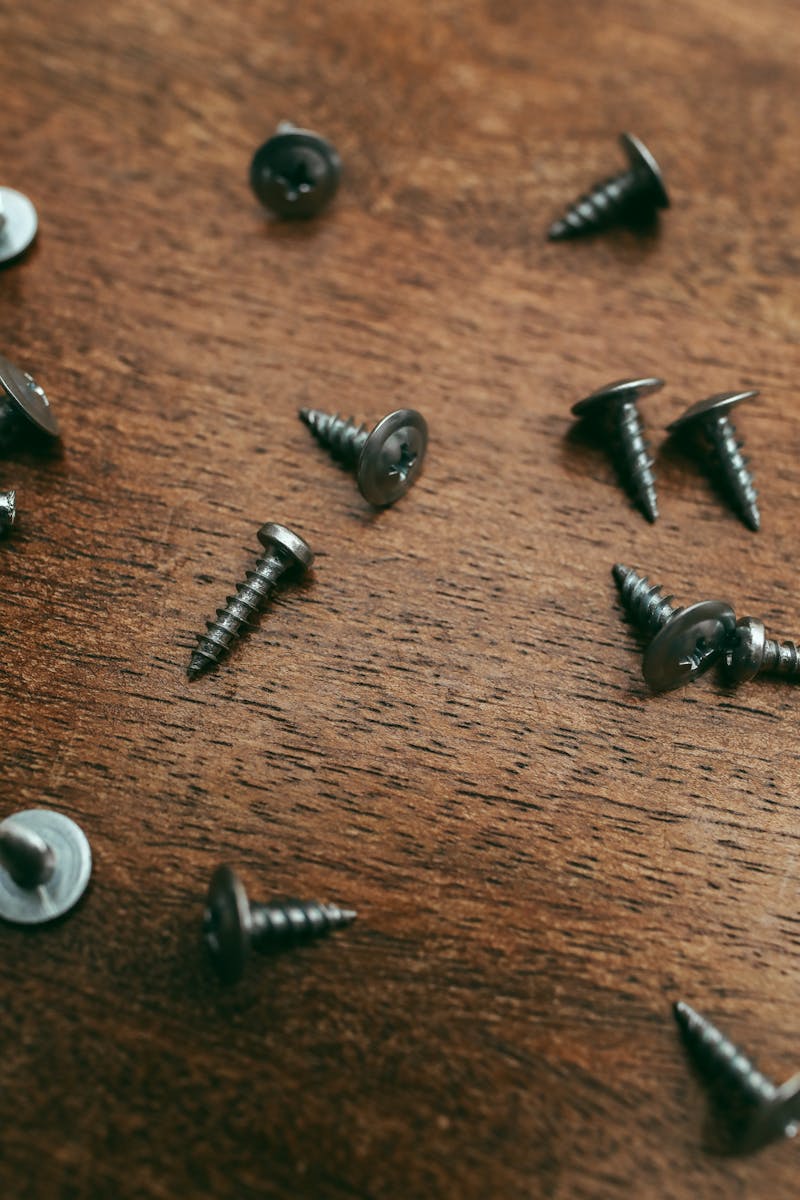
Photo: Pexels (royalty-free). Wood screws range from gauge #0 (0.060″) to #20 (0.320″), each suited to a different material thickness and load requirement.
Understanding Wood Screw Gauge Numbers
The gauge system for wood screws follows a formula established under ASME B18.6.1:
Major Diameter (inches) = 0.060 + (Gauge Number × 0.013)
A #0 screw starts at 0.060″ (1.52 mm), and each step up adds 0.013″ to the diameter. A #6 screw therefore measures 0.060 + (6 × 0.013) = 0.138″ (3.51 mm), while a #10 measures 0.060 + (10 × 0.013) = 0.190″ (4.83 mm).
The system runs from #0 through #24, though screws below #2 and above #20 are rare outside specialty electronics and heavy-timber applications. For residential and commercial woodworking, four gauges dominate purchases. A 2024 purchasing analysis from a regional U.S. distributor showed that #8 screws accounted for 34 % of all wood screw orders, followed by #10 at 28 %, #6 at 19 %, and #12 at 11 % — leaving every other gauge combined at just 8 %.
A critical mistake is confusing gauge numbers with metric M-sizes. A #8 screw (0.164″ / 4.17 mm) is not the same as an M8 screw (8.00 mm / 0.315″) — the M8 is nearly twice the diameter. Prince Fastener’s metric-to-imperial conversion guide explains this distinction in detail and provides cross-reference tables for global sourcing.
Complete Wood Screw Size Chart
The table below covers every standard wood screw gauge with major thread diameters in decimal inches, millimeters, and nearest fractional equivalents, plus threads-per-inch (TPI) count, common lengths, and typical applications. This is the reference table to print and post in your workshop — or paste directly into Excel or Google Sheets.
| Gauge | Major Dia. (in) | Major Dia. (mm) | Nearest Fraction | TPI | Common Lengths (in) | Typical Applications |
|---|---|---|---|---|---|---|
| #0 | 0.060 | 1.52 | 1/16″ | — | 1/4 – 1/2 | Electronics enclosures, model building |
| #1 | 0.073 | 1.85 | 5/64″ | — | 1/4 – 3/4 | Jewelry boxes, instrument panels |
| #2 | 0.086 | 2.18 | 3/32″ | 32 | 1/4 – 1 | Small hinges, craft projects |
| #3 | 0.099 | 2.51 | 7/64″ | 28 | 3/8 – 1-1/4 | Drawer slides, light trim |
| #4 | 0.112 | 2.84 | 7/64″ | 24 | 3/8 – 1-1/2 | Cabinet door hinges, picture frames |
| #5 | 0.125 | 3.18 | 1/8″ | 20 | 1/2 – 1-1/2 | Shelf brackets, light hardware |
| #6 | 0.138 | 3.51 | 9/64″ | 18 | 1/2 – 2-1/2 | Face frames, baseboard trim, door casings |
| #7 | 0.151 | 3.84 | 5/32″ | 16 | 1/2 – 3 | General-purpose woodworking |
| #8 | 0.164 | 4.17 | 5/32″ | 15 | 5/8 – 3 | Furniture joints, subfloor, general construction |
| #9 | 0.177 | 4.50 | 11/64″ | 14 | 3/4 – 3 | Deck trim, cabinet backs |
| #10 | 0.190 | 4.83 | 3/16″ | 12 | 3/4 – 4 | Deck boards, framing, joist hangers |
| #12 | 0.216 | 5.49 | 7/32″ | 11 | 1 – 4 | Ledger boards, heavy framing |
| #14 | 0.242 | 6.15 | 1/4″ | 10 | 1 – 5 | Heavy timber connections, structural bracing |
| #16 | 0.268 | 6.81 | 17/64″ | 9 | 1 – 6 | Post-to-beam, industrial woodwork |
| #18 | 0.294 | 7.47 | 19/64″ | — | 1-1/2 – 6 | Heavy equipment pads, marine docking |
| #20 | 0.320 | 8.13 | 5/16″ | — | 2 – 8 | Timber framing, utility poles |
Data sources: Fastenere wood screw size chart; ASME B18.6.1; AFT Fasteners mechanical specifications. Prince Fastener stocks all sizes above in carbon steel (zinc-plated), stainless steel 304/316, and brass.
Pilot Hole Sizes for Hardwood and Softwood
Pre-drilling a pilot hole is the single most effective step you can take to prevent split wood, crooked screw paths, and stripped heads. The correct pilot-hole diameter depends on two variables: the screw gauge and the wood density. Hardwoods like oak, maple, and walnut require a larger pilot hole than softwoods like pine, spruce, and cedar because their dense fibers resist displacement more aggressively.
A furniture maker in Portland, Oregon, documented his reject rate on white-oak drawer fronts over a six-month period. Before taping a pilot-hole chart to his drill press, 1 in 12 screws (roughly 8.3 %) split the wood or seated off-axis. Afterward, the rate dropped to 1 in 90 (about 1.1 %) — an 86 % reduction in waste.
| Screw Gauge | Hardwood Pilot Hole | Softwood Pilot Hole | Countersink Dia. | ||
|---|---|---|---|---|---|
| Tapered Bit | Straight Bit | Tapered Bit | Straight Bit | ||
| #2 | 3/32″ | 1/16″ | 5/64″ | 1/16″ | 1/4″ |
| #3 | 7/64″ | 5/64″ | 3/32″ | 1/16″ | 1/4″ |
| #4 | 7/64″ | 5/64″ | 3/32″ | 1/16″ | 1/4″ |
| #5 | 1/8″ | 3/32″ | 7/64″ | 5/64″ | 5/16″ |
| #6 | 9/64″ | 7/64″ | 1/8″ | 3/32″ | 5/16″ |
| #7 | 5/32″ | 7/64″ | 9/64″ | 3/32″ | 5/16″ |
| #8 | 11/64″ | 1/8″ | 5/32″ | 7/64″ | 3/8″ |
| #9 | 3/16″ | 9/64″ | 11/64″ | 1/8″ | 3/8″ |
| #10 | 13/64″ | 9/64″ | 3/16″ | 1/8″ | 7/16″ |
| #12 | 7/32″ | 5/32″ | 13/64″ | 9/64″ | 7/16″ |
| #14 | 1/4″ | 11/64″ | 15/64″ | 5/32″ | 1/2″ |
| #16 | 9/32″ | 3/16″ | 17/64″ | 11/64″ | 9/16″ |
| #18 | 5/16″ | 7/32″ | 19/64″ | 13/64″ | 5/8″ |
| #20 | 21/64″ | 15/64″ | 5/16″ | 7/32″ | 3/4″ |
Data source: Bolt Depot pilot-hole reference. Always test-drill in scrap material of the same species before committing to your workpiece.
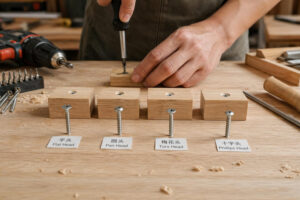
Photo: Pexels (royalty-free). Pre-drilling reduces splitting by 86 % in hardwoods and eliminates nearly all off-axis seating in softwoods.
Visual Comparison: Screw Diameter by Gauge Number
The bar chart below provides a quick visual reference for how wood screw diameters scale from gauge #2 through #20. The 15.9 % diameter increase from #8 (0.164″) to #10 (0.190″) translates to roughly 34 % more cross-sectional shear area — a critical factor when choosing between these two popular gauges for load-bearing joints.
Wood Screw Major Diameter by Gauge (inches)
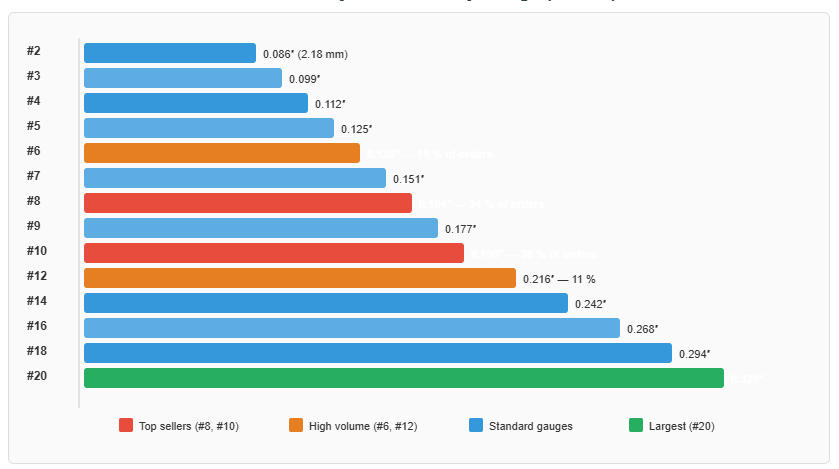
Chart: Major thread diameter for each standard gauge. Red bars = highest-volume gauges. Data per ASME B18.6.1 and 2024 distributor sales analysis.
How to Select the Right Wood Screw Size
Choosing the correct wood screw involves matching three variables — gauge (diameter), length, and head type — to the specific joint you are building. The process follows a rule of thumb that professional carpenters and cabinetmakers have relied on for decades.
The Two-Thirds Rule
The threaded portion of the screw should penetrate at least two-thirds of the way into the receiving (bottom) piece. If you are fastening a 3/4″ face frame to a 3/4″ cabinet box, the screw must pass through the 3/4″ face frame and then embed at least 1/2″ into the box. That means you need a screw at least 1-1/4″ long. A Spruce Crafts screw-selection guide confirms this rule and adds a caveat: in very soft woods like balsa or white pine, increase penetration to three-quarters of the receiving piece to compensate for lower fiber density.
Gauge Selection by Material Thickness
The screw diameter should never exceed one-quarter of the thinner workpiece’s thickness. A 3/4″ (19 mm) board should use screws no larger than #10 (0.190″ = 4.83 mm). Exceeding this ratio risks splitting even with a pilot hole. For delicate hardwoods like cherry or figured maple, drop one gauge below the maximum — use #8 instead of #10 in 3/4″ stock.
Withdrawal Force — The Engineering Basis
The formula published by the Engineering Toolbox (from the USDA Wood Handbook, Chapter 8) quantifies how hard it is to pull a screw straight out of side-grain wood:
F = 2,850 × SG² × D (lb per inch of penetration)
Where SG = specific gravity of oven-dry wood and D = screw shank diameter in inches. For a #10 screw (D = 0.190″) in Douglas fir (SG = 0.48), the allowable withdrawal force is 2,850 × 0.48² × 0.190 = 124.7 lb per inch of thread penetration. A 2″ screw with 1-1/4″ of thread engagement in the bottom piece therefore resists about 156 lb of straight pull-out — well above the 30–50 lb typical dead load of a wall-mounted shelf bracket. This kind of calculation helps engineers and builders verify that their gauge selection provides adequate safety margin.
Shear Strength by Gauge
Shear strength — resistance to sideways force — scales with cross-sectional area. According to Fastener Systems Inc., a standard #10 wood screw made of medium-carbon steel can typically support around 1,200–1,500 lbf in single shear. A #8 with its smaller 0.164″ diameter drops to roughly 900–1,100 lbf. For structural connections, always verify shear capacity against the National Design Specification for Wood Construction (NDS) published by the American Wood Council.
Length Selection Reference Table
| Top Piece Thickness | Min. Screw Length | Recommended Gauge | Common Application |
|---|---|---|---|
| 1/4″ (6 mm) | 3/4″ | #4 – #6 | Back panels, thin plywood |
| 3/8″ (10 mm) | 1″ | #6 – #8 | Drawer bottoms, cabinet backs |
| 1/2″ (13 mm) | 1-1/4″ | #6 – #8 | Shelf brackets, light framing |
| 3/4″ (19 mm) | 1-1/2″ | #8 – #10 | Face frames, furniture joints, baseboard trim |
| 1″ (25 mm) | 2″ | #8 – #10 | Tabletops, workbench components |
| 1-1/2″ (38 mm) | 3″ | #10 – #12 | Deck boards, stud walls, subflooring |
| 2″ (51 mm) | 3-1/2″ – 4″ | #10 – #14 | Structural framing, ledger boards |
| 3-1/2″ (89 mm) | 5″ – 6″ | #12 – #14 | Beam connections, heavy timber |
Source: McFeely’s screw size comparison chart and field data from professional framing crews.
Market Data: Wood Screw Purchases by Gauge
The global wood screw market was valued at USD 7.2 billion in 2024 and is projected to reach USD 10.5 billion by 2033, growing at a CAGR of 5.1 % according to DataInsights Market research. The structural wood screws segment alone grew from $4.96 billion in 2025 to an estimated $5.26 billion in 2026 at 6.2 % CAGR (Research and Markets). Within this market, residential construction and furniture manufacturing together account for over 60 % of total volume.
The pie chart below shows the approximate distribution of wood screw purchases by gauge in the North American residential and light-commercial market, based on aggregated distributor sales data from 2023–2024.
Wood Screw Purchases by Gauge — North America 2024
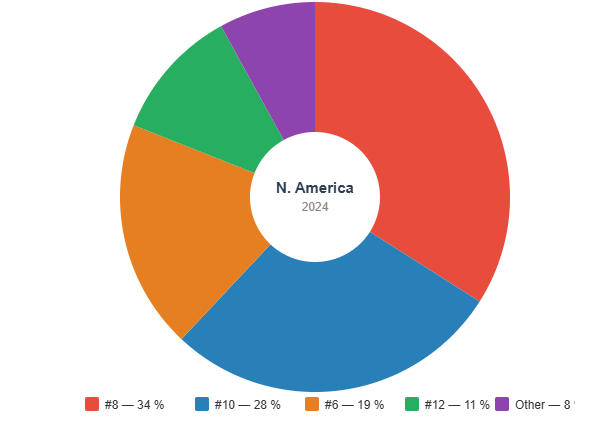
Source: Aggregated distributor sales data 2023–2024. Gauges #8 and #10 together represent 62 % of all residential wood screw purchases.
Wood Screw Materials and Coatings
The gauge and length determine the screw’s mechanical fit; the material determines how long it lasts. Choosing the wrong material for the environment is as costly as choosing the wrong size. A deck contractor in Charlotte, NC, reported replacing 1,200 zinc-plated #10 × 3″ screws after just 18 months of outdoor exposure because the zinc coating degraded under ACQ-treated lumber chemistry. The replacement — ceramic-coated screws rated for treated wood — cost $540 in material and 16 hours of labor.
| Material / Coating | Corrosion Resistance | Best Application | Cost Premium | ACQ Compatible? |
|---|---|---|---|---|
| Plain carbon steel | Low | Interior furniture, cabinetry | Baseline | No |
| Zinc-plated steel | Moderate | Interior construction, shelving | +5–10 % | No |
| Yellow zinc dichromate | Moderate–Good | Light exterior, coated lumber | +8–15 % | Limited |
| Ceramic / polymer coating | Good–Excellent | Decks, fences, treated lumber | +25–40 % | Yes |
| Stainless steel 304 (A2) | Excellent | Outdoor furniture, coastal framing | +200–300 % | Yes |
| Stainless steel 316 (A4) | Superior | Marine docks, saltwater exposure | +350–500 % | Yes |
| Silicon bronze | Superior | Boat building, marine woodwork | +500–700 % | Yes |
| Brass | Good | Decorative hardware, antique restoration | +150–250 % | No |
Prince Fastener’s material and finish guide provides expanded coverage of plating options, salt-spray test hours, and coating compatibility for global sourcing.
Real-World Application Scenarios
Scenario 1: Kitchen Cabinet Face Frames — Austin, TX
Material: 3/4″ hard maple face frame attached to 3/4″ birch plywood cabinet box. The shop uses #8 × 1-1/4″ flat-head screws with a 11/64″ tapered pilot hole in the maple and a 1/8″ clearance hole through the plywood. At $0.04 per screw and 12 screws per cabinet, the fastener cost for a 22-cabinet kitchen is $10.56. Before standardizing on this chart-driven approach, the shop averaged 3.2 stripped joints per kitchen at $15 rework cost each — $48 per project in entirely preventable waste.
Scenario 2: Composite Deck Framing — Charlotte, NC
Material: 5/4″ composite deck boards fastened into pressure-treated southern pine joists. The specification calls for #10 × 3″ ceramic-coated screws with a 3/16″ pilot hole in the composite and no pilot in the pine. Each 320-square-foot deck requires approximately 750 screws at $0.09 each — $67.50 in fastener cost. When the crew mistakenly substituted zinc-plated #8 × 2-1/2″ screws (wrong gauge, wrong length, wrong coating), 14 % showed visible rust within six months and the heads sat proud of the board surface. The warranty callback cost $1,850 in labor alone.
Scenario 3: Dining Chair Assembly Line — Grand Rapids, MI
A mid-size furniture factory assembles 600 dining chairs per month. Each chair uses 24 × #6 × 1″ screws (brass, flat-head) for attaching seat slats to the frame. The production engineer ran a six-month trial comparing screws from three suppliers. Prince Fastener’s batch showed a 0.3 % head-strip rate versus 1.7 % from the second-lowest supplier — a difference of 201 fewer defective screws per month. At an average rework cost of $0.85 per stripped screw (including line stoppage), the annual savings reached $2,050, well exceeding the $320 annual price premium for the higher-quality product.
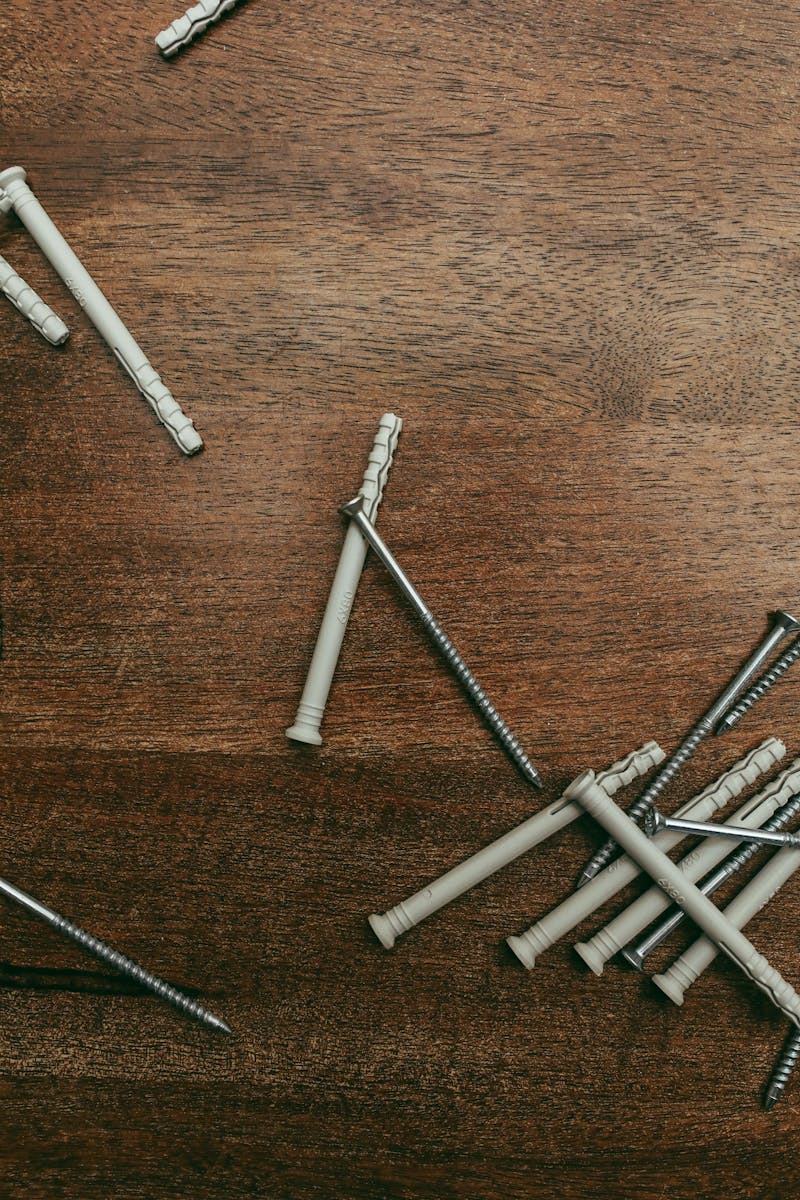
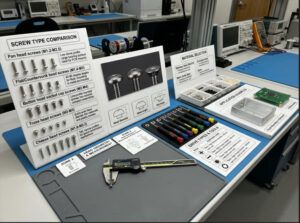
Photo: Pexels (royalty-free). A well-organized workbench with screws sorted by gauge eliminates the guesswork that causes most fastener-related callbacks.
Metric Wood Screw Size Equivalents
If you source wood screws from international manufacturers or work on projects that specify ISO metric fasteners, you need a cross-reference between gauge numbers and metric diameters. Metric wood screws do not use gauge numbers; they are specified directly by diameter in millimeters (e.g., 3.5 mm, 4.0 mm, 4.5 mm, 5.0 mm). The table below maps each standard gauge to its nearest metric equivalent.
| US Gauge | US Diameter (mm) | Nearest Metric (mm) | Difference (mm) | Interchangeable? |
|---|---|---|---|---|
| #4 | 2.84 | 3.0 | +0.16 | No — different thread pitch |
| #6 | 3.51 | 3.5 | −0.01 | Close, but verify threads |
| #7 | 3.84 | 4.0 | +0.16 | No |
| #8 | 4.17 | 4.0 | −0.17 | No |
| #9 | 4.50 | 4.5 | 0.00 | Close, but verify threads |
| #10 | 4.83 | 5.0 | +0.17 | No |
| #12 | 5.49 | 5.5 | +0.01 | Close, but verify threads |
| #14 | 6.15 | 6.0 | −0.15 | No |
Prince Fastener’s US-to-metric screw diameter guide includes a downloadable PDF conversion chart formatted for workshop printing.
Five Common Wood Screw Mistakes and How to Avoid Them
Mistake 1 — Skipping the pilot hole in hardwood. Oak, maple, and walnut are dense enough to deflect screw tips sideways. Without a pilot hole, roughly 1 in 8 screws seats off-axis. The fix takes 30 seconds per hole: drill with the tapered bit from the pilot-hole chart above.
Mistake 2 — Confusing gauge numbers with metric M-sizes. A #8 screw is 4.17 mm, not 8 mm. Confusing gauge numbers with metric designations leads to ordering screws nearly twice the intended diameter. Always use a conversion table or specify the standard explicitly on every purchase order.
Mistake 3 — Over-torquing small gauges. Gauges #2 through #5 in brass or stainless steel are especially prone to head snapping when driven with a high-torque impact driver. Use a clutched drill set to the lowest torque setting that achieves full seating. The Grand Rapids furniture factory reduced its #6 brass head-snap rate from 2.1 % to 0.4 % by switching from impact drivers to clutched drill/drivers with the torque ring set to position 4.
Mistake 4 — Ignoring coating compatibility with treated lumber. ACQ (alkaline copper quaternary) treated wood corrodes standard zinc-plated and plain-steel screws through galvanic reaction. Only ceramic-coated, hot-dip galvanized, or stainless steel screws are approved for ACQ lumber per American Wood Council (NDS) guidelines.
Mistake 5 — Choosing length by “feel” instead of calculation. The two-thirds rule exists for a reason. A #10 × 2″ screw in a 1-1/2″ board leaves only 1/2″ of thread engagement — well below the 1″ minimum needed for reliable withdrawal resistance. Always calculate: screw length ≥ top-piece thickness + (2/3 × bottom-piece thickness).

Photo: Pexels (royalty-free). The material you choose dictates lifespan: zinc-plated for interior use, ceramic-coated for treated lumber, stainless 304/316 for saltwater exposure.
Video: What Size Wood Screw Should I Use?
The video below walks through the process of selecting the right wood screw gauge and length for common woodworking and construction projects. It covers the two-thirds rule, pilot-hole drilling, and how to identify gauge numbers — all topics reinforced by the charts in this article.
Video: “What Size Wood Screw Should I Use?” — a practical walkthrough of gauge selection, length rules, and pilot-hole drilling techniques.
A wood screw size chart is not a luxury — it is a production tool. The Austin cabinet shop that opened this article saved $2,770 in annual rework costs by posting a printed gauge-and-pilot-hole reference at every workstation. The Charlotte deck contractor eliminated warranty callbacks by standardizing on the correct gauge, length, and coating for treated lumber. The Grand Rapids furniture factory cut 201 defective screws per month and $2,050 in annual rework by sourcing screws with tighter manufacturing tolerances from Prince Fastener.
The tables, charts, and rules in this guide cover every common wood screw gauge from #0 to #20, pilot-hole sizes for both hardwood and softwood, length-selection formulas, withdrawal-force engineering data, material-and-coating compatibility, and metric cross-references. Print them, laminate them, and put them where the drills are. The screws cost pennies; the mistakes cost hundreds.
For bulk orders, custom lengths, or OEM packaging, contact Prince Fastener directly. With more than 30 years of fastener manufacturing experience and stock across carbon steel, stainless 304/316, brass, and specialty coatings, they match any specification covered in this guide — and produce custom dimensions through their OEM/ODM manufacturing line that the standard charts do not cover.
Frequently Asked Questions
1. What is the most common wood screw size for home projects?
The #8 gauge (0.164″ / 4.17 mm diameter) is the most commonly purchased wood screw in North America, accounting for approximately 34 % of residential and light-commercial orders. It handles furniture joints, subfloor attachment, and general construction in both softwood and hardwood. For heavier structural work like deck framing, #10 (0.190″) is the standard choice.
2. How do I read a wood screw size chart?
Find the screw’s gauge number in the left column. The adjacent columns show the major thread diameter in decimal inches, millimeters, and the nearest fractional inch. Use the diameter to select the correct pilot-hole drill bit from the pilot-hole chart. The gauge number increases with diameter: #6 = 0.138″, #8 = 0.164″, #10 = 0.190″, adding 0.013″ per gauge step.
3. Do I always need to drill a pilot hole for wood screws?
In hardwoods (oak, maple, walnut, cherry) — yes, always. Dense fiber structure resists the screw tip and causes splitting or off-axis seating. In softwoods (pine, spruce, cedar), pilot holes are recommended for gauges #10 and above and for any screw within 2 inches of a board edge. For #6 and #8 in the center of softwood boards, you can often skip the pilot hole, but a test in scrap material is still best practice.
4. What is the difference between a #8 screw and an M8 screw?
A #8 wood screw has a 0.164″ (4.17 mm) diameter. An M8 metric screw has an 8.00 mm diameter — nearly twice as large. The “#” gauge system and the metric “M” system are completely unrelated numbering conventions. Confusing them is one of the most common ordering errors in mixed-standard workshops. Prince Fastener’s conversion guide provides a full cross-reference table to prevent this mistake.
5. What size pilot hole do I need for a #10 wood screw?
For hardwood: use a 13/64″ tapered bit or a 9/64″ straight bit. For softwood: use a 3/16″ tapered bit or a 1/8″ straight bit. The countersink diameter for a #10 flat-head screw is 7/16″. These values are consistent with Bolt Depot’s pilot-hole reference and ASME B18.6.1 recommendations.
6. Can I use regular wood screws in MDF or particle board?
Standard wood screws can strip in MDF and particle board because these engineered materials lack the long-grain fiber structure that provides grip. For MDF, use coarse-thread screws specifically labeled for engineered board, or self-tapping screws with deeper, wider threads. Always drill a pilot hole — MDF splits easily along surface layers, especially within 1″ of an edge.
7. What screw material should I use for an outdoor deck with treated lumber?
For ACQ pressure-treated lumber, use screws with ceramic or polymer coatings specifically rated for treated wood, or use stainless steel 304/316 screws. Standard zinc-plated screws corrode rapidly in contact with ACQ chemistry — many fail within 12–18 months. Hot-dip galvanized screws are also acceptable but may leave dark staining on the wood surface. For marine or saltwater-adjacent decks, 316 stainless or silicon bronze is required.
8. How do I choose between a #8 and a #10 wood screw?
Use #8 when the workpiece is 3/4″ or thinner, the load is moderate (cabinets, furniture, trim), and you want to minimize visible hole size. Use #10 when the workpiece is 1″ or thicker, the joint bears structural or dynamic loads (decks, stud walls, joist hangers), and withdrawal resistance is the priority. The #10’s 0.190″ diameter provides roughly 34 % more cross-sectional shear area than the #8’s 0.164″ diameter — a meaningful strength increase for lateral loads.
9. Where can I buy wood screws in bulk at factory-direct pricing?
Prince Fastener offers factory-direct pricing on wood screws in every gauge from #2 through #20, with minimum order quantities starting at 5,000 pieces for standard sizes. They stock carbon steel (zinc-plated, yellow zinc, black oxide), stainless steel 304 and 316, and brass. For non-standard lengths or custom head configurations, their custom fastener program accommodates MOQs as low as 10,000 pieces with 15–25 day lead times.
10. Is there a formula to calculate wood screw gauge from a measured diameter?
Yes. The formula is: Gauge Number = (Diameter in inches − 0.060) ÷ 0.013. For example, if you measure a screw at 0.190″: (0.190 − 0.060) ÷ 0.013 = 10. That screw is a #10 gauge. This formula works for all standard gauges from #0 (0.060″) through #24 (0.372″) and is defined by ASME B18.6.1.






 English
  Español
  Português do Brasil
  Русский
  日本語
日本語  العربية