
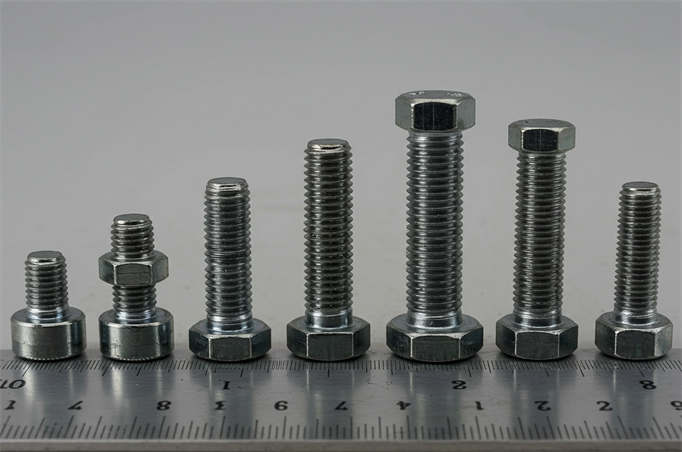

A bridge in rural Minnesota failed a routine load test in 2019. The root cause was not design error or material fatigue — it was wrong bolt grade selection. The contractor had installed Class 8.8 bolts where the specification called for Class 10.9. The bolts yielded under sustained cyclic loading, and the repair cost exceeded $2.3 million. This scenario repeats across industries far more often than engineers like to admit.
Understanding bolt grade strength is not optional knowledge — it is a fundamental engineering responsibility. Whether you are specifying fasteners for a steel-frame building, an automotive powertrain, a wind turbine tower, or a chemical processing plant, the grade number stamped on the bolt head tells you exactly how much load that fastener can bear before it deforms permanently or fractures entirely.
This guide provides a complete bolt grade strength chart covering the most common metric classes (4.6, 5.8, 8.8, 10.9, and 12.9), their SAE equivalents, head markings, mechanical properties, cost implications, and practical selection criteria. Every table and recommendation draws from ISO 898-1, ASTM standards, and real-world procurement data from Prince Fastener, a manufacturer with over 30 years of experience supplying industrial fasteners globally.
What Do Bolt Grade Numbers Mean?
Metric bolt grades use a two-number system separated by a decimal point. The first number multiplied by 100 gives the minimum ultimate tensile strength (UTS) in megapascals (MPa). The second number, when multiplied by the first and then by 10, gives the minimum yield strength. For example, a Class 10.9 bolt has a minimum UTS of 1,040 MPa and a minimum yield strength of approximately 1,040 × 0.9 = 940 MPa. This system makes grade comparison intuitive once you understand the formula.
In the SAE (Society of Automotive Engineers) system used primarily in North America, bolt grades are designated as Grade 2, Grade 5, and Grade 8 — where higher numbers indicate higher strength. These numbers do not follow the same mathematical logic as metric classes, so direct conversion requires a reference table.
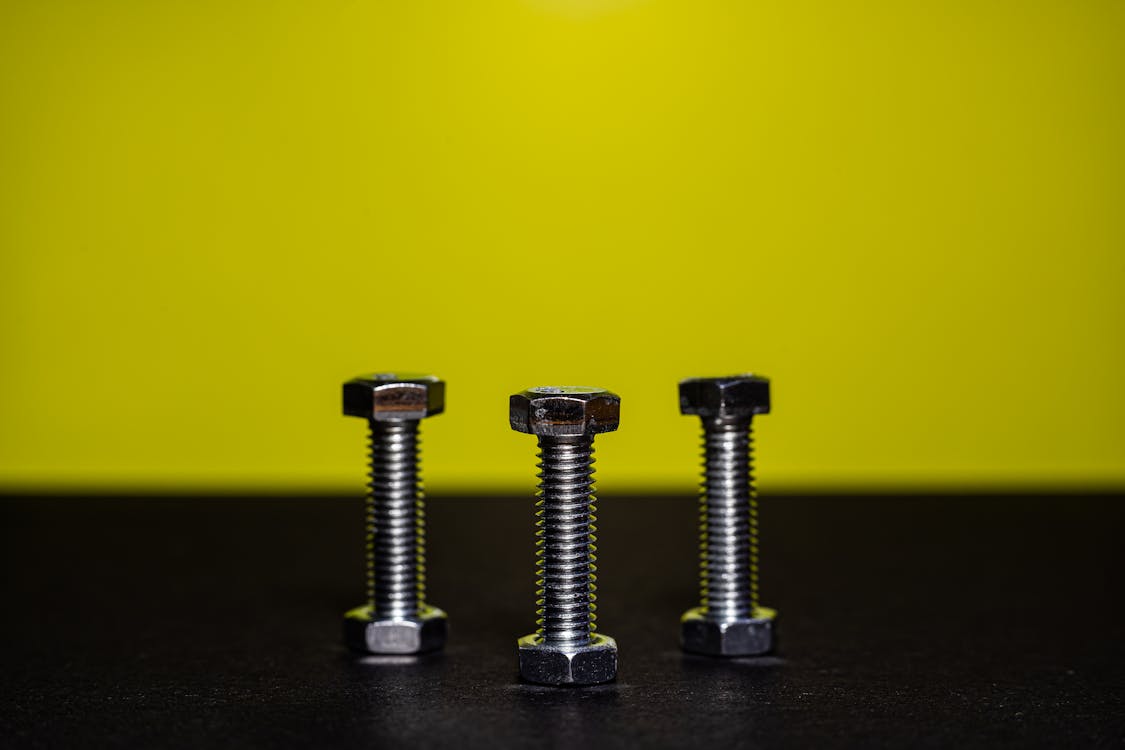
Photo: Close-up of steel bolts — grade markings on the head identify the strength class. (Credit: Pexels)
Complete Bolt Grade Strength Chart — Metric Classes
The following table presents the mechanical properties of all commonly specified metric bolt grades per ISO 898-1:2013. These values apply to bolts and screws with coarse-pitch threads in sizes M5 through M39.
| Property Class | Material | Proof Load (MPa) | Min Yield Strength (MPa) | Min Tensile Strength (MPa) | Min Tensile Strength (PSI) | Hardness (HRC) | Head Marking |
|---|---|---|---|---|---|---|---|
| 4.6 | Low/medium carbon steel | 225 | 240 | 400 | 58,000 | — | 4.6 |
| 4.8 | Low/medium carbon steel | 310 | 340 | 420 | 60,900 | — | 4.8 |
| 5.8 | Low/medium carbon steel | 380 | 420 | 520 | 75,400 | — | 5.8 |
| 8.8 | Medium carbon steel, quenched & tempered | 580 | 640 | 800 | 116,000 | 22–32 | 8.8 |
| 9.8 | Medium carbon steel, quenched & tempered | 650 | 720 | 900 | 130,500 | 28–34 | 9.8 |
| 10.9 | Alloy steel, quenched & tempered | 830 | 940 | 1,040 | 150,800 | 32–39 | 10.9 |
| 12.9 | Alloy steel, quenched & tempered | 970 | 1,100 | 1,220 | 176,900 | 39–44 | 12.9 |
Source: ISO 898-1:2013 — Mechanical properties of fasteners made of carbon steel and alloy steel. Values are minimums for bolts with nominal diameters up to M39. Always verify against the specific standard revision and your project specification.
SAE vs Metric Bolt Grade Equivalency Table
North American engineers frequently need to cross-reference between SAE and metric systems. While these are not exact 1:1 equivalents (they use different test methods and standards), the following table shows the closest functional comparisons as referenced by Bolt Depot and Prince Fastener’s grade comparison guide.
| SAE Grade | Min Tensile (PSI) | Min Tensile (MPa) | Closest Metric Class | Metric Min Tensile (MPa) | Head Marking (SAE) |
|---|---|---|---|---|---|
| Grade 2 | 74,000 | 510 | 4.6 / 5.8 | 400 / 520 | No marking or manufacturer logo |
| Grade 5 | 120,000 | 827 | 8.8 | 800 | 3 radial lines |
| Grade 8 | 150,000 | 1,034 | 10.9 | 1,040 | 6 radial lines |
Note: SAE Grade 8 and Metric Class 10.9 have nearly identical minimum tensile strengths (~150,000 PSI / ~1,040 MPa). Class 12.9 has no standard SAE equivalent and is specified where Grade 8 / 10.9 is insufficient.
Tensile Strength Comparison — Bar Chart
The visual below compares the minimum ultimate tensile strength across all common bolt grades. The jump from 8.8 to 10.9 represents a 30% increase in load capacity — the single largest strength jump between commonly available grades.
Chart: Minimum ultimate tensile strength by metric bolt property class. Grade 10.9 delivers 30% more strength than 8.8 — the biggest jump between common grades.
Industry Usage Distribution — Pie Chart
Based on procurement data from global fastener distributors including Prince Fastener, the following pie chart illustrates the approximate market share of each bolt grade by volume across all industries combined.
Chart: Class 8.8 dominates at 45% of global fastener volume. Class 10.9 follows at 25%, driven by structural and automotive demand.
Class 8.8 dominates because it strikes the optimal balance between strength, cost, and availability. It serves general construction, automotive assembly, and machinery applications. Class 10.9 is the go-to grade for structural steel connections, heavy equipment, and high-vibration environments where the 30% strength premium over 8.8 justifies the cost increase.

Photo: A pile of assorted industrial fasteners — proper grade selection prevents over-engineering and under-engineering. (Credit: Pexels)
How to Read Bolt Head Markings
Every properly manufactured bolt carries a grade identification on its head. For metric bolts, the property class number (e.g., 8.8, 10.9, 12.9) is embossed or raised directly on the hex head. SAE bolts use radial lines: three lines indicate Grade 5, and six lines indicate Grade 8. Grade 2 bolts typically carry no markings.
If a bolt head shows no marking at all, assume the lowest available grade unless mill certification proves otherwise. Counterfeit or improperly marked bolts are a documented safety risk — the ASTM F3125 standard requires traceable markings for structural bolts. Always source from verified manufacturers like Prince Fastener who provide mill test reports (MTRs) and certificates of conformity.
Grade 8.8 Bolts — The Industry Workhorse
Class 8.8 bolts are made from medium carbon steel that has been quenched and tempered. With a minimum tensile strength of 800 MPa (116,000 PSI) and a yield strength of 640 MPa, they handle the vast majority of industrial fastening tasks. According to Prince Fastener’s 8.8 vs 4.6 bolt comparison, a single M12 Class 8.8 bolt can sustain a tensile load of approximately 54.1 kN (12,160 lbf) — enough for most structural and mechanical connections.
Typical applications include automotive engine components, construction framing, agricultural equipment, conveyor systems, and general machinery. Class 8.8 bolts are widely stocked in every standard size from M5 to M64, making lead times short and procurement straightforward.
Grade 10.9 Bolts — The Structural Standard
When 8.8 falls short, 10.9 is the next step. Made from alloy steel (typically with chromium, molybdenum, or boron additions), Class 10.9 bolts deliver a minimum tensile strength of 1,040 MPa (150,800 PSI). That 30% jump over 8.8 makes them essential for structural steel connections per AISC specifications, high-rise construction, bridge erection, heavy machinery, and wind turbine tower flanges.
The Prince Fastener bolt strength guide notes that Grade 10.9 bolts are functionally equivalent to SAE Grade 8 — the strongest commonly available grade in the imperial system. For structural applications governed by AISC 360, 10.9 bolts (marketed as A490 equivalents in ASTM F3125) are specified for slip-critical and bearing-type connections.
Grade 12.9 Bolts — Maximum Strength
Class 12.9 represents the highest standard metric bolt grade. With 1,220 MPa minimum tensile strength and 1,100 MPa yield, these bolts are reserved for applications where space constraints demand maximum clamping force from the smallest possible fastener. Common uses include socket head cap screws in machine tool fixtures, aerospace sub-assemblies, motorsport components, and precision mechanical equipment.
However, higher strength comes with trade-offs. Class 12.9 bolts are more susceptible to hydrogen embrittlement (especially if zinc-plated or galvanized), have lower ductility before fracture, and cost significantly more. Engineers should never default to 12.9 “just to be safe” — over-specifying can introduce brittleness and unnecessary cost. As a rule, use 12.9 only when engineering calculations specifically require it.

Photo: Chrome-finished hex bolts — thread quality and heat treatment determine the grade. (Credit: Pexels)
Torque Specifications by Bolt Grade
Correct torque is inseparable from correct grade selection. Under-torquing a high-grade bolt wastes its clamping potential; over-torquing a lower-grade bolt causes yield failure. The following table shows recommended torque values for common metric bolt sizes across grades 8.8, 10.9, and 12.9, assuming dry (unlubricated) conditions and a friction coefficient of ~0.14. For more detailed torque charts, refer to Prince Fastener’s top 10 bolt torque charts.
| Bolt Size | Class 8.8 (N·m) | Class 10.9 (N·m) | Class 12.9 (N·m) |
|---|---|---|---|
| M6 | 9.9 | 14.3 | 16.3 |
| M8 | 24.6 | 34.5 | 41 |
| M10 | 48.4 | 68 | 81 |
| M12 | 84 | 118 | 140 |
| M16 | 210 | 295 | 350 |
| M20 | 410 | 580 | 690 |
| M24 | 710 | 1,000 | 1,190 |
| M30 | 1,420 | 2,000 | 2,370 |
Values are approximate and assume K-factor = 0.2 (dry, as-received). Lubricated assemblies require 15–25% lower torque. Always follow the project specification.
Cost Comparison: 8.8 vs 10.9 vs 12.9
Price increases with grade, but not linearly. A typical M16 × 80 hex bolt (zinc-plated, bulk 100 pcs) costs approximately:
| Grade | Unit Cost (USD) | Cost vs 8.8 | Tensile Strength | Strength vs 8.8 |
|---|---|---|---|---|
| 8.8 | $0.85 | Baseline | 800 MPa | Baseline |
| 10.9 | $1.05 | +24% | 1,040 MPa | +30% |
| 12.9 | $1.65 | +94% | 1,220 MPa | +53% |
The sweet spot is clear: upgrading from 8.8 to 10.9 costs ~24% more but delivers ~30% more strength. The jump from 10.9 to 12.9 costs an additional ~57% for only ~17% more strength — a significantly less efficient trade. This is why 10.9 dominates structural and heavy-industrial procurement.
Common Bolt Grade Selection Mistakes
After decades of supplying fasteners to construction, automotive, and energy sectors, the engineering team at Prince Fastener has identified these recurring mistakes:
Mistake 1: Defaulting to the highest grade. Specifying 12.9 “for safety” ignores that higher-grade bolts are more brittle and more vulnerable to hydrogen embrittlement after plating. In a 2021 wind farm project in Texas, a contractor replaced specified 10.9 flange bolts with 12.9 equivalents. Three bolts fractured during a winter temperature drop — the reduced ductility of 12.9 made them crack under thermal contraction stress that 10.9 bolts would have absorbed through elastic deformation.
Mistake 2: Ignoring the nut grade match. A Class 10.9 bolt must be paired with a minimum Class 10 nut. Using a Class 8 nut with a 10.9 bolt means the nut threads will strip before the bolt reaches its design clamping load — creating a hidden failure mode that looks properly assembled.
Mistake 3: Mixing SAE and metric. A Grade 5 SAE bolt is close to Class 8.8, but thread pitches differ. Installing a 1/2″-13 UNC bolt in an M12×1.75 hole produces cross-threading, reduced engagement, and catastrophic failure under load.
Mistake 4: Not accounting for temperature. Standard carbon and alloy steel bolt grades (8.8, 10.9, 12.9) lose significant strength above 300°C. For elevated-temperature service, stainless steel or specialty alloy bolts (Inconel, A286) are required regardless of the carbon-steel grade chart.
Mistake 5: Skipping verification. Relying solely on head markings without requesting a mill test report. Counterfeit bolts with false markings have been documented in infrastructure projects — always source from certified suppliers.

Photo: Assorted bolts and screws — verifying grade markings prevents costly installation errors. (Credit: Pexels)
Application Guide: Which Bolt Grade for Which Industry?
| Application | Recommended Metric Class | SAE Equivalent | Why This Grade |
|---|---|---|---|
| General construction framing | 8.8 | Grade 5 | Sufficient strength; cost-effective; widely available |
| Structural steel connections (AISC) | 10.9 | Grade 8 / A490 | Required by specification for slip-critical joints |
| Automotive engine & chassis | 10.9 | Grade 8 | High vibration; cyclic loading; compact spaces |
| Agricultural equipment | 8.8 | Grade 5 | Good strength; tolerant of field conditions; replaceable |
| Wind turbine tower flanges | 10.9 | — | Cyclic fatigue; pretension requirements per EN 14399 |
| Machine tool fixtures | 12.9 | — | Maximum clamping from small socket head cap screws |
| Furniture / light duty | 4.6 / 5.8 | Grade 2 | Low cost; adequate for light loads; no safety criticality |
| Chemical / marine (corrosive) | A4-80 (SS 316) | — | Corrosion resistance overrides raw strength |
YouTube Video: Bolt Grades Explained & Tested
For a visual explanation of how bolt grades perform under extreme pressure, watch this hydraulic press test comparing M32 bolts in classes 8.8, 10.9, and 12.9:
Video: M32 bolts in grades 8.8, 10.9, and 12.9 tested to destruction on a 200-ton hydraulic press. (Credit: YouTube)
Stainless Steel Bolt Classes: A2-70, A2-80, A4-70, A4-80
Stainless steel bolts follow a different classification system. The letter indicates the steel group (A2 = 304 series, A4 = 316 series), and the number indicates the minimum tensile strength in tens of MPa. So A4-80 means 316 stainless with 800 MPa tensile strength — roughly equivalent to Class 8.8 in carbon steel strength, but with far superior corrosion resistance.
However, stainless bolts cannot be heat-treated to achieve grades like 10.9 or 12.9. When both high strength and corrosion resistance are needed, engineers typically use carbon/alloy steel bolts in the required grade and apply a protective coating (hot-dip galvanizing, Dacromet, or Geomet). Prince Fastener supplies both stainless and coated alloy steel bolts with full material certifications.

Photo: Fasteners, anchors, and screws — each designed for specific load and environment requirements. (Credit: Pexels)
How to Verify Bolt Grade: A Step-by-Step Process
Step 1: Visual inspection. Check the head marking. Metric bolts should display the class number (8.8, 10.9, 12.9). SAE bolts show radial lines. No marking typically means Grade 2 / Class 4.6 or lower.
Step 2: Request documentation. Obtain the mill test report (MTR) from the supplier. This document shows the actual chemical composition and mechanical test results for the specific heat of steel. Prince Fastener provides MTRs with every order upon request — a standard practice for any reputable fastener supplier.
Step 3: Hardness check. Use a portable Rockwell hardness tester. Class 8.8 should read HRC 22–32; Class 10.9 should read HRC 32–39; Class 12.9 should read HRC 39–44. Values outside these ranges indicate incorrect heat treatment or counterfeit product.
Step 4: Proof load test (if warranted). For safety-critical applications, subject sample bolts to the specified proof load per ISO 898-1 and verify zero permanent elongation after load removal.
Frequently Asked Questions (FAQ)
1. What does the “8.8” marking on a bolt head mean?
The first number (8) multiplied by 100 gives the minimum ultimate tensile strength in MPa — so 800 MPa. The second number (0.8) represents the yield-to-tensile strength ratio — so yield strength is 800 × 0.8 = 640 MPa. This system applies to all metric bolt classes per ISO 898-1.
2. Is Grade 10.9 stronger than SAE Grade 8?
They are approximately equivalent. SAE Grade 8 has a minimum tensile strength of 150,000 PSI (~1,034 MPa), while ISO Class 10.9 has 1,040 MPa. The difference is less than 1%. However, they are not interchangeable because thread dimensions differ between imperial and metric systems.
3. Can I substitute 12.9 bolts where 10.9 is specified?
Generally no. Class 12.9 bolts are harder and less ductile. In applications subject to impact, vibration, or thermal cycling, the reduced ductility can cause sudden brittle fracture. Always follow the engineering specification. If in doubt, consult the structural engineer of record.
4. What nut grade should I use with a 10.9 bolt?
Use a minimum Class 10 nut (sometimes marked as “10” on one face). A lower-grade nut (e.g., Class 8) will strip before the bolt achieves full clamping force. ISO 898-2 specifies nut property classes that match bolt grades.
5. Are Grade 8.8 bolts suitable for outdoor use?
Yes, but they require a protective coating. Uncoated 8.8 bolts are medium carbon steel and will corrode in moisture. Common protective options include zinc plating (mild indoor/outdoor), hot-dip galvanizing (moderate outdoor), and Dacromet/Geomet (severe outdoor/chemical). For marine environments, consider A4-80 stainless steel bolts instead.
6. Why is Class 10.9 more popular than 12.9 for structural work?
Three reasons: cost efficiency (10.9 costs ~24% more than 8.8 for 30% more strength, while 12.9 costs ~94% more for 53% more strength), ductility (10.9 has a wider safety margin before fracture), and hydrogen embrittlement risk (12.9 is significantly more susceptible, especially with zinc or cadmium plating).
7. How do I identify a bolt grade if the head marking has worn off?
Use a portable Rockwell hardness tester. Compare the reading to standard ranges: HRC 22–32 = Class 8.8, HRC 32–39 = Class 10.9, HRC 39–44 = Class 12.9. For critical applications, send a sample for full tensile testing at an accredited laboratory.
8. What is the strongest bolt grade available?
In standard metric classification, Class 12.9 is the highest at 1,220 MPa tensile strength. Beyond this, specialty fasteners made from materials like Inconel 718 (1,240 MPa), MP35N (1,790 MPa), or custom alloys can exceed these values but are not covered by ISO 898-1.
9. Does bolt diameter affect the grade’s strength properties?
The grade’s MPa rating is consistent across sizes, but the actual load capacity (in kN or lbf) increases with the bolt’s tensile stress area, which grows with diameter. An M20 Class 8.8 bolt holds far more load than an M8 Class 8.8 bolt — even though both have the same 800 MPa rating.
10. Where can I source certified 8.8, 10.9, and 12.9 bolts with mill test reports?
Prince Fastener supplies metric hex bolts in all standard grades with full mill test reports, ISO 9001 certification, and worldwide shipping. With over 30 years as a fastener manufacturer, they offer both standard inventory and custom-engineered bolts for OEM and construction projects. Visit princefastener.com for specifications and quotes.
Last updated: March 2026. Data sourced from ISO 898-1:2013, ASTM F3125/F3125M, Bolt Depot, and Prince Fastener procurement records. Always verify specifications against the governing code for your project.



 English
  Español
  Português do Brasil
  Русский
  日本語
日本語  العربية