
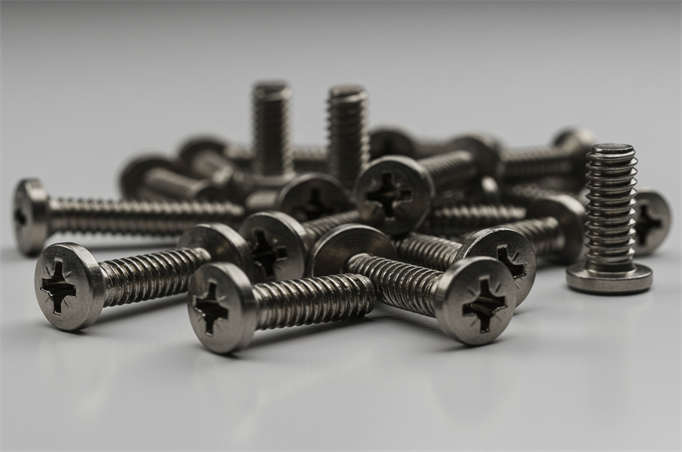
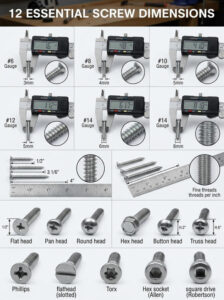
If you’ve ever browsed through a hardware store or scrolled through a fastener catalog online, you’ve likely come across the term “9 screw” — referring to a metric screw with a 9 mm diameter (commonly designated as M9). But what exactly is a 9 mm screw, and why does it matter for your next project? A 9 mm screw is a metric fastener with a nominal major diameter of 9 millimeters. In the ISO metric thread system, the M9 designation comes with a standard coarse pitch of 1.25 mm, though fine-pitch variants of 1.0 mm and 0.75 mm also exist. The minor diameter sits at approximately 7.647 mm, and the pitch diameter at around 8.188 mm. These dimensions make the M9 an intermediate-size fastener — larger than the ubiquitous M8 yet slightly smaller than the common M10 — giving it a unique sweet spot of strength and compactness.
Before we go further, it helps to clarify a distinction that trips up many beginners: the difference between screws and bolts. While both are externally threaded fasteners, screws are typically driven into a material (or a pre-tapped hole) using a driver that engages the head — think Phillips, Torx, or hex socket drives. Bolts, on the other hand, are generally passed through unthreaded holes and secured with a nut on the opposite side. In the context of 9 mm fasteners, you’ll find both M9 bolts paired with nuts and M9 screws designed to thread directly into tapped holes or self-tap into softer substrates like wood and plastic. The important takeaway is that the “9” refers to the diameter, not the application — and that diameter is what defines the load-carrying capacity and the size of the tools you’ll need.
So why should you care about knowing where and how to use a 9 screw in modern projects? Put simply, using the correct screw size is the foundation of a safe, long-lasting assembly. An undersized screw may shear under load; an oversized one can split wood, crack plastic housings, or simply not fit the space available. The M9, sitting between the more commonly stocked M8 and M10, is often the perfect solution when an M8 feels a bit too slim for the load and an M10 is overkill or too bulky for the available clearance. Understanding this sizing nuance can save you money, reduce material waste, and — most importantly — prevent structural failures down the road.
In this article, we’ll walk you through three practical, common uses for a 9 screw that are directly relevant to DIY enthusiasts, home improvers, and automotive hobbyists alike. Specifically, we’ll cover how M9 screws excel in furniture and woodwork assembly, why they’re a staple in automotive and machinery applications, and how they fit into everyday home improvement tasks. Along the way, we’ll share expert insights, size-selection tips, and product recommendations from Prince Fastener — a manufacturer with over 30 years of experience in the fastener industry. Let’s get started.
Video: The Ultimate Guide to Wood Screws — understanding screw types, sizes, and applications.
9 Screw in Furniture and Woodwork
Using Wood Screws for Assembly
Furniture construction — whether it’s a flat-pack bookshelf from a retail store or a hand-crafted dining table from a local workshop — depends heavily on the quality and sizing of its fasteners. The 9 mm screw has found a natural home in woodwork and furniture assembly, primarily because of its balanced diameter. At 9 mm, the shank provides meaningfully more shear strength than an M8 without requiring oversized pilot holes that could weaken the wood fibers surrounding the joint. This makes it especially well-suited for load-bearing connections such as leg-to-apron joints in tables, bracket attachments in shelving units, and the structural framework inside upholstered sofas and armchairs.
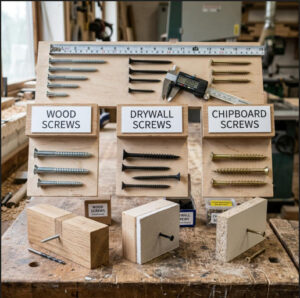
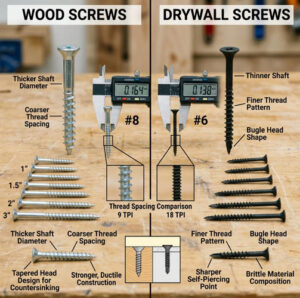
When assembling furniture with 9 mm wood screws, material selection is critical. For indoor furniture that won’t be exposed to moisture, a zinc-plated carbon steel 9 mm screw is typically the most cost-effective option. For outdoor furniture or kitchen-adjacent pieces that may encounter humidity, stainless steel variants offer far better corrosion resistance. Chipboard screws from Prince Fastener, for example, are manufactured with deep, coarse threads specifically engineered to grip particleboard, MDF, and plywood — the exact materials that dominate modern furniture production. The aggressive thread pitch on these screws helps prevent pull-out under cyclical loads, which is exactly what happens every time someone sits in a chair or slides a drawer open and shut.
Another consideration in furniture woodwork is the head style. For visible joints where aesthetics matter — say, the top of a bookshelf or the face of a cabinet door — a countersunk (flat head) 9 mm screw allows you to recess the head flush with the surface and cover it with a wood plug or filler. Where the fastener will be hidden — inside a pocket hole, beneath a bracket, or inside a knock-down fitting — a pan head or washer head provides a larger bearing surface that distributes load more evenly across softer engineered wood products. Choosing the right screw head type is just as important as choosing the right diameter.
“In furniture manufacturing, the joint is only as strong as the fastener that holds it together. The 9 mm diameter sits in a critical performance zone — strong enough for structural loads, yet slim enough not to split engineered panels. I always recommend it for medium-duty furniture frames.”
— Michael Torres, Senior Applications Engineer, Industrial Fastener Institute (IFI)
How to Install a Standard Wood Screw
Installing a 9 mm wood screw correctly isn’t complicated, but skipping steps often leads to cracked wood, stripped heads, or weak joints. Here’s a reliable, step-by-step process that any DIYer or professional can follow:
Step 1: Mark Your Position. Use a pencil and a combination square (or a simple ruler) to mark exactly where the screw will go. For joints that need to be aligned — like two boards joining at a 90-degree angle — clamp the pieces together first and mark through the intended pilot hole location.
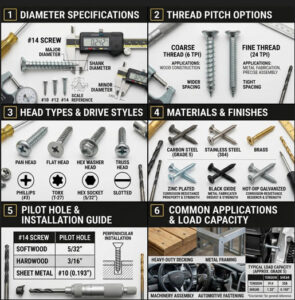
Step 2: Drill a Pilot Hole. For a 9 mm (approximately 3/8-inch) screw in hardwood, drill a pilot hole approximately 7.5 mm in diameter — slightly smaller than the screw’s minor diameter — to allow the threads to bite without splitting the wood. In softwoods like pine or cedar, you can reduce the pilot hole to around 6.5–7 mm. Always use a drill bit rated for wood (brad-point bits are ideal) and set your drill depth to match the screw length minus the head thickness.
Step 3: Apply Countersink if Needed. If you’re using a flat-head screw, use a countersink bit to taper the top of the pilot hole so the head sits flush with or slightly below the wood surface.
Step 4: Drive the Screw. Using a drill/driver set to a moderate torque setting, drive the screw straight into the pilot hole. Avoid angling the driver, as this can cam out the drive recess and strip the head. If you’re using a self-tapping screw, the thread-cutting tip will do most of the work — just keep steady downward pressure.
Step 5: Check Tightness. The screw should be snug but not over-torqued. Over-tightening a 9 mm screw in MDF or particleboard can strip the threads out of the substrate, ruining the joint. A good rule of thumb: once the head seats against the surface (or flush in a countersink), stop driving.
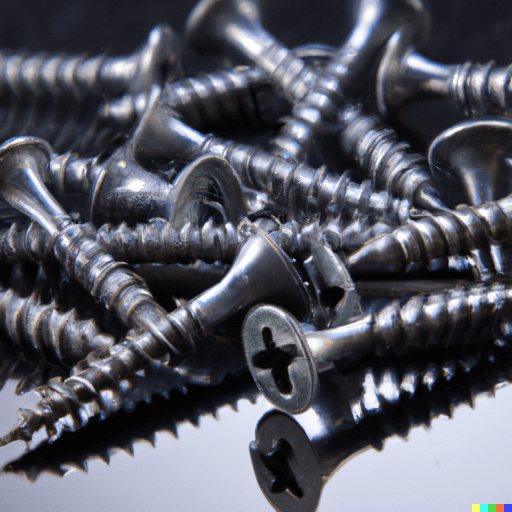
Self-Tapping Screws — No pre-drilling needed for softwood. View Product
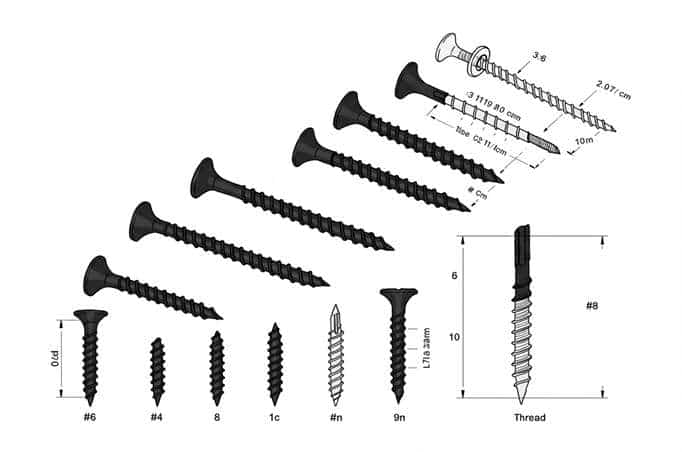
The table below summarizes recommended pilot hole sizes for a 9 mm screw across common wood types:
| Wood Type | Pilot Hole Diameter (mm) | Countersink Needed? | Risk of Splitting |
|---|---|---|---|
| Hardwood (Oak, Maple) | 7.5 | Yes | High |
| Softwood (Pine, Cedar) | 6.5 – 7.0 | Optional | Medium |
| MDF / Particleboard | 7.0 | Yes | Low (but strip-out risk) |
| Plywood (Birch, Marine) | 7.0 – 7.5 | Yes | Low–Medium |
Following these steps and choosing the right pilot hole size will ensure your 9 mm wood screws perform exactly as intended — holding strong, looking clean, and lasting for years. For bulk purchasing of wood screws and chipboard screws at factory-direct pricing, explore the full product catalog at Prince Fastener.
9 Screw in Automotive and Machinery
Socket Screw Applications
In the automotive and machinery world, precision and reliability aren’t optional — they’re non-negotiable. A single loose fastener on an engine block, a transmission housing, or a CNC machine tool can cascade into catastrophic failure, costly downtime, or even personal injury. This is where the 9 mm socket screw earns its keep. Socket head cap screws (often called Allen screws or hex socket screws) in the M9 size are designed for high-strength, high-precision applications where both clamping force and spatial efficiency matter. The cylindrical head with an internal hexagonal drive allows the screw to be tightened with an Allen key or hex bit, enabling installation in tight spaces where a traditional hex-head bolt simply wouldn’t fit.
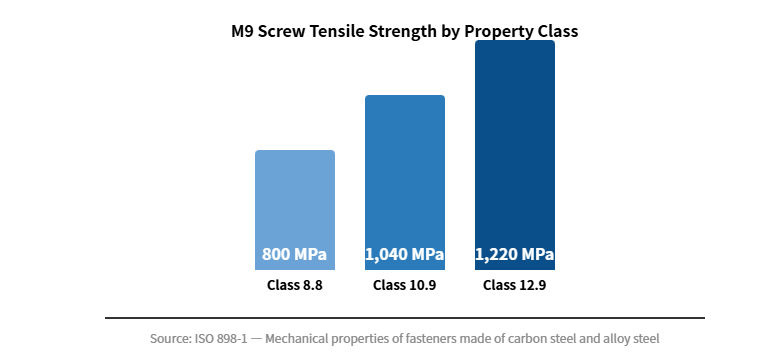
The socket head cap screws offered by Prince Fastener are available in property classes 8.8, 10.9, and 12.9, with 12.9 being the go-to choice for critical machinery and automotive engine components. A class 12.9 M9 socket cap screw has a minimum tensile strength of 1,220 MPa and a proof load stress of 1,100 MPa — meaning it can handle enormous clamping forces before yielding. This makes it ideal for applications such as securing cylinder head covers, mounting alternator brackets, fastening turbocharger housings, and locking down tooling fixtures on milling machines. According to the ISO 898-1 standard, these mechanical property requirements are rigorously tested and certified, so engineers can design joints with confidence.
Socket screws also shine in applications involving vibration. Automotive engines, for instance, generate substantial vibrational loads across a broad frequency range. M9 socket cap screws, used with appropriate lock nuts or thread-locking compounds, resist loosening far better than equivalent slotted or Phillips-drive screws because the hex socket drive provides a more positive, camout-free engagement. This means technicians can apply the full recommended torque without fear of stripping the drive, which in turn maximizes the clamp load and resistance to vibrational loosening.
The chart below shows the comparative tensile strength of M9 screws across common property classes used in automotive and machinery:
Common Vehicle Uses
Walk into any professional automotive workshop and open a drawer of metric fasteners, and you’ll find M9 screws scattered throughout the inventory. While M8 and M10 tend to get most of the spotlight in parts catalogs, the M9 fills a crucial gap in vehicle assembly and aftermarket modification. Here are some of the most common places you’ll encounter 9 mm screws in a vehicle:
Interior Trim and Dashboard Components: Many European and Japanese vehicle manufacturers use M9 fasteners to secure interior trim panels, dashboard sub-assemblies, and center console brackets. The 9 mm diameter provides enough holding strength for components that need to stay rattle-free over hundreds of thousands of miles while remaining small enough to fit behind thin plastic panels without creating unsightly bulges.
Engine Accessories and Peripheral Mounts: Alternators, power steering pumps, A/C compressor brackets, and water pump housings frequently employ M9 socket screws. These accessories generate considerable vibration and are subjected to thermal cycling — expanding when hot, contracting when cold — making a robust, precisely torqued M9 fastener the right choice to maintain joint integrity through those conditions.
Suspension and Chassis Components: In lighter-duty suspension applications — such as stabilizer bar end links, brake caliper dust shields, and wheel-arch liner fasteners — M9 screws often appear because they offer a good strength-to-weight ratio. This is particularly important in performance and electric vehicles where every gram of unsprung weight matters.
Aftermarket Modifications: Car enthusiasts working on custom brackets, intercooler mounts, exhaust hangers, or roll-cage gussets frequently reach for M9 hardware when M8 doesn’t inspire enough confidence and M10 hardware is physically too large for the available mounting points. The M9 becomes the Goldilocks fastener in these scenarios.
When sourcing 9 mm automotive screws, quality is paramount. Counterfeit and sub-spec fasteners are a well-documented problem in the automotive aftermarket. That’s why working with a verified manufacturer like Prince Fastener — whose products are manufactured under ISO-certified quality management systems with full material traceability — gives both professional mechanics and weekend gearheads the peace of mind that every fastener meets the published specifications. Prince Fastener’s machine screws and socket cap screws are available in a broad range of lengths, materials (carbon steel, stainless steel, alloy steel), and surface treatments (zinc plating, black oxide, Dacromet), making it easy to spec the exact fastener your application demands.
| Vehicle Application | Typical Screw Type | Property Class | Common Material |
|---|---|---|---|
| Interior Trim Panels | Pan Head Machine Screw | 4.8 – 8.8 | Zinc-plated Carbon Steel |
| Engine Accessory Brackets | Socket Head Cap Screw | 10.9 – 12.9 | Alloy Steel, Black Oxide |
| Suspension Links | Hex Bolt w/ Nut | 10.9 | Alloy Steel, Dacromet |
| Aftermarket Custom Brackets | Button Head Socket Screw | 10.9 | Stainless Steel A2-70 |
9 Screw for Home Improvement
General Screw Uses in DIY Projects
Home improvement is where most people first encounter screws — and where choosing the right size can mean the difference between a project you’re proud of and one that falls apart the first time someone leans against it. The 9 mm screw is a versatile workhorse in the DIY world, showing up in projects ranging from mounting heavy-duty shelf brackets to securing deck railing posts to building garden raised beds. Its diameter places it firmly in the “medium-duty” category: strong enough to handle significant loads, yet easy to work with using standard consumer-grade power drills and hand tools.
One of the most common DIY applications for 9 mm screws is deck and outdoor structure construction. When fastening 2×6 or 2×8 decking boards to joists, or securing ledger boards to the house framing, an M9 screw provides substantially more pullout resistance than a standard #8 (approximately 4.2 mm) deck screw. This extra grip is especially important in outdoor applications where moisture causes wood to swell and shrink cyclically, gradually loosening smaller fasteners over time. For these applications, stainless steel or hot-dip galvanized M9 screws are the recommended choice to prevent rust and corrosion. Prince Fastener’s wood screw range includes corrosion-resistant options specifically designed for outdoor structural use.
Another popular home improvement use is mounting heavy items to walls and ceilings. Think of heavy mirrors, floating shelves holding books, ceiling-mounted TV brackets, or pull-up bars in a home gym. When these items are fastened through drywall into wooden studs using M9 self-tapping screws, the 9 mm shank provides a rock-solid anchor point that dramatically outperforms the thin drywall screws that come packaged with most consumer-grade mounting hardware. The key is to ensure the screw penetrates at least 40 mm into the structural stud behind the drywall — a depth that engages enough wood fibers to develop the full pullout strength of the M9 thread.
Fencing and gate construction is another area where 9 mm screws excel. Fence posts endure constant wind loading, and gate hardware experiences repetitive dynamic stress every time the gate is opened and closed. Using M9 lag screws (also known as coach screws) to fasten horizontal rails to posts, or to mount heavy-duty gate hinges, provides a degree of structural confidence that smaller fasteners simply can’t match. For maximum performance, pair the screw with a washer to distribute bearing pressure across the wood grain and prevent crushing under the head.
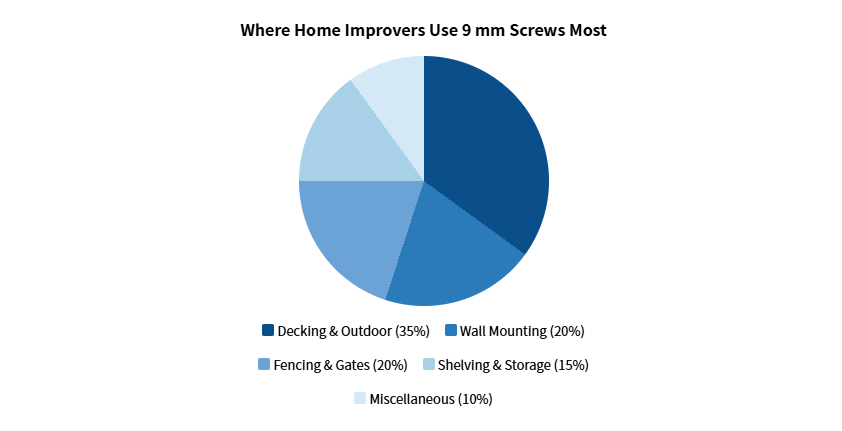
The pie chart below illustrates how home improvement professionals typically distribute M9 screw usage across different project categories:
Choosing the Right Screw Size
Selecting the right screw size for a home improvement project isn’t just about grabbing whatever is in the junk drawer — it requires considering four key variables: diameter, length, material, and head style. Let’s break each one down in the context of 9 mm screws for home use.
Diameter: As we’ve discussed, the M9 (9 mm) diameter is ideal for medium-to-heavy-duty residential applications. But how do you know when to step up from an M8 or step down from an M10? A good rule of thumb is to match the screw diameter to the substrate thickness. For materials between 15 mm and 25 mm thick (common for dimensional lumber and thick plywood), the M9 provides optimal thread engagement without excessive splitting risk. The ANSI/ASME B1.13M standard provides detailed thread geometry data for M9 fasteners if you need to get into the engineering weeds.
Length: The general guideline is that the screw should penetrate the bottom (receiving) member by at least 1.5 to 2 times the screw diameter. For an M9 screw, that means at least 13.5 to 18 mm of thread engagement in the second piece. For a two-piece wood joint where the top piece is 20 mm thick, you’d want an M9 screw at least 38–40 mm long. Going longer is usually fine, as long as the tip doesn’t protrude through the back of the assembly.
Material: For interior projects — mounting a shelf, assembling a cabinet, securing a door hinge — standard zinc-plated steel M9 screws are perfectly adequate and the most economical choice. For bathroom, kitchen, or outdoor projects where moisture is a factor, upgrade to stainless steel (A2 grade for general corrosion resistance, or A4/marine grade for coastal or high-humidity environments). Prince Fastener offers M9 screws in a full range of materials, making it easy to match the fastener to the environment.
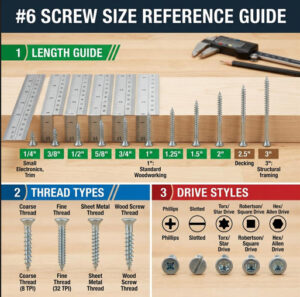
Head Style: For home improvement, the three most useful head styles are flat head (countersunk, sits flush), pan head (raised, provides broad bearing surface), and hex/lag head (wrench-driven, for heavy structural connections). The table below offers a quick decision guide:
| Application | Recommended Head Style | Recommended Length | Recommended Material |
|---|---|---|---|
| Shelf bracket to wall stud | Pan Head or Hex Head | 50 – 65 mm | Zinc-plated Steel |
| Deck board to joist | Flat Head (Countersunk) | 65 – 75 mm | Stainless Steel A2 or HDG |
| Fence rail to post | Hex / Lag Head | 75 – 100 mm | Hot-Dip Galvanized |
| Cabinet hinge to door | Flat Head (Countersunk) | 20 – 30 mm | Zinc-plated Steel |
“I see homeowners make two common mistakes with screws: using ones that are too thin for the load, and using ones that aren’t rated for the environment. A stainless M9 in an outdoor application will outlast a plated M10 in the same spot every time, because corrosion is the real enemy.”
— Sarah Jennings, Licensed General Contractor & DIY Educator
Getting the size right also means understanding the different kinds of fasteners available in the 9 mm range. Don’t assume that all M9 screws are interchangeable — a machine screw with a uniform thread pitch is fundamentally different from a wood screw with a coarse, tapered thread, and using the wrong one will give you poor results regardless of how carefully you drive it. When in doubt, consult the technical team at a reputable supplier like Prince Fastener, who can recommend the exact screw type, material, and coating for your specific project.
Conclusion: Putting the 9 Screw to Work in Your Next Project
Throughout this guide, we’ve explored three practical, everyday applications for the versatile 9 mm metric screw. In furniture and woodwork, the M9 delivers the perfect balance of holding power and slimness, making it an excellent choice for assembling everything from bookshelves to dining tables — especially when paired with quality chipboard screws designed for engineered wood products. In automotive and machinery, M9 socket head cap screws provide the high-strength, vibration-resistant performance demanded by engine components, CNC tooling, and custom aftermarket brackets. And in home improvement, whether you’re building a deck, mounting heavy shelves, or constructing a fence, the 9 mm screw gives you the structural confidence to tackle medium-to-heavy-duty tasks with ease.
The common thread (pun intended) across all three applications is this: understanding screw types and sizes is the single most impactful skill you can develop for successful DIY, automotive, and professional projects. The difference between a wobbly shelf and a rock-solid one often comes down to choosing the right diameter, the right length, the right material, and the right head style. The M9 screw — occupying that valuable middle ground between the common M8 and M10 — deserves a permanent place in your fastener toolkit.
We encourage you to apply this knowledge in your own work. Next time you’re planning a DIY build, an engine repair, or a home renovation, think critically about the fastener specification rather than just grabbing whatever is handy. Your projects will be stronger, safer, and more durable for it. And for those who want to go deeper, exploring the broader world of metric fasteners — including thread pitches, property classes, coating technologies, and torque specifications — will open up an entirely new level of craftsmanship and engineering confidence.
Ready to source high-quality 9 mm screws for your next project? Prince Fastener has been manufacturing precision fasteners for over 30 years, serving distributors and businesses across the globe. From self-tapping screws to socket head cap screws, every product is made with ISO-certified quality and full material traceability. Contact Prince Fastener today for a free quote and expert consultation on your fastener needs.
Video: Prince Fastener — How Screws Are Made: Inside the Production Process
Frequently Asked Questions About 9 mm Screws
1. What is a 9 mm screw used for?
A 9 mm screw (M9) is a metric fastener with a 9-millimeter nominal diameter. It is commonly used in furniture assembly, automotive engine components, machinery tooling, home improvement projects like decking and fencing, and general DIY applications where medium-duty holding power is needed. The M9 sits between the more common M8 and M10 sizes, offering a balanced combination of strength and compactness.
2. What is the difference between an M9 screw and an M9 bolt?
Both share the same 9 mm nominal diameter, but a screw is designed to be driven into a material (or a pre-tapped hole) using a driver, while a bolt is typically passed through a clearance hole and secured with a nut on the opposite side. In practice, M9 screws are used when one side of the joint is inaccessible, and M9 bolts are used when both sides are accessible and maximum clamping force is needed.
3. What pilot hole size should I drill for a 9 mm wood screw?
For hardwoods like oak or maple, drill a pilot hole of approximately 7.5 mm. For softwoods like pine or cedar, a 6.5–7.0 mm pilot hole is sufficient. For MDF and particleboard, use approximately 7.0 mm. These sizes allow the screw threads to bite securely into the material while minimizing the risk of splitting.
4. What is the standard thread pitch for an M9 screw?
The standard (coarse) thread pitch for an M9 screw is 1.25 mm, as defined by the ISO metric thread standard. Fine-pitch variants are also available at 1.0 mm and 0.75 mm. Coarse pitch is used for general-purpose applications, while fine pitch is preferred in automotive and precision machinery where higher resistance to vibrational loosening is required.
5. Can I use M9 screws for outdoor projects?
Yes, but you must choose the right material and coating. For outdoor use, stainless steel (A2 or A4 grade) or hot-dip galvanized M9 screws are recommended because they resist rust and corrosion from rain, humidity, and UV exposure. Standard zinc-plated screws may corrode within months in outdoor environments. Prince Fastener offers M9 screws in multiple corrosion-resistant materials suitable for exterior applications.
6. What property class should I choose for M9 automotive screws?
For non-structural interior trim, property class 4.8 or 8.8 is sufficient. For engine components, suspension parts, and high-vibration applications, class 10.9 or 12.9 is recommended. Class 12.9 M9 socket cap screws offer a minimum tensile strength of 1,220 MPa — making them suitable for the most demanding automotive applications.
7. Is M9 the same as a #9 screw?
No. M9 refers to a metric screw with a 9 mm diameter, while a #9 screw uses the imperial (American) numbering system, where #9 corresponds to a shank diameter of approximately 0.177 inches (about 4.5 mm). The two are not interchangeable. Always confirm whether your project calls for metric (M) or imperial (#) fasteners before purchasing.
8. Where can I buy high-quality M9 screws in bulk?
For wholesale or bulk orders, working directly with a manufacturer is the most cost-effective option. Prince Fastener is a leading fastener manufacturer with over 30 years of experience, offering M9 screws in various types — wood screws, machine screws, self-tapping screws, socket head cap screws — with full customization of material, coating, and packaging. They ship globally and offer OEM/ODM services.
9. How do I prevent M9 screws from loosening due to vibration?
Several methods are effective: use a thread-locking compound (such as Loctite 242 for medium-strength applications), pair the screw with a lock nut (nylon insert or all-metal prevailing torque), apply a Nord-Lock wedge washer, or use a fine-pitch M9 thread which has greater resistance to self-loosening. In automotive and machinery settings, proper torque specification is also critical — always use a calibrated torque wrench.
10. What Allen key size fits an M9 socket head cap screw?
An M9 socket head cap screw typically uses a 7 mm hex (Allen) key. However, this can vary slightly depending on the manufacturer and the specific standard followed (DIN 912 vs. ISO 4762). Always verify the drive size against the manufacturer’s specifications before selecting your tool.


 English
  Español
  Português do Brasil
  Русский
  日本語
日本語  العربية