

You have lots of options when choosing screws for your project. Looking at metric and imperial screw gauge chart details helps you not make expensive errors. Knowing both standards stops:
- Stripped threads from wrong pitch or TPI
- Loose joints that make things weaker
- Tool problems between metric and imperial heads
Prince Fastener helps you pick the correct screw. With easy charts and helpful tips, you feel sure and get things right.
Key Takeaways
- A screw gauge chart helps you pick the right screw size. This stops mistakes and makes sure your project is strong.
- Know the difference between metric and imperial systems. Metric uses millimeters. Imperial uses inches and gauge numbers.
- Always check the diameter and thread pitch before buying screws. This helps you avoid problems like stripped threads or loose joints.
- Use a simple process: measure, compare, and double-check. This helps you pick the best screw for your project.
- Use conversion tables when changing between metric and imperial sizes. This helps you find the closest match and keeps your project safe.
What is a screw gauge chart?
Chart purpose
You use a screw gauge chart to find the right screw size for your project. This chart shows you the diameter, length, and thread pitch of screws. It helps you match the screw to the hole or nut you need. In mechanical engineering and DIY projects, you often need to know the distance between threads on screws and bolts. A screw gauge chart makes this easy. You can quickly check the thread pitch and pick the correct fastener for assembly, repair, or replacement. The chart often has labeled columns or rows, so you can compare sizes at a glance. This tool saves you time and prevents mistakes.
Tip: Prince Fastener recommends always checking the chart before you start your project. This step helps you avoid using the wrong screw and keeps your work strong.
Why it matters
Choosing the right screw size is important for safety and strength. If you pick the wrong size, you might strip the threads or make the joint loose. A screw gauge chart helps you avoid these problems. The chart also helps you switch between metric and imperial systems. The metric system uses millimeters for diameter and length, and it shows thread pitch as the distance between threads. The imperial system uses inches and fractions, which can make calculations harder.
Here is a quick comparison:
| System Type | Measurement Units | Characteristics |
|---|---|---|
| Metric | Millimeters | Decimal-based, more size choices in smaller steps, good for exact measurements |
| Imperial | Inches, fractions | Non-decimal-based, often more complex calculations, common in the U.S. |
You see that the metric system gives you more exact choices. The imperial system is common in the U.S., but it can be tricky to convert sizes. A screw gauge chart helps you compare both systems and pick the best screw for your job.
Metric screw gauge chart
Metric measurements
You measure metric screws using millimeters. The size shows two things: the diameter and the thread pitch. The diameter tells you how wide the screw is. The thread pitch tells you the distance between each thread. For example, an M18x2.5 screw means the diameter is 18 millimeters and the thread pitch is 2.5 millimeters. This system helps you pick the right screw for your project.
You often see metric screws in hardware stores with sizes like M3, M4, M5, M6, M8, M10, and M12. Each size works best for different jobs:
- M3: Used in electronics and small machines.
- M4: Found in cars and airplanes.
- M5: Good for furniture and general use.
- M6: Used in construction and machines.
- M8: Popular for cars and industry.
- M10: Used in heavy machines.
- M12: Great for big construction projects.
Tip: Prince Fastener recommends checking both the diameter and thread pitch before you buy. This step helps you avoid mistakes.
Reading the chart
A screw gauge chart for metric screws shows the size, diameter, and thread pitch. You can use the chart to match the screw to your needs. Here is a simple example:
| Screw Size (Metric) | Diameter (mm) | Thread Pitch (mm) |
|---|---|---|
| M6 | 6 | 1 |
| M12 | 12 | 1.75 |
| M18 | 18 | 2.5 |
| M33 | 33 | 3.5 |
| M36 | 36 | 4 |
| M39 | 39 | 4 |
You read the chart by looking at the screw size. Then, check the diameter and thread pitch. The main difference between metric and imperial screws is the thread pitch. Metric screws always show this number. This makes it easy to compare and choose the right screw.
If you use a screw gauge chart, you can quickly find the right size for your project. Prince Fastener makes it simple to pick the correct screw every time.
Imperial screw gauge chart
Gauge numbers
Imperial screws use gauge numbers to show their thickness. A bigger gauge number means the screw is thicker. You use these numbers to pick the right screw. For example, a #2 screw is good for electronics and small appliances. A #6 screw works for many jobs. A #10 screw is used in building and machines. You can find these gauge numbers in the screw gauge chart. The chart helps you compare sizes and pick the best fastener.
Here is a simple table with gauge numbers, diameters, and uses:
| Gauge Number | Diameter (inches) | Application Type |
|---|---|---|
| #0 | < 0.086 | Small, delicate tasks |
| #2 | ~0.086 | Precision applications |
| #6 | ~0.138 | Light to medium-duty tasks |
| #12 | > 0.138 | Larger, heavier applications |
You also see screws measured in fractions of an inch. Some examples are 1/4 inch or 3/8 inch. These sizes are common in building and factories.
Chart reading
When you read an imperial screw gauge chart, look for three things:
- Gauge numbers and diameter: This shows how thick the screw is. A higher gauge means a thicker screw.
- Thread count and pitch: This tells you how many threads are on the screw. It helps you match the screw with the right nut or hole.
- Length measurement: You measure from the bottom of the head to the tip. This makes sure the screw fits your material.
You can find common screw sizes in the chart. Here is a table with some sizes and what they are used for:
| Screw Size | Common Applications |
|---|---|
| #2 | Electronics and small appliances |
| #4 | Furniture and cabinetry |
| #6 | General-purpose applications |
| #8 | Automotive and industrial applications |
| #10 | Construction and machinery |
| 1/4 inch | Automotive and plumbing |
| 5/16 inch | Heavy-duty applications |
| 3/8 inch | Construction and industrial projects |
| 1/2 inch | Large-scale construction and machinery |
Imperial screws use standards like UNC and UNF. These show thread count and pitch. Prince Fastener says you should check the chart before you buy. This helps you avoid mistakes and keeps your project strong.
Tip: Always use the screw gauge chart to match the screw size, thread count, and length. You get the best fit and avoid problems.
Metric vs imperial differences

Units and numbering
Metric and imperial systems measure screws in different ways. Metric screws use millimeters for diameter and thread pitch. For example, M10 means the screw is 10 millimeters wide. Imperial screws use inches or fractions, like 3/8 inch. They also use gauge numbers, such as #6 or #10, to show thickness.
Here is a table to help you compare the two systems:
| Feature | Metric (ISO/DIN) | Imperial (ANSI/SAE) |
|---|---|---|
| Measurement Units | Millimeters (M10 = 10 mm) | Inches/Fractions (3/8″) |
| Thread Pitch | Millimeters (1.25 mm) | Threads per inch (20 TPI) |
| Labeling | M plus diameter/pitch | Fractional diameter & TPI |
Metric screws use a decimal system that is easy to read. Imperial screws use numbers, fractions, and threads per inch. A screw gauge chart helps you compare these numbers fast. This makes it easier to pick the right screw for your project.
Note: Prince Fastener says to check the labeling system before you buy. This step helps you avoid mistakes and saves time.
Thread pitch
Thread pitch shows how close the threads are on a screw. In the metric system, you measure thread pitch in millimeters. For example, a 1.25 mm pitch means each thread is 1.25 millimeters apart. In the imperial system, you count how many threads fit in one inch. This is called threads per inch, or TPI. A screw with 20 TPI has 20 threads in one inch.
Here is a table that shows the main differences:
| Feature | Metric Screws | Imperial Screws |
|---|---|---|
| Measurement Units | Millimeters (e.g., M6 = 6 mm) | Inches (fractions or decimals) |
| Thread Pitch | Distance between threads (mm) | Threads per inch (TPI) |
| Size Increments | Consistent decimal system | Gauge numbers and fractional |
| Holding Power & Fit | Finer adjustment | Coarser standard pitches |
| Industry Preferences | Global usage (automotive, etc.) | U.S. and UK legacy industries |
Metric screws let you make small, even changes because of the pitch. Imperial screws often have bigger threads, which can be stronger in some materials. You need to match the thread pitch to the nut or hole for a good fit.
Tip: Always check the thread pitch before you start your project. Prince Fastener suggests using a thread gauge if you are not sure.
Applications
Metric and imperial screws are used in different places and jobs. Metric screws are common in cars, planes, electronics, and factories. You also see them in global trade. Imperial screws are mostly used in the United States. You find them in building, plumbing, big machines, and some car work.
Here is a quick list to help you remember:
Metric screws:
- Automotive industry
- Aerospace industry
- Electronics industry
- Manufacturing industry
- International trade
Imperial screws:
- United States construction
- Automotive industry
- Plumbing industry
- Heavy machinery applications
- Structural applications
You need to know which system your project uses. This helps you buy the right screws and tools. Prince Fastener can help you find the right fastener for any job, no matter the system.
Using screw gauge charts
Selection steps
You can follow clear steps to pick the right screw for your project. Using a screw gauge chart makes this process simple and helps you avoid mistakes. Here is a step-by-step guide:
Learn the difference between imperial and metric systems.
You need to know if your project uses millimeters (metric) or inches (imperial).Measure the screw’s diameter with calipers.
Place the calipers across the screw’s threads to get an accurate reading.Measure the screw length from the correct points.
For most screws, measure from the bottom of the head to the tip.Determine the thread pitch or thread count.
For metric screws, check the distance between threads. For imperial screws, count how many threads fit in one inch.Compare your measurements to the screw gauge chart.
Find the closest match for diameter, length, and thread pitch.Double-check the head, drive, material, and finish.
Make sure the screw fits your tool and matches your project’s needs.
Tip: Prince Fastener offers easy-to-read charts and measuring tools. You can use these resources to make sure you always pick the right screw.
Conversion tips
Sometimes, you need to switch between metric and imperial screw sizes. This can happen if you work on international projects or use parts from different countries. Here are some tips to help you convert sizes:
- Use a conversion table to match metric sizes to their closest imperial equivalents.
- Remember that some sizes do not have an exact match. Always check the fit before you use the screw.
- Use calipers or a screw gauge to measure the actual diameter if you are unsure.
Here is a helpful table that shows common conversions:
| Metric Size (mm) | Decimal Inch | Closest Common Fraction |
|---|---|---|
| M6 | 0.236 | 1/4″ |
| M8 | 0.315 | 5/16″ |
| M10 | 0.394 | 3/8″ |
You can also use this table for imperial gauge numbers:
| Screw Size | Fraction | Decimal |
|---|---|---|
| #1 | 1/16 | 0.0625 |
| #2 | 5/64 | 0.0781 |
| #3 | 3/32 | 0.0937 |
| #4 | 7/64 | 0.1093 |
| #5 | 1/8 | 0.125 |
| #6 | 9/64 | 0.1406 |
| #8 | 5/32 | 0.1562 |
| #9 | 11/64 | 0.1718 |
| #10 | 3/16 | 0.1875 |
| #11 | 13/64 | 0.1718 |
| #12 | 7/32 | 0.2187 |
| #13 | 15/64 | 0.2343 |
| #14 | 1/4 | 0.25 |
| #16 | 17/64 | 0.2656 |
| #18 | 17/64 | 0.2968 |
| #20 | 5/16 | 0.3125 |
| #24 | 3/8 | 0.375 |
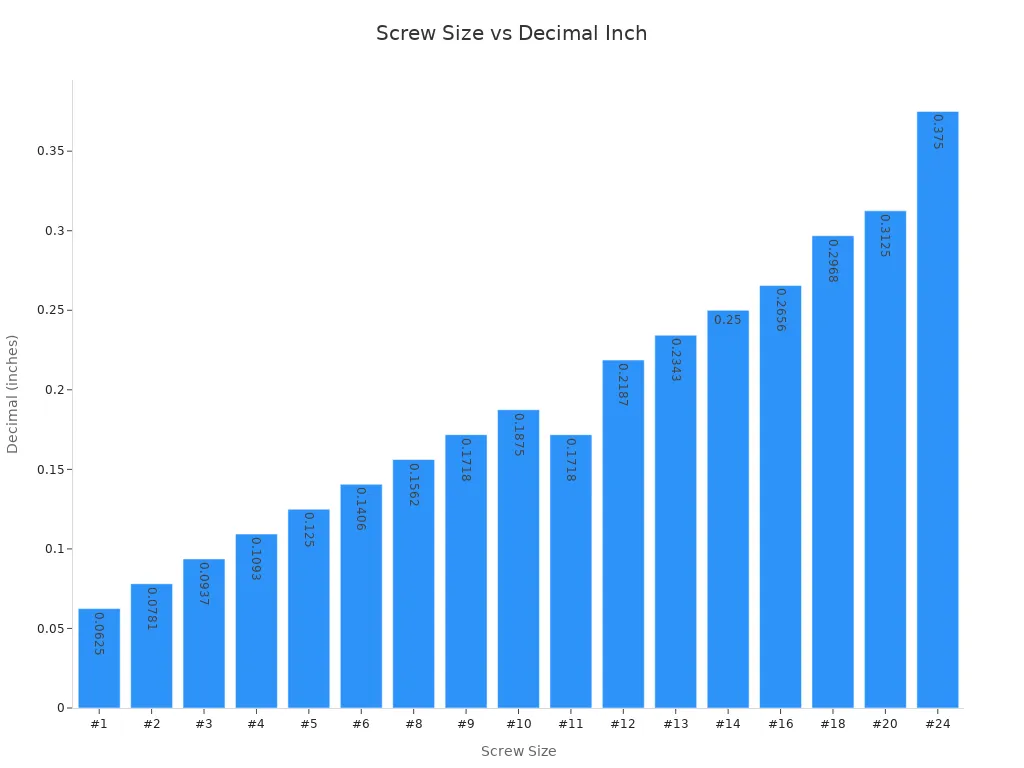
Note: Prince Fastener recommends using both a chart and a measuring tool when you convert screw sizes. This helps you avoid errors and keeps your project strong.
You can always rely on a screw gauge chart to compare sizes and make smart choices. If you follow these steps and tips, you will feel confident when working with any screw standard.
Screw gauge chart conversion table
Metric to imperial
If you use both metric and imperial screws, you need a way to compare sizes. A screw gauge chart conversion table helps you match metric screws to imperial ones. This makes it simple to find the right screw, even if you only have one kind. You can check the table below for common conversions:
| US Screw Size | Inch Decimal | Metric Equivalent (mm) | Common Use |
|---|---|---|---|
| #6 | 0.138 | 3.51 | Light woodwork |
| #8 | 0.164 | 4.17 | Furniture, cabinets |
| #10 | 0.190 | 4.83 | Drywall, frames |
| 1/4″ | 0.250 | 6.35 | Heavy-duty |
You can also look at fractional inch sizes and see how they match metric sizes:
| Fractional Inch | Inch Decimal | Metric Equivalent (mm) | Nearest US Gauge |
|---|---|---|---|
| 1/8″ | 0.125 | 3.18 | #5 |
| 3/16″ | 0.188 | 4.76 | #10 |
| 1/4″ | 0.250 | 6.35 | #14 |
| 3/8″ | 0.375 | 9.53 | — |
| 1/2″ | 0.500 | 12.70 | — |
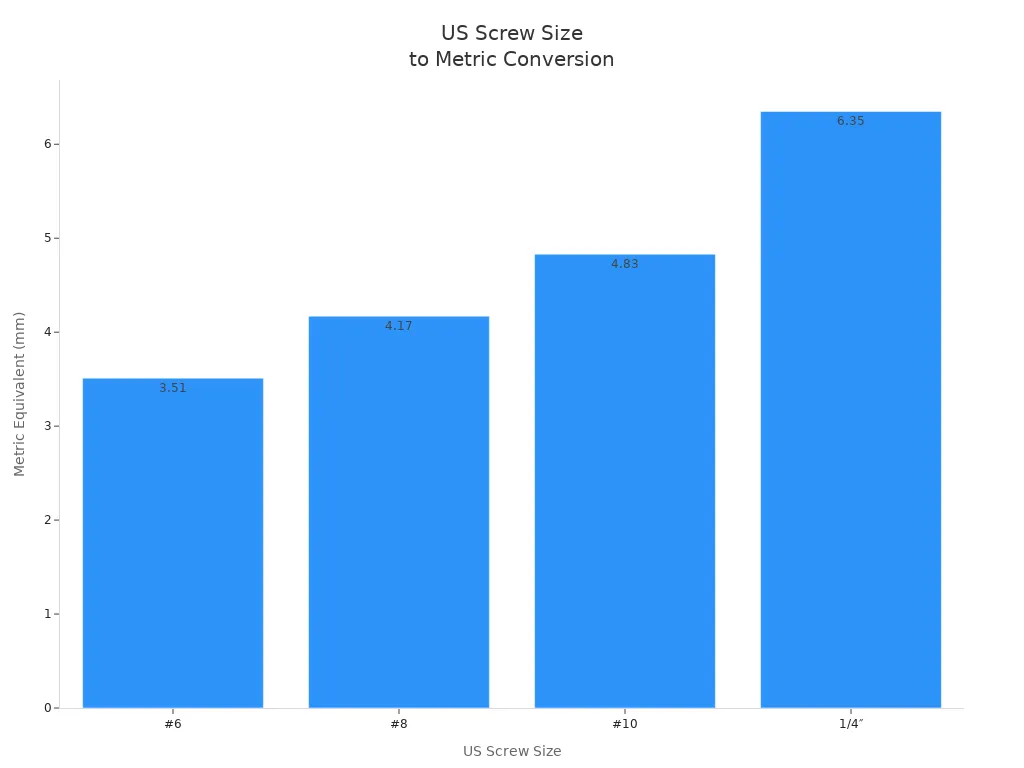
Note: Conversion tables give you close matches, but metric and imperial screws do not always fit the same. Always check both the diameter and thread pitch before you use a different screw.
Using the table
A screw gauge chart conversion table helps you save time and avoid mistakes. First, measure the screw’s diameter with calipers. Then, use the table to find the closest size. If you do not have a thread gauge, compare your screw to one you know. Always check the thread pitch, because even a small change can cause problems.
Some common mistakes are measuring the wrong part of the screw, using the wrong tool, or forgetting to check the thread pitch. You should also make sure you do not read the measurement at an angle. Prince Fastener says to use calipers and a chart for the best results.
- Measure the threaded part, not the head.
- Use calipers or a thread gauge to be exact.
- Double-check the pitch and diameter before picking a new screw.
Tip: Conversion tables help you compare sizes, but you should always test the fit before you finish your project. This keeps your work strong and safe.
A screw gauge chart conversion table helps you feel sure when you use different standards. You can count on Prince Fastener for good charts and advice for any project.
Now you know the big differences between metric and imperial screw gauge charts. Metric screws use millimeters and thread pitch to show size. Imperial screws use inches, fractions, and gauge numbers instead. You can use screw gauge charts and conversion tables to work faster and make fewer mistakes.
- You pick the right pilot hole size and stop damage.
- You can switch between metric and imperial sizes easily.
- You get better results when you drill and fasten things.
If you want to measure screws in a more advanced way, you can use these tools:
| Tool Type | Purpose |
|---|---|
| Vernier Caliper | Measures screw length very carefully |
| Bolt Thread Gauge | Checks thread pitch and size so you do not mix up fasteners |
| Advanced Thread Gauge | Gives digital accuracy and saves data |
Prince Fastener helps you pick the right screw for every project.
FAQ
What is the main difference between metric and imperial screw sizes?
Metric screws use millimeters for size and thread pitch. Imperial screws use inches, fractions, or gauge numbers. You can check both types on a screw gauge chart from Prince Fastener.
How do I know if I need a metric or imperial screw?
Check your project instructions or the tools you have. Metric screws fit metric tools. Imperial screws fit inch-based tools. If you are unsure, measure the screw and compare it to a chart.
Can I use a metric screw in an imperial hole?
You should not mix metric and imperial screws. The threads and sizes do not match. This can damage your project. Always use the correct type for the best fit.
What tool helps me measure screw size?
You can use calipers to measure the diameter. A thread gauge checks the thread pitch. Prince Fastener recommends these tools for accurate results.
Where can I find a screw gauge chart?
You can find screw gauge charts online or at hardware stores. Prince Fastener offers easy-to-read charts on their website for both metric and imperial sizes.





 English
  Español
  Português do Brasil
  Русский
  日本語
日本語  العربية