The average passenger car rolls off the assembly line held together by roughly 3,000 to 30,000 fasteners — a range that varies by vehicle platform, from a compact sedan to a full-size SUV. A standard three-bedroom house consumes approximately 25,000 to 35,000 screws during construction, and a mid-rise commercial building can require over 500,000 individual fasteners across structural steel, curtain walls, MEP systems, and interior finishes.
These numbers matter because every one of those screws was selected — or should have been — based on a specific combination of material, thread design, head style, coating, and load rating matched to the environment it will live in for years or decades. A self-tapping sheet metal screw that performs flawlessly inside a car door panel would fail within months if driven into a pressure-treated deck joist exposed to rain. A drywall screw that hangs gypsum board affordably has no business in a structural beam-to-column connection that must resist seismic forces.
This guide, informed by three decades of fastener manufacturing and export experience at Принц Застежка, breaks down the screw types, materials, and selection criteria for the three industries where fastener decisions have the biggest consequences: automotive, residential homes, and commercial/structural buildings. Every recommendation references specific material grades, code standards, or field-documented performance data — not generalities.
Introduction: Why Different Industries Require Different Screws
The global industrial fasteners market reached USD 91.04 billion in 2025 and is projected to hit USD 115.67 billion by 2032, according to MarketsandMarkets. Within that market, automotive fasteners alone account for approximately 33.1% of total demand — the single largest end-use sector. Construction follows at 27%, with residential and commercial building combined representing the second-largest consumption category.
The divergence between industries comes down to four variables that shift dramatically from a car factory to a job site to a living room: operating environment (vibration, temperature cycling, chemical exposure), load profile (static, dynamic, shear, tensile), installation method (robotic torque guns vs. cordless drills vs. hand tools), and regulatory framework (SAE/ISO automotive specs vs. IRC/IBC building codes vs. no formal code for most home DIY). Each variable narrows the pool of acceptable screw types, and selecting outside that pool results in failure modes ranging from a rattling dashboard trim to a collapsed deck railing.
The following sections dissect screw selection for each industry with the specificity that the decision demands.
Automotive Screws
Types Used in Cars
A modern vehicle uses at least 15 distinct screw categories. The most prevalent, based on volume, are саморезы (used in body panels, trim, and plastic housings), крепежные винты (engine block assemblies, transmission housings), винты для листового металла (HVAC ducting, underbody shielding), болты с шестигранной головкой (suspension, subframe mounting), and винты с головкой под торцевой ключ (high-precision engine and turbocharger assemblies). Specialty types include thread-forming screws for thermoplastic housings, саморезы for mixed-material body structures, and Torx-drive screws that resist cam-out during high-torque robotic tightening, according to RL Fasteners.
The shift to electric vehicles (EVs) is reshaping the mix. Battery pack enclosures require thread-locking screws with micro-encapsulated adhesive patches (pre-applied Loctite) to withstand the vibration frequencies unique to electric drivetrains. Tesla’s Model Y battery pack, for instance, uses over 1,200 fasteners in the pack alone — many of them flanged Torx bolts in Grade 10.9 with zinc-flake coating for corrosion protection in the underfloor environment.
Prince Fastener’s self-tapping screw line serves automotive tier-1 suppliers across Asia, Europe, and North America, offering thread-forming and thread-cutting variants in carbon steel, stainless steel, and bi-metal configurations to match the multi-material body structures (aluminum + high-strength steel + composites) now standard in modern vehicles.
Functions in Automotive
Automotive screws perform three broad functions: structural attachment (engine mounts, suspension arms, body-in-white joints), component retention (interior trim, mirrors, lighting assemblies, sensors), and sealing/clamping (oil pan, valve cover, exhaust manifold). Each function imposes different requirements. Structural screws must meet minimum proof-load and tensile-strength values defined by САЕ Интернэшнл grade standards (e.g., Grade 8.8 = 800 MPa tensile, Grade 10.9 = 1,040 MPa). Component-retention screws prioritise consistent clamp load across temperature swings from –40 °C to +85 °C in an engine bay. Sealing screws must maintain gasket compression without distortion — a 0.05 mm variation in clamp length on an oil pan bolt can create a leak path.
Selection Criteria
Automotive screw selection follows a qualification protocol that typically includes: material grade verification (mill cert required), dimensional inspection per ASME B18.6 or ISO 7049, salt-spray testing (minimum 720 hours for zinc-flake coated, 96 hours for standard zinc plate), hydrogen embrittlement testing for any fastener above 1,000 MPa, and torque-tension validation on the actual production joint. The chart below shows how screw types map to automotive subsystems.
| Automotive Subsystem | Primary Screw Type | Typical Material | Grade / Class | Typical Coating | Qty per Vehicle |
|---|---|---|---|---|---|
| Engine & Transmission | Machine screw, socket head cap screw | Легированная сталь | 10.9 / 12.9 | Phosphate + oil | ~400 |
| Body-in-White (structure) | Self-drilling, flow-drill screw | Boron steel, carbon steel | 10.9 | Zinc-flake (Geomet) | ~350 |
| Interior Trim | Self-tapping, thread-forming | Carbon steel, stainless | 4.8 / A2 | Zinc plate, black oxide | ~800 |
| Chassis & Suspension | Hex flange bolt, stud bolt | Легированная сталь | 10.9 | Zinc-flake, Dacromet | ~200 |
| Electrical & Sensors | Micro screw, grounding screw | Brass, stainless steel | А2-70 | Nickel plate, tin plate | ~500 |
| EV Battery Pack | Flanged Torx, thread-locking | Alloy steel, stainless | 10.9 / A4-80 | Zinc-flake + micro-adhesive | ~1,200 |
Source: SAE International, RapidDirect, National Engineered Fasteners, Принц Застежка automotive supply records.
Home Screws
Common Household Types
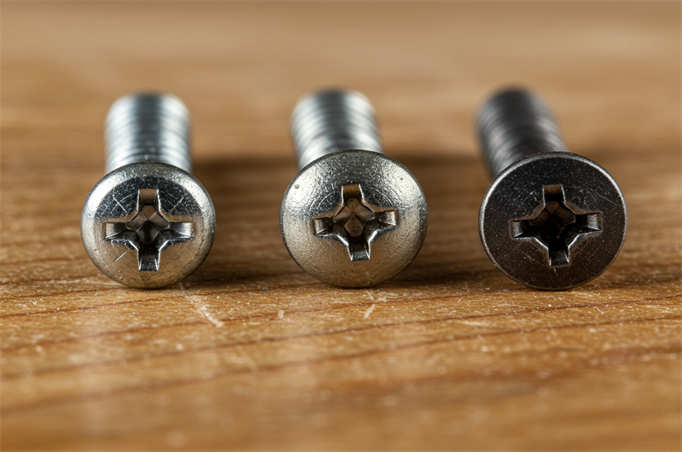
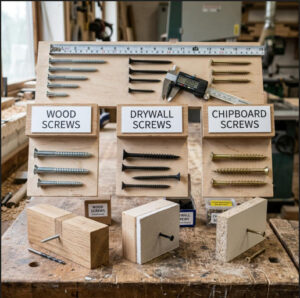
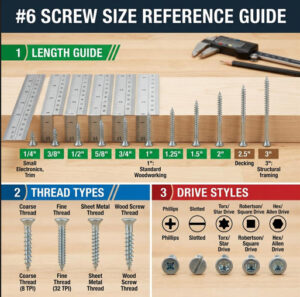
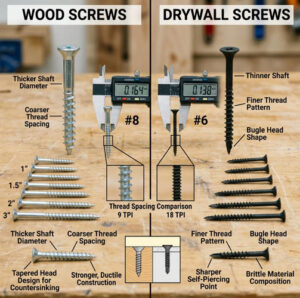
Home screws divide into five core categories, each engineered for a specific substrate and function. Шурупы по дереву feature coarse threads, a smooth shank below the head, and a tapered point — the coarse thread bites aggressively into softwood and hardwood, while the smooth shank allows the top piece to pull tight against the bottom piece without the thread jacking them apart. Шурупы для гипсокартона have a bugle head (a concave taper that seats flush without tearing the paper face), fine or coarse thread depending on whether the stud is steel or wood, and a phosphate coating that resists moisture during the mudding/taping phase. Палубные винты combine coarse threads with an exterior-rated coating — typically ceramic, ACQ-compatible polymer, or stainless steel — to survive ground-contact moisture and the copper-based preservatives in pressure-treated lumber. Шурупы для ДСП (also called particleboard screws) have a single full-length thread optimised for the low-density fibre structure of MDF, particleboard, and melamine — Prince Fastener’s chipboard screw range is one of the most specified in furniture manufacturing across Southeast Asia and Europe. Винты по бетону (Tapcon-style) cut threads directly into masonry or concrete with hardened hi-lo threads and require a pre-drilled pilot hole.
Applications in Homes
The table below maps common household projects to the correct screw type, size, and material — a decision matrix that prevents the two most common DIY mistakes: using drywall screws for structural connections (they are brittle, hardened to Rockwell C55–60, and snap under shear loads) and using interior-grade screws outdoors (standard zinc-plated carbon steel corrodes in as little as 6 months on an exposed deck).
| Home Project | Тип винта | Recommended Size | Material / Coating | Why This Screw |
|---|---|---|---|---|
| Hanging drywall on wood studs | Drywall screw (coarse thread) | #6 × 1-1/4″ | Carbon steel, phosphate | Bugle head seats flush; coarse thread grips wood grain |
| Hanging drywall on steel studs | Drywall screw (fine thread) | #6 × 1″ | Carbon steel, phosphate | Fine thread prevents stripping in thin-gauge steel |
| Building a deck (joist-to-board) | Deck screw (star/Torx drive) | #9 × 3″ | Stainless 305 or ceramic-coated | ACQ-compatible; resists pull-out in wet lumber |
| Assembling flat-pack furniture | Chipboard screw / confirmat | 7 × 50 mm | Zinc-plated carbon steel | Full thread maximises grip in low-density panels |
| Mounting a TV bracket to concrete | Concrete screw (Tapcon) | 3/16″ × 2-3/4″ | Carbon steel, blue Climaseal | Hi-lo thread self-taps into masonry; high shear |
| Cabinet hinge installation | Wood screw (flat head) | #8 × 1-1/4″ | Zinc-plated or brass | Countersinks flush; smooth shank prevents panel split |
Источник: The Home Depot Screws Buying Guide, Lowe’s, Prince Fastener Drywall Screw Selection Guide.
Выбор правильного винта
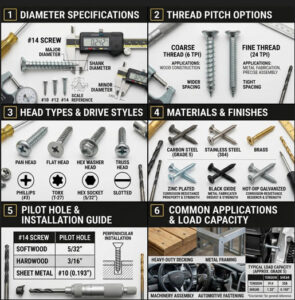
The selection process for home screws follows a four-step logic: (1) identify the substrate (wood, metal stud, concrete, MDF), (2) determine the environment (interior, exterior, ground-contact), (3) calculate the required penetration depth (at least 1″ into the receiving piece for wood; manufacturer’s embedment spec for concrete), and (4) match the coating to the chemical environment (standard zinc for interior; ACQ-compatible or stainless for pressure-treated lumber; stainless 316 for coastal). Prince Fastener’s wood screw selection guide walks through this logic with specific product recommendations.
For a visual overview of how to identify and select screws for home projects, watch this video:
Video: How to Decode Screws | Ask This Old House (This Old House)
Building Screws
Structural vs. Non-Structural
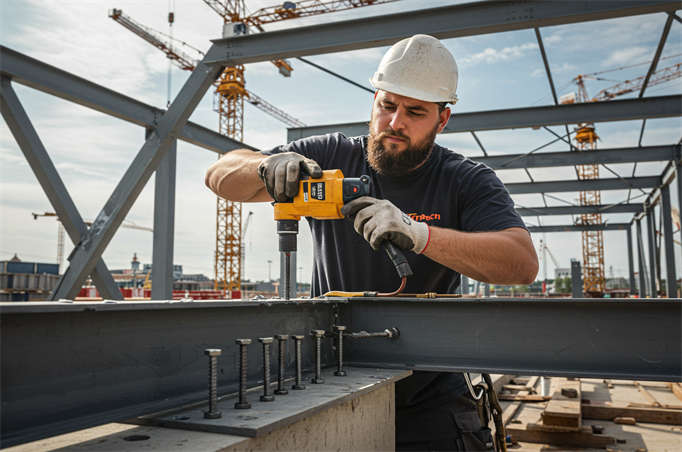
This is the most consequential distinction in construction fastening. Конструкционные винты are engineered, code-approved fasteners tested for load-bearing applications — they carry published shear, tensile, and withdrawal values recognised by the International Building Code (IBC) and the International Residential Code (IRC). GRK’s RSS Rugged Structural Screw, FastenMaster’s HeadLok, and Simpson Strong-Tie’s SDWS series are examples. These screws are manufactured from heat-treated, high-carbon steel with tensile strengths exceeding 150,000 psi, and they undergo ICC-ES evaluation testing (ESR reports) that building inspectors accept as proof of code compliance.
Non-structural screws — standard construction screws, general-purpose wood screws, and drywall screws — have no published load ratings and are not code-approved for connections that resist structural loads. A renovation contractor in Minneapolis documented the difference in stark terms: a deck ledger board attached with non-structural lag screws pulled away from the house band joist after 11 years of freeze-thaw cycling, requiring USD 14,000 in repair. The same connection made with code-approved structural screws would have had a published withdrawal value of 500+ lbs per screw and a 50-year design life. As Grip-Rite’s structural screw guide explains, the visual similarity between a structural screw and a standard construction screw masks fundamental engineering differences in metallurgy, thread geometry, and quality-assurance testing.
Совместимость материалов
Material compatibility in building screws has two dimensions: mechanical compatibility (the screw material must match or exceed the strength of the connection) and electrochemical compatibility (the screw metal must not create a galvanic cell with the substrate metal). Fastenal’s corrosion guide documents that when a stainless steel screw is driven into an untreated aluminium panel without isolation, the aluminium corrodes at up to 10× its normal rate due to the galvanic potential difference (approximately 0.50 V between 316 stainless and 6061 aluminium).
The practical rule: keep all metals in a connection within 0.25 V of each other on the galvanic series, or physically isolate them with nylon washers, EPDM gaskets, or paint barriers. In ACQ pressure-treated lumber, the copper preservative creates a corrosive environment that attacks standard zinc-plated screws — only hot-dip galvanized (G185), stainless steel (304 or 316), or ACQ-rated polymer-coated screws should be used.
Safety Considerations
Building codes are explicit about screw use in structural connections. The IBC Section 2304.10 and IRC Section R602 require that fasteners used in permanent structural connections be approved for the specific load path — which in practice means using screws with an ICC-ES ESR report. Using uncertified screws in a structural connection is a code violation that can result in failed inspections, forced rework, and liability exposure. Additionally, screws used in fire-rated assemblies (Type X drywall, fire-rated sheathing) must meet the specific fastener schedules in the tested assembly — substituting a different screw type or spacing voids the fire rating. Prince Fastener’s drywall screw specifications are engineered to meet the fastener schedules of common UL-listed fire-rated assemblies.
Screws Industries Comparison
Основные характеристики
The comparison table below consolidates the critical differences across all three industries into a single reference. The divergence in requirements — from tensile strength to corrosion protection to regulatory framework — illustrates why a “universal screw” does not exist, and why each industry has evolved its own fastener ecosystem.
| Атрибут | Автомобильный | Home / Residential | Building / Construction |
|---|---|---|---|
| Primary screw types | Self-tapping, machine, sheet metal, Torx, flow-drill | Wood, drywall, deck, chipboard, concrete | Structural, lag, self-drilling, TEK, concrete |
| Dominant material | Alloy steel, boron steel, stainless | Carbon steel, stainless steel | High-carbon heat-treated steel, stainless |
| Typical tensile strength | 800–1,240 MPa (Grade 8.8–12.9) | 350–600 MPa (Grade 4.8–5.8) | 1,000–1,200 MPa (structural screws) |
| Coating requirement | Zinc-flake, Dacromet, phosphate | Zinc plate, ceramic, ACQ polymer | Hot-dip galvanized, Dacromet, stainless |
| Installation method | Robotic torque gun, CNC assembly | Cordless drill/driver, hand tool | Impact driver, pneumatic tool, hand wrench |
| Regulatory framework | SAE J429, ISO 898, OEM spec | No formal code for most DIY; IRC for structural | IBC, IRC, ICC-ES ESR, ASTM standards |
| Failure consequence | Vehicle recall, warranty claim, safety risk | Cosmetic damage, deck collapse (structural) | Structural collapse, code violation, liability |
| Avg. fasteners per unit | 3,000–30,000 per vehicle | 25,000–35,000 per house | 500,000+ per commercial building |
| Corrosion test standard | ASTM B117 (96–720 h salt spray) | ASTM B117 (varies by coating) | ASTM B117, ASTM G85 (SO₂ salt spray) |
Source: SAE International, IBC/IRC, Принц Застежка, MarketsandMarkets, Grip-Rite, FastenMaster.
Material & Durability
Material choice determines durability in every industry, but the environmental stressors differ dramatically. Automotive screws endure engine-bay temperatures up to 150 °C, road-salt splash, and engine-frequency vibration (50–200 Hz). Home screws face moisture from rain, ground contact, and wood-preservative chemistry. Building screws confront structural loads that persist for decades, plus environmental exposure if the connection is exterior.
The bar chart below compares tensile strength across the most common screw grades used in each industry.
Tensile Strength by Screw Grade Across Industries (MPa)
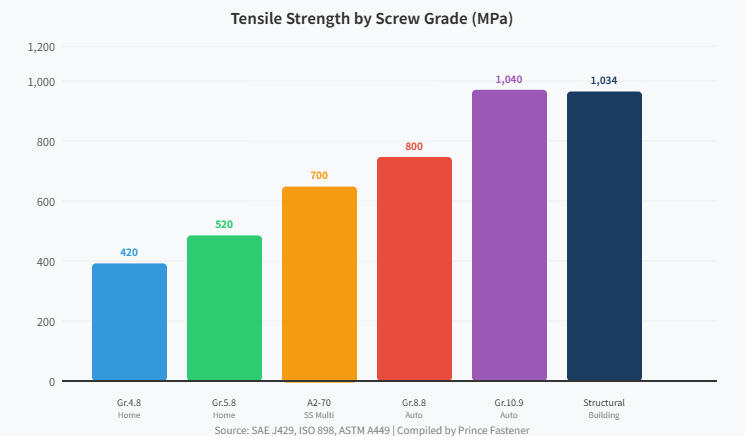
Home screws (Grade 4.8–5.8) occupy the 420–520 MPa range — sufficient for wood-to-wood joints that are not load-bearing. Automotive and structural building screws converge around 1,000+ MPa because both industries demand resistance to dynamic or high-magnitude loads, but the engineering approaches differ: automotive uses alloy steel with high-temperature tempering, while building structural screws use high-carbon steel with aggressive thread geometry to maximise withdrawal resistance in wood.
Selection Guidelines
The selection decision can be distilled to a three-question framework: (1) What am I fastening to what? (substrate materials determine thread type and potential galvanic issues), (2) What loads must the screw resist? (static vs. dynamic, tensile vs. shear, and for how many years), and (3) What is the environment? (interior, exterior, submerged, chemical exposure, temperature range). If the answer to question 2 is “structural load,” the screw must be code-approved with published values and an ICC-ES ESR report. If the answer to question 3 is “exterior” or “corrosive,” the coating and base material must be matched to the corrosion mechanism.
Global Fastener Market Share by Industry — Pie Chart
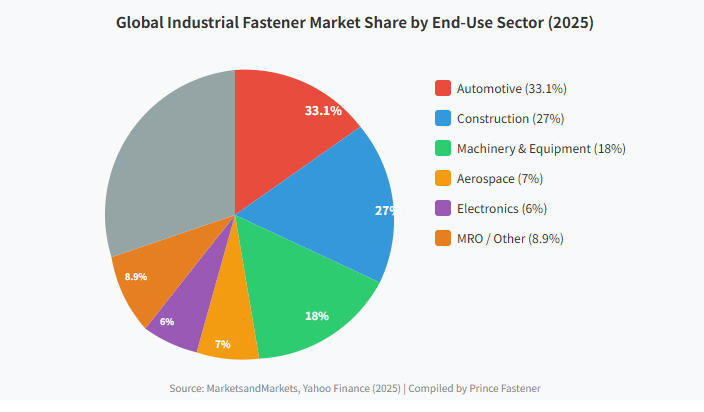
Source: MarketsandMarkets, Yahoo Finance (2025) | Compiled by Prince Fastener
Automotive and construction together consume 60.1% of all industrial fasteners produced globally. This concentration explains why screw engineering resources — including material development, coating technology, and testing standards — are disproportionately advanced in these two sectors. Home/residential fasteners borrow heavily from construction technology (structural screws, ACQ-compatible coatings) but at lower price points and without the same regulatory oversight.
Matching the Right Screw to the Right Industry
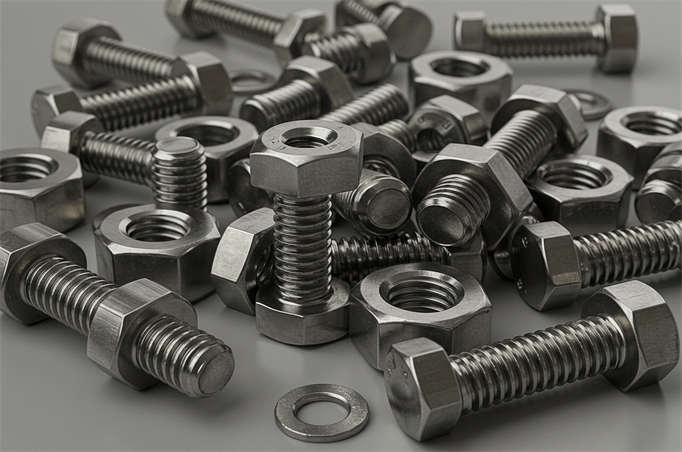
The differences between screws for cars, homes, and buildings are not cosmetic — they are metallurgical, geometric, and regulatory. An automotive Grade 10.9 self-tapping screw is engineered to withstand 15 years of engine-bay vibration at 150 °C without loosening. A deck screw must survive 25+ years of rain, UV, and copper-based wood preservative without corroding. A structural building screw must carry a published shear load of 1,000+ lbs per connection and satisfy a building inspector who will check the ICC-ES report number.
The actionable framework for every screw decision is: identify the substrate, quantify the load, assess the environment, and match the coating and material grade to those three factors. When the application is structural — in any industry — use only code-approved or OEM-specified fasteners with documented mechanical properties.
Принц Застежка manufactures саморезы, винты для гипсокартона, шурупы для ДСП, крепежные винты, и custom-engineered fasteners for all three industries, with 30 years of production experience and export to markets across Asia, Europe, the Middle East, and the Americas. Every product ships with material certifications and dimensional inspection reports.
Frequently Asked Questions (FAQ)
1. What types of screws are used in cars?
Cars use self-tapping screws (interior trim, plastic housings), machine screws (engine, transmission), sheet metal screws (underbody panels), hex flange bolts (suspension, chassis), socket head cap screws (precision engine assemblies), and thread-forming screws (thermoplastic components). A single vehicle contains 3,000 to 30,000 fasteners depending on the platform. Prince Fastener’s self-tapping screw range serves automotive tier-1 suppliers globally.
2. Can I use drywall screws for structural connections like deck ledger boards?
No. Drywall screws are case-hardened to Rockwell C55–60, making them extremely brittle under shear loads. They have no published load ratings and are not code-approved for structural use. For deck ledger boards, use structural screws (e.g., FastenMaster HeadLok, GRK RSS, or Simpson SDWS) that carry ICC-ES evaluation reports with published withdrawal and shear values.
3. What is the difference between structural screws and regular construction screws?
Structural screws are engineered from heat-treated high-carbon steel with tensile strengths exceeding 150,000 psi (1,034 MPa), carry ICC-ES ESR reports with published load values, and are code-approved for load-bearing connections. Regular construction screws are general-purpose fasteners without published load ratings, manufactured from lower-grade carbon steel, and suitable only for non-structural applications such as sheathing, sub-floor, and temporary bracing.
4. Which screws should I use for a pressure-treated wood deck?
Use deck screws that are explicitly rated as “ACQ-compatible.” The copper in ACQ/CA-B/CA-C pressure-treated lumber corrodes standard zinc-plated carbon steel within 6–12 months. Acceptable options include stainless steel 305 or 316, hot-dip galvanized (G185 coating weight), or polymer-coated deck screws certified for treated lumber. Prince Fastener’s wood screw guide provides specific coating recommendations.
5. Why do automotive screws require salt-spray testing?
Vehicles operate in corrosive environments: road salt, mud, humidity, and chemical splash from coolant, brake fluid, and fuel. ASTM B117 salt-spray testing simulates accelerated corrosion to verify that the screw’s coating (zinc plate, zinc-flake, Dacromet) will protect the base steel for the vehicle’s design life — typically 10–15 years or 150,000+ miles. Zinc-flake coatings must survive 720+ hours; standard zinc plate is rated for 96 hours.
6. What causes galvanic corrosion in screw connections, and how do I prevent it?
Galvanic corrosion occurs when two dissimilar metals are in contact in the presence of an electrolyte (moisture). The metal lower on the galvanic series (more anodic) corrodes at an accelerated rate. Prevention methods include using screws made from the same metal as the substrate, maintaining a galvanic potential difference below 0.25 V, and isolating dissimilar metals with nylon washers, EPDM gaskets, or paint barriers. Fastenal’s corrosion guide includes a full compatibility chart.
7. How many screws does an average house require?
A standard three-bedroom, single-storey house typically requires 25,000 to 35,000 screws, including approximately 10,000–15,000 drywall screws, 3,000–5,000 framing/structural screws, 2,000–4,000 deck screws (if a deck is included), and several thousand additional screws for cabinets, trim, hardware, and MEP. The count increases substantially for two-storey homes and those with complex rooflines.
8. What screw grade is most common in automotive manufacturing?
Grade 8.8 and Grade 10.9 (ISO 898 metric) are the two most common bolt/screw grades in automotive manufacturing. Grade 8.8 (800 MPa tensile) is used in body structure and general mechanical connections. Grade 10.9 (1,040 MPa tensile) is used in chassis, suspension, engine, and safety-critical connections. EV battery packs increasingly use Grade 10.9 with anti-vibration thread-locking features.
9. Can I use a home wood screw in a metal stud application?
No. Wood screws have coarse threads designed to grip wood fibres. For metal studs (typically 25-gauge to 20-gauge steel), use fine-thread drywall screws or self-drilling metal screws with a drill-point tip that penetrates steel without a pilot hole. Using a wood screw on a metal stud will strip the thread and fail to achieve clamp load. Prince Fastener’s drywall screw selection guide specifies the correct thread type for each stud material.
10. Where can I buy screws for all three industries — automotive, home, and construction?
Принц Застежка is a global manufacturer supplying self-tapping screws, machine screws, drywall screws, chipboard screws, construction screws, and custom-engineered fasteners across automotive, residential, and commercial building sectors. With over 30 years of production experience, they provide OEM/ODM services, full material certifications, and export to Asia, Europe, the Americas, and the Middle East. Visit their product catalogue for specifications and ordering.


 Русский
  English
  Español
  Português do Brasil
  日本語
日本語  العربية