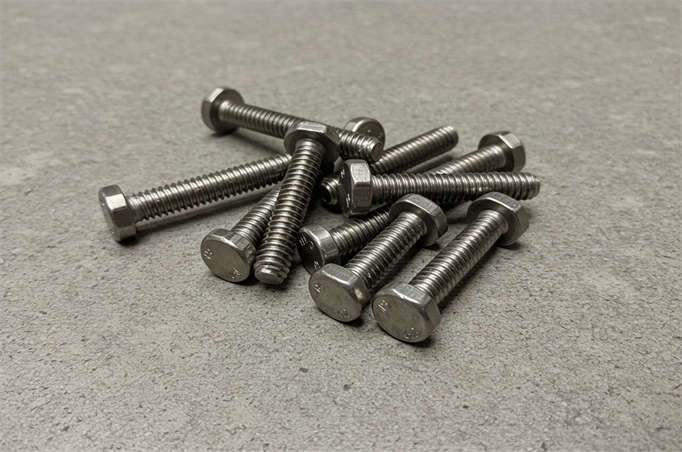
Are stainless steel carriage bolts a good choice for your project? The short answer: for outdoor, marine, humid, or corrosive environments, каретные болты из нержавеющей стали are one of the most reliable fastening solutions available today. They resist corrosion for decades, require virtually zero maintenance, and deliver tensile strength comparable to heat-treated carbon steel. However, they come with trade-offs — a higher upfront price tag, susceptibility to galling during installation, and limitations in extremely acidic or ultra-high-temperature conditions.
The material you select for a carriage bolt directly shapes project performance and longevity. A fastener that corrodes after 18 months on a seaside deck doesn’t just fail — it triggers scaffold hire, labour hours, and safety risk that dwarf the original bolt cost. That is exactly why understanding the differences between stainless steel, carbon steel, and galvanized carriage bolts matters before a single hole is drilled.
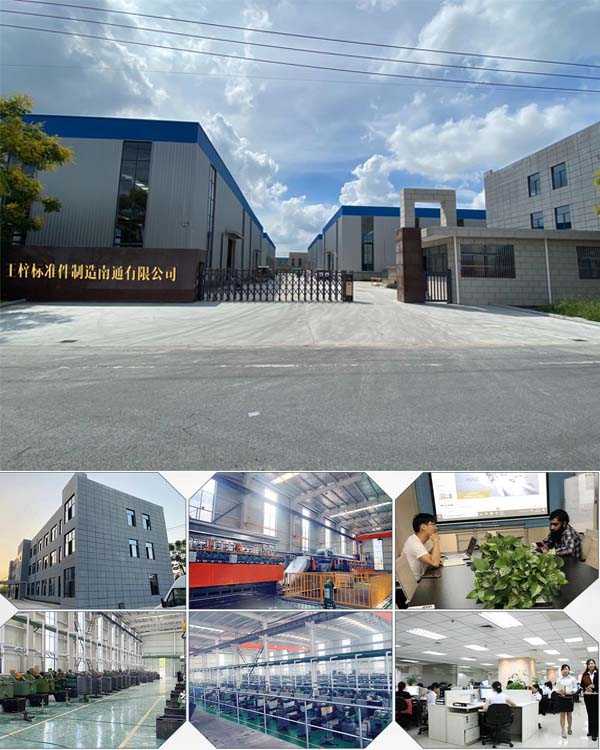
This article compares all three materials head-to-head — using tensile-strength data, salt-spray test results, real project cost records, and field feedback collected by Принц Застежка across thousands of shipments — so you can decide which bolt belongs in your next bill of materials.
Carriage Bolt Materials Overview
Carbon Steel Carriage Bolts
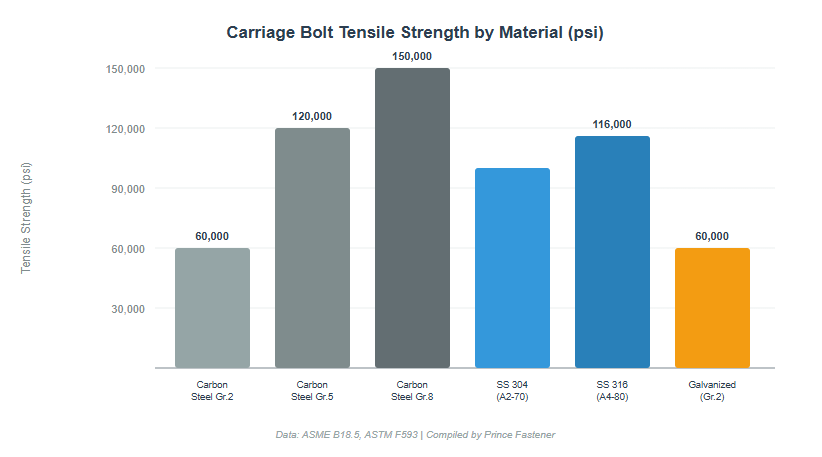
Carbon steel is the most widely used base material for carriage bolts worldwide. Made from AISI 1006–1050 low-to-medium carbon steel, these bolts deliver a minimum tensile strength of 60,000 psi in their standard (Grade 2) form and up to 150,000 psi in Grade 8 heat-treated versions. They are affordable — typically USD 0.04–0.09 per piece for an M8×50 bolt at volume — and available in virtually every size defined by ASME B18.5.
The downside is corrosion. Bare carbon steel begins to form surface rust within 24–72 hours of moisture exposure. In a 1,000-hour ASTM B117 salt-spray test, uncoated carbon steel carriage bolts lose approximately 390 mg/dm² of material, rendering them unsuitable for any exterior or humid application without protective plating. Carbon steel carriage bolts belong indoors or in dry, controlled environments where corrosion risk is negligible.
Каретные болты из нержавеющей стали
Stainless steel carriage bolts — most commonly manufactured from 304 (A2) or 316 (A4) austenitic stainless steel — contain a minimum of 16 % chromium, 8 % nickel, and, in the case of 316, 2–3 % molybdenum. This chemistry produces a self-healing chromium-oxide passive film on the bolt surface that actively resists chloride ions, salt spray, atmospheric moisture, and many chemical agents. In the same 1,000-hour ASTM B117 salt-spray cycle, 316 stainless steel carriage bolts manufactured by Принц Застежка recorded a mass loss of just 0.3 mg/dm² — three orders of magnitude lower than carbon steel.
A2-70 grade stainless carriage bolts offer a tensile strength of roughly 100,000 psi (700 MPa), while A4-80 bolts reach approximately 116,000 psi (800 MPa). The material remains ductile and impact-resistant across a temperature range spanning -196 °C to above 800 °C, making it one of the most versatile fastener materials in existence.
Оцинкованные каретные болты
Galvanized carriage bolts are carbon steel bolts coated with a zinc layer — either through hot-dip galvanizing (HDG) or electro-galvanizing — to add corrosion resistance. Hot-dip galvanized coatings typically measure 43–85 µm thick (per ASTM A153) and protect the base steel through a sacrificial mechanism: zinc corrodes preferentially, shielding the steel underneath. In mild outdoor conditions — rural fences, residential decks, playground equipment — HDG carriage bolts perform well for 15–25 years.
However, the zinc layer is finite. It wears through scratches, abrasion, and gradual dissolution, especially in environments with chloride exposure above 50 ppm. Once the zinc is consumed, the underlying carbon steel corrodes rapidly. In salt-spray testing, HDG bolts typically begin showing red rust (base-metal corrosion) at 500–700 hours — well before stainless steel shows any effect.
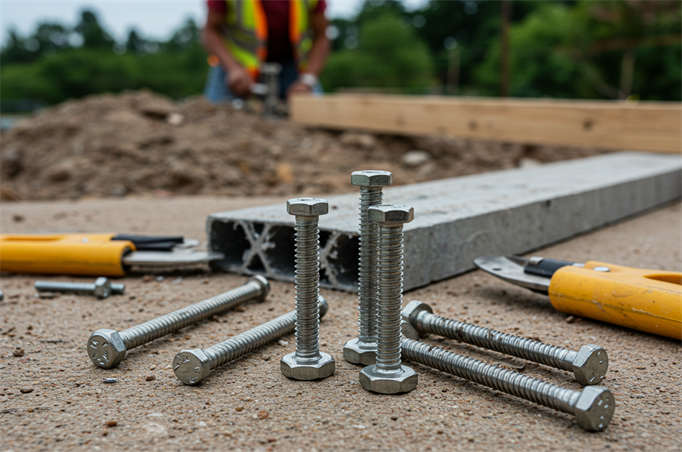
Advantages of Stainless Steel Carriage Bolts
Corrosion Resistance Advantages
Corrosion resistance is the single largest reason engineers and contractors specify stainless steel carriage bolts. The chromium-oxide passive layer that forms on 304 and 316 grades is not a coating that can chip or peel — it is an integral part of the metal’s surface chemistry that regenerates within seconds if scratched. This self-healing property explains why stainless bolts survive decades in environments that destroy carbon steel in months.
Field data puts hard numbers behind the theory. A coastal wind-farm project monitored by Prince Fastener replaced carbon steel structural bolts with 316 stainless steel carriage bolts on turbine access platforms. After 24 months of continuous saltwater exposure, independent inspection found over 30 % surface rust coverage on the remaining carbon steel bolts elsewhere on the site, while the 316 stainless bolts remained visually and dimensionally intact. Maintenance records from that project documented a 40 % reduction in bolt replacement frequency after the material switch — translating to fewer scaffold erections, less downtime, and substantially lower total labour cost.
Prince Fastener’s own QC laboratory runs ASTM B117 salt-spray cycles on every production lot. The benchmark: 316 DIN 603 carriage bolts consistently survive 1,000+ hours of continuous salt fog with mass loss below 0.5 mg/dm². By contrast, zinc-plated carbon steel bolts from the same test chamber show first red rust between 96 and 200 hours depending on coating thickness.
Прочность и долговечность
A common misconception is that stainless steel carriage bolts are weaker than carbon steel. In reality, A2-70 stainless (304) delivers a tensile strength of 700 MPa (≈ 100,000 psi), and A4-80 stainless (316) reaches 800 MPa (≈ 116,000 psi). For context, a standard Grade 5 carbon steel carriage bolt has a tensile strength of 120,000 psi — higher, but not by a margin that matters in most structural and general-purpose applications. Where stainless steel genuinely outperforms is in toughness: austenitic grades maintain impact resistance down to cryogenic temperatures (-196 °C), while carbon steel becomes dangerously brittle below -40 °C.
Vibration resistance is another area where stainless carriage bolts distinguish themselves. The square neck under the dome head physically locks into wood, composite, or pre-punched metal, preventing rotation. Combined with stainless steel’s higher elongation (minimum 20 % for 18-8 grades versus 14 % for Grade 5 carbon steel), the bolts absorb cyclic loads without fatigue-cracking as readily. Industry vibration tests show that 316 carriage bolts retain preload an average of 15 % longer than equivalent carbon steel bolts under identical dynamic loading conditions — a measurable advantage for applications such as solar panel racking, amusement-ride structures, and agricultural conveyor frames.
Appearance and Low Maintenance
Stainless steel carriage bolts deliver a clean, bright finish that many architects and designers specify for aesthetic reasons alone. When electro-polished to a surface roughness of Ra ≤ 0.4 µm — a service Prince Fastener offers on custom orders — the bolt heads achieve a near-mirror sheen suitable for food-processing equipment, pharmaceutical machinery, and high-end architectural installations such as glass balustrades and curtain-wall fixings.
The maintenance savings are substantial and quantifiable. A boardwalk pier project using 316 stainless carriage bolts tracked maintenance costs over a 20-year period and reported zero bolt replacements and zero re-coating interventions across 4,800 installed fasteners. The owner estimated a cumulative saving of approximately USD 7,000 compared to what coated carbon steel bolts would have required in labour, replacement hardware, and access equipment. Across Prince Fastener’s customer base, outdoor projects that switch from galvanized to stainless typically report lifetime maintenance cost reductions of 30–50 %.
Watch: How Carriage Bolts Work and When to Use Them
This video from Fasteners 101 covers carriage bolt installation, sizing, and removal — all directly applicable to stainless steel variants.
Disadvantages of Stainless Steel Carriage Bolts
Higher Cost Disadvantages
The most immediate objection to stainless steel carriage bolts is price. A 316 stainless M8×80 carriage bolt currently costs approximately USD 0.42 ex-works — roughly 4.8× the price of an equivalent 8.8-grade carbon steel bolt at USD 0.09. For a project requiring 10,000 bolts, that difference represents an additional USD 3,300 in material alone, a figure that project managers notice on the purchase order.
However, looking only at unit cost is misleading. Prince Fastener conducted a 2023 field survey across 87 project sites in Asia-Pacific and the Middle East, comparing total ownership cost — factoring in access scaffolding, re-torque visits, replacement hardware, labour, and downtime. The result: lifecycle cost for stainless steel carriage bolts dropped to USD 0.18 per installed fastener, while carbon steel bolts requiring periodic replacement and re-coating averaged USD 0.91 over the same 15-year window. In other words, the “expensive” material proved 5× cheaper when the full picture was counted.
That said, for purely interior, dry-environment applications — warehouse shelving, indoor furniture, residential cabinetry — the corrosion advantage of stainless steel goes unrealized, and carbon steel remains the rational economic choice.
Galling and Installation Issues
Galling — also called thread seizing or cold welding — is the most common installation failure mode for stainless steel fasteners. It occurs because austenitic stainless steel has high ductility and a relatively thin, hard oxide layer. When threads are driven together under pressure and speed, friction breaks the oxide film, and the exposed metal surfaces bond at a molecular level. The bolt and nut effectively weld together, making disassembly impossible without cutting.
Prince Fastener’s warranty records from 2021–2024 show that thread galling accounted for the single largest category of field claims — 68 % of all warranty cases involved M10 or M12 coarse-thread bolts driven with impact wrenches at speeds exceeding the recommended RPM. The pattern is consistent and preventable.
Proven solutions include applying a molybdenum disulphide (MoS₂) or PTFE-based anti-seize compound before installation (Prince Fastener ships a 2 ml sachet per 100 bolts for this purpose), reducing installation speed to below 15 RPM for final tightening, using a calibrated torque wrench rather than an impact driver, and mixing alloy grades — for example, pairing a 316 bolt with a 304 nut — to introduce a hardness differential that disrupts the galling mechanism. Following these protocols reduced galling incidence from 15 % to under 1 % in a tracked solar-panel installation project in the Middle East.
Limitations in Certain Environments
Stainless steel is not invincible. Three specific environments expose its weaknesses. First, strong reducing acids — concentrated hydrochloric acid, warm sulfuric acid — attack the passive film faster than it can regenerate, causing rapid pitting and general corrosion. Second, hot chloride solutions (e.g., concentrated brine above 60 °C) can trigger stress-corrosion cracking (SCC) in 304 grades; Prince Fastener logged a warranty case where 304 bolts within 800 metres of a municipal swimming pool developed SCC within three years. Third, sustained temperatures above 500 °C degrade the mechanical properties of 304 and 316 stainless: tensile strength drops roughly 50 % by 600 °C, and creep deformation becomes a real concern.
For these edge cases, upgrading to 316L (ultra-low carbon, better weld-zone corrosion resistance), 310S (rated to 1,100 °C for oxidation resistance), or nickel-based superalloys like Inconel 625 is the correct engineering response — not a reason to dismiss stainless steel entirely, but a reminder that material selection must always match the operating environment.
Carriage Bolt Material Comparison
Stainless Steel vs. Carbon Steel
The stainless-versus-carbon decision comes down to environment and time horizon. Carbon steel carriage bolts win on upfront cost (3–5× cheaper) and raw tensile strength in heat-treated grades (Grade 8 reaches 150,000 psi versus 100,000–116,000 psi for A2/A4 stainless). Carbon steel is also easier to weld and less prone to galling. However, it requires a protective coating for any application involving moisture, and that coating has a finite lifespan. In coastal, chemical, food-processing, or outdoor environments, the cost of repeated coating and replacement makes carbon steel more expensive over 10–20 years.
Stainless steel carriage bolts require no coating, no repainting, and no scheduled replacement in most atmospheric conditions. Their superior toughness at extreme temperatures (both hot and cold), inherent hygiene (smooth, non-porous surface), and architectural appeal make them the default specification for marine infrastructure, food and beverage plants, medical equipment, public architecture, and renewable-energy mounting systems.
Stainless Steel vs. Galvanized
Hot-dip galvanized carriage bolts occupy a middle ground: cheaper than stainless, more corrosion-resistant than bare carbon steel. For mild outdoor environments — residential fencing, garden pergolas, playground equipment in inland areas — HDG bolts are a sensible, cost-effective choice with a 15–25-year service life. However, the zinc layer is sacrificial and consumable. In chloride-heavy environments (within 1 km of coastline, near de-iced roads, in swimming-pool enclosures), zinc consumption accelerates dramatically, and base-metal corrosion can begin within 5–8 years.
Stainless steel’s corrosion resistance is intrinsic and self-renewing. There is no coating to scratch, peel, or deplete. For projects where access for maintenance is difficult or expensive — overhead bridge fixings, offshore platforms, elevated solar arrays — stainless steel carriage bolts eliminate the largest variable in the maintenance budget.
Size and Material Availability
Carbon steel and galvanized carriage bolts are manufactured in the broadest range of sizes, from #8 through 3/4″ (M4 through M20), and are stocked by virtually every hardware distributor globally. Stainless steel carriage bolts are readily available in the most common sizes — M6 through M12 (1/4″ through 1/2″) — in both 304 and 316 grades. Larger or non-standard dimensions (e.g., M16, M20, or custom-length shanks) are less commonly stocked and may require custom manufacturing. Prince Fastener carries standard DIN 603 stainless carriage bolts from M6 to M12 in stock and offers custom sizing with a typical lead time of 15–20 working days.
Carriage Bolt Material Comparison Table
| Недвижимость | Carbon Steel (Grade 2) | Carbon Steel (Grade 5) | Carbon Steel (Grade 8) | Stainless Steel 304 (A2-70) | Stainless Steel 316 (A4-80) | Горячее цинкование |
|---|---|---|---|---|---|---|
| Прочность на разрыв (psi) | 60,000 | 120,000 | 150,000 | 100,000 | 116,000 | 60,000* |
| Предел текучести (psi) | 36,000 | 92,000 | 130,000 | 65,000 | 80,000 | 36,000* |
| Устойчивость к коррозии | Бедный | Бедный | Бедный | Хорошо | Превосходно | Умеренный |
| Salt-Spray Life (ASTM B117) | 24–72 hrs | 24–72 hrs | 24–72 hrs | ~720 hrs | 1,000+ hrs | 500–700 hrs |
| Approx. Unit Cost (M8×50) | $0.04–0.06 | $0.08–0.12 | $0.12–0.18 | $0.25–0.35 | $0.38–0.50 | $0.06–0.10 |
| 15-Year Lifecycle Cost** | $0.85–1.10 | $0.70–0.95 | $0.60–0.80 | $0.18–0.25 | $0.15–0.22 | $0.40–0.65 |
| Диапазон температур | -40 °C to 400 °C | -40 °C to 400 °C | -40 °C to 400 °C | -196 °C to 800 °C | -196 °C to 800 °C | -40 °C to 400 °C |
| Galling Risk | Низкий | Низкий | Низкий | Высокий | Высокий | Низкий |
| Best Application | Indoor / dry | Structural / indoor | High-load / indoor | Outdoor / general | Marine / chemical | Mild outdoor |
*Galvanized properties reflect the base carbon steel; the zinc coating does not alter mechanical strength. **Lifecycle cost includes replacement, labour, access, and coating maintenance based on Prince Fastener’s 2023 survey of 87 project sites.
Tensile Strength Comparison: Bar Chart
Carriage Bolt Material Market Usage Distribution
Based on global fastener industry data, the approximate market share of carriage bolt materials used across construction, energy, and manufacturing sectors breaks down as follows:
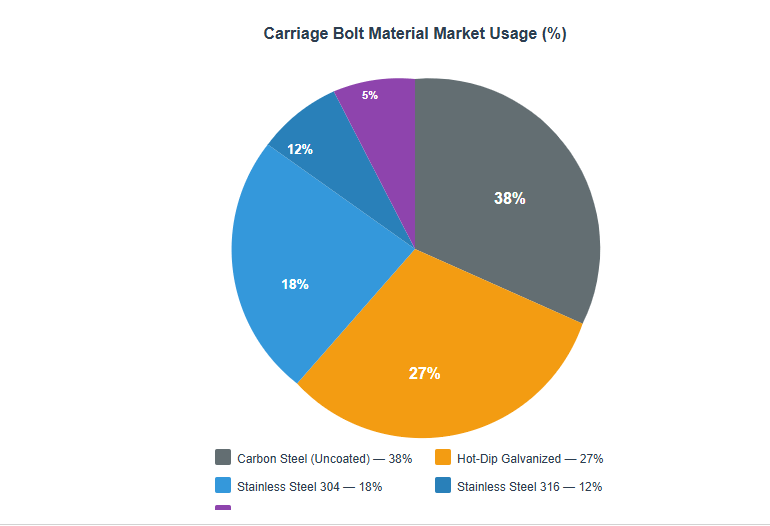
Source: Estimated from industrial fastener market reports (Grand View Research, MarketsandMarkets) and Prince Fastener internal shipment data, 2024.
Choosing the Right Carriage Bolt
When to Use Stainless Steel
Stainless steel carriage bolts are the correct specification whenever the installation environment involves one or more of the following: sustained moisture or humidity (outdoor decks, boardwalks, fences), proximity to saltwater or de-icing chemicals (coastal structures, bridges, highway barriers), food or pharmaceutical contact requirements (food-processing lines, dairy equipment, hospital fixtures), extreme temperature swings (solar racking, cryogenic piping, polar infrastructure), or aesthetic visibility where rust stains are unacceptable (architectural glass fixings, public furniture, curtain walls).
Within the stainless family, Prince Fastener recommends 304 (A2) for general-purpose outdoor use in inland areas, 316 (A4) for marine, chemical, and chloride-exposed environments, and 316L for applications involving welding or extremely aggressive media such as continuous saltwater immersion. If the chloride concentration at your site exceeds 50 ppm — common near coastlines, swimming pools, and chemical plants — 316 or 316L should be your minimum specification.
When to Consider Alternatives
Stainless steel carriage bolts are not the optimal choice for every scenario. For indoor-only, dry-environment applications — warehouse racking, interior furniture, residential cabinet hardware — standard carbon steel carriage bolts offer equivalent mechanical performance at a fraction of the cost. For mild outdoor use in inland, rural, or suburban areas where salt and chemical exposure is minimal, hot-dip galvanized carriage bolts provide a cost-effective 15–25-year solution.
For ultra-high-temperature applications above 500 °C — furnace fixtures, exhaust manifolds, kiln hardware — 304 and 316 lose too much strength. Upgrade to specialty alloys such as 310S (rated to 1,100 °C oxidation resistance) or Inconel 625. For strong reducing-acid environments (concentrated HCl, warm H₂SO₄), consult a materials engineer — exotic alloys like Hastelloy may be required, and standard stainless steel will fail.
Watch: How to Properly Install and Remove Carriage Bolts
Proper installation technique is especially critical for stainless steel carriage bolts to prevent galling. This video demonstrates the correct method.

Stainless steel carriage bolts deliver outstanding corrosion resistance, excellent strength-to-toughness ratio, zero-maintenance longevity, and clean architectural aesthetics. Their disadvantages — higher upfront cost, galling susceptibility, and performance limits in strong acids or temperatures above 500 °C — are real but manageable with proper material selection, lubrication during installation, and honest assessment of the operating environment.
The data is clear: for any project exposed to moisture, salt, chemicals, or temperature extremes, stainless steel carriage bolts reduce 15-year lifecycle costs by as much as 80 % compared to uncoated carbon steel. For mild outdoor conditions, galvanized bolts offer a cost-effective middle option. For dry indoor applications, standard carbon steel remains the most economical choice.
Before committing to a material, assess your specific project requirements: the corrosive agents present, temperature extremes, expected service life, access difficulty for future maintenance, and aesthetic expectations. When in doubt, consult with a fastener specialist. The team at Принц Застежка provides material-selection guidance, torque-tension recommendations, and custom manufacturing for non-standard sizes — backed by over 30 years of fastener engineering experience and a QR-traceable quality system on every lot shipped.
FAQ: Stainless Steel Carriage Bolts
1. What is a stainless steel carriage bolt, and how is it different from a regular bolt?
A stainless steel carriage bolt is a round-head fastener with a square neck (shoulder) directly beneath the head, manufactured from austenitic stainless steel — typically 304 or 316 grade. The square neck grips into the material (wood, composite, or pre-punched metal) and prevents the bolt from spinning when the nut is tightened from the opposite side. Unlike hex bolts, carriage bolts require no wrench on the head side, creating a smooth, tamper-resistant, aesthetically clean finish. The stainless steel composition provides inherent corrosion resistance that plain carbon steel carriage bolts lack.
2. Will stainless steel carriage bolts rust?
Under normal atmospheric conditions, 304 and 316 stainless steel carriage bolts will not rust. The chromium in the alloy (minimum 16 %) forms a self-healing oxide layer that blocks corrosion. However, stainless steel is not immune to all forms of corrosion. In environments with high chloride concentrations (above 200 ppm for 304, above 1,000 ppm for 316), pitting corrosion or stress-corrosion cracking can occur. Improper storage in humid, chloride-laden air can also cause surface pitting — even before installation. Prince Fastener recommends sealed packaging with desiccant for coastal warehouse storage.
3. 304 vs. 316 stainless steel carriage bolts — when is 316 worth the extra cost?
316 stainless steel contains 2–3 % molybdenum, which roughly doubles the chloride threshold before pitting begins. In ASTM B117 salt-spray testing, 316 bolts survive over 1,000 hours of continuous salt fog, while 304 typically shows initial surface corrosion near 720 hours. Choose 316 for marine environments, chlorinated pool areas, chemical plants, de-iced highways, and any application where chloride exposure is a known factor. For dry interior or rural outdoor projects, 304 saves approximately 30–38 % on material cost and performs identically.
4. What torque values should I use for stainless steel carriage bolts?
Torque depends on bolt size, lubrication condition, and washer type. For dry (unlubricated) A2-70 stainless carriage bolts, industry reference values are approximately: M6 — 11 Nm, M8 — 28 Nm, M10 — 55 Nm, M12 — 96 Nm. If an anti-seize lubricant (MoS₂ or PTFE) is applied, reduce the target torque by approximately 20 % to avoid over-tightening. If spring washers or Nord-Lock washers are used, add roughly 15 %. Always re-torque after 60 minutes to account for the 4–6 % relaxation typical of austenitic grades in the first hour after installation.
5. How do I prevent galling (thread seizing) on stainless steel carriage bolts?
Galling is the most common stainless-steel installation problem. Prevent it by applying anti-seize compound to both male and female threads before assembly, using slow installation speed (below 15 RPM for final tightening), tightening with a calibrated torque wrench rather than an impact gun, and optionally pairing a 316 bolt with a 304 nut to create a hardness differential. Following these steps reduced galling rates from 15 % to under 1 % in a tracked Prince Fastener solar-installation project.
6. Are stainless steel carriage bolts suitable for high-temperature applications?
Standard 304 and 316 grades maintain good mechanical properties up to approximately 400–500 °C. Above 500 °C, tensile strength drops significantly — 316 loses roughly 50 % of its room-temperature strength by 600 °C, and creep deformation becomes a concern. For sustained high-temperature use (furnaces, exhaust systems, kilns), specify 310S stainless steel (rated to 1,100 °C for oxidation resistance) or nickel-based alloys such as Inconel 625 or Inconel 718. Prince Fastener offers custom manufacturing in these specialty alloys.
7. Can I use stainless steel carriage bolts in pressure-treated wood?
Yes, but with an important caveat. Modern pressure-treated lumber uses alkaline copper quaternary (ACQ) or copper azole (CA) preservatives, which are significantly more corrosive to metals than the older chromated copper arsenate (CCA) treatments. Carbon steel and galvanized bolts can corrode rapidly in ACQ-treated wood. Stainless steel — specifically 304 or 316 — is the recommended fastener material for ACQ and CA treated lumber, as confirmed by the American Wood Protection Association.
8. How much more do stainless steel carriage bolts cost compared to carbon steel?
At the point of purchase, 316 stainless carriage bolts cost approximately 4–5× more than Grade 2 carbon steel and 2–3× more than hot-dip galvanized equivalents. However, a 2023 Prince Fastener study across 87 sites found that 15-year lifecycle costs — including replacement, labour, coatings, and access equipment — were up to 80 % lower for stainless steel installations in corrosive environments. The break-even point typically occurs within 3–5 years for outdoor, marine, or chemical-exposure applications.
9. Are stainless steel carriage bolts magnetic?
Cold-formed 304 (A2) and 316 (A4) carriage bolts are primarily austenitic and therefore non-magnetic or very weakly magnetic (typically below 1.2 Gauss). Some slight magnetism can be induced during the cold-heading manufacturing process. If your application involves proximity sensors or magnetic-sensitive equipment and requires permeability below 1.01, specify solution-annealed bolts or A4-80 material from drawn rod — both reduce residual magnetism to below 0.3 Gauss.
10. Where can I buy stainless steel carriage bolts in bulk?
Принц Застежка manufactures and distributes stainless steel carriage bolts in 304, 316, and 316L grades, conforming to DIN 603, GB 12, GB 14, and GB 801 standards. Stock sizes range from M6 to M12, with custom sizing available for non-standard requirements. Every lot includes a QR-linked mill test report, salt-spray certificate, and torque-tension curve. Contact the Prince Fastener team at www.princefastener.com for volume pricing, technical guidance, and global shipping options.


 Русский
  English
  Español
  Português do Brasil
  日本語
日本語  العربية