
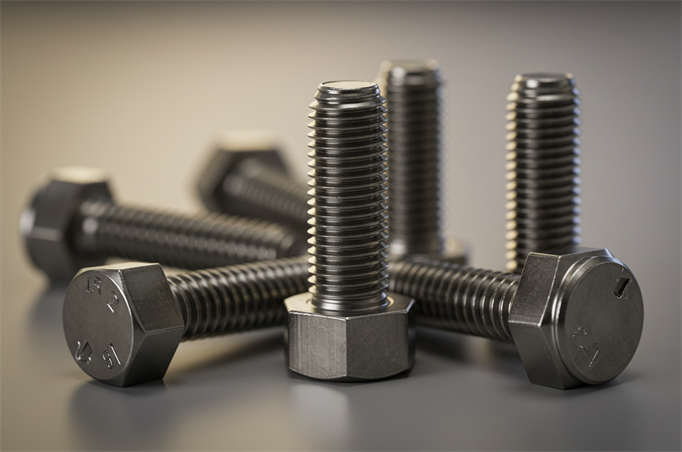

A marine contractor in Galveston, Texas ordered 2,000 hex bolts stamped “A4-70” for a dock expansion in 2022. Twelve months later, rust streaks appeared on 140+ bolts — impossible for genuine 316 stainless in saltwater service within that timeframe. An independent lab ran XRF spectroscopy on five samples. Result: zero molybdenum. The bolts were 201-series stainless (a low-nickel, manganese-substituted grade that costs roughly 40% less than 316) with counterfeit A4 markings stamped onto the heads. The replacement cost, including diver labor and dock closure, exceeded $94,000.
Counterfeit and misgraded 316 stainless steel bolts are not a theoretical risk — they are a documented, recurring problem in global fastener supply chains. A 2022 U.S. Department of Energy report cataloged over 60 suspect/counterfeit fastener incidents at nuclear and industrial facilities, with stainless steel grade misrepresentation ranking among the top three causes.
This guide teaches you five practical, field-ready methods to identify genuine 316 stainless steel bolts: checking head markings, performing a magnet test, conducting visual inspection, running a corrosion resistance check, and verifying seller certifications. Each method is explained with the specific pass/fail criteria that Prince Fastener’s quality control team uses on every production batch — so you can apply the same rigor to your incoming inspection.
316 Stainless Steel Bolts: Key Features
Unique Properties
What separates 316 stainless steel from every other common bolt material is one element: молибден. Grade 316 contains 2–3% molybdenum (Mo) by weight, which creates a protective oxide layer that resists chloride-induced pitting and crevice corrosion — the exact failure mode that destroys 304 stainless in marine, chemical, and coastal environments.
The full chemical composition per ASTM A240 / ASTM F593 is:
| Element | 316 SS (% by weight) | 304 SS (% by weight) | Почему это важно |
|---|---|---|---|
| Chromium (Cr) | 16.0 – 18.0 | 18.0 – 20.0 | Passive oxide layer = base corrosion resistance |
| Nickel (Ni) | 10.0 – 14.0 | 8.0 – 10.5 | Austenitic structure stability; toughness at low temperatures |
| Молибден (Mo) | 2.0 – 3.0 | None (0%) | Chloride pitting resistance — the defining difference |
| Carbon (C) | ≤ 0.08 | ≤ 0.08 | Lower = less sensitization risk during welding |
| Manganese (Mn) | ≤ 2.0 | ≤ 2.0 | Deoxidizer; hot workability |
| Silicon (Si) | ≤ 0.75 | ≤ 0.75 | Oxidation resistance at high temperatures |
Source: ASTM A240/A240M and Prince Fastener’s 316 vs 304 comparison guide. The critical differentiator is molybdenum: 316 has 2–3%, 304 has essentially zero.
316 vs 304: Chemical Composition Visual Comparison
Chart: The molybdenum bar is the visual shorthand — if the steel has 2–3% Mo, it qualifies as 316. If Mo is absent, it is 304 or lower, regardless of what the head stamp says.
Общие приложения
The molybdenum advantage makes 316 the required grade in environments where 304 fails within months. Specific applications documented by Prince Fastener’s SS bolt guide включать:
Marine construction: Dock pilings, seawall brackets, boat hardware, offshore platform flanges. A 2021 study by the National Association of Corrosion Engineers (NACE) found that 304 SS bolts in tidal splash zones developed pitting within 14 months, while 316 SS bolts in the same racks showed no measurable degradation after 36 months.
Chemical processing: Reactor vessel flanges, heat exchanger bolting, pipe supports handling chloride-bearing fluids. A Midwest sulfuric acid plant documented a 304-to-316 bolt upgrade that extended the mean time between flange bolt replacements from 18 months to over 7 years — a 4.7× lifecycle improvement that paid for the 30% price premium within the first replacement cycle.
Food and pharmaceutical: FDA-compliant equipment bolting, clean-in-place (CIP) system connections, brewery tanks. 316 resists the chloride sanitizers (sodium hypochlorite) used in daily CIP cycles, which cause crevice corrosion on 304 bolt threads within 6–12 months of repeated exposure.
Coastal construction: Balcony railings, exterior cladding fasteners, structural connections within 1 mile of saltwater. Building codes in Florida, Hawaii, and Australian coastal zones explicitly specify 316 SS or equivalent for exterior-exposed fasteners.

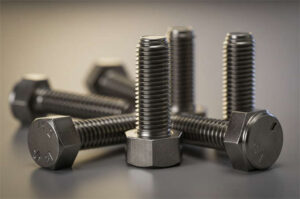
Photo: Bulk stainless steel hex bolts. Their shiny appearance looks identical regardless of grade — which is exactly why counterfeits are hard to spot visually. (Credit: Pexels)
How to Identify 316 Stainless Steel Bolts
Head Markings: ‘A4’ and ASTM F593
The first — and fastest — identification step is reading the bolt head. Genuine 316 stainless steel bolts carry specific markings depending on the manufacturing standard:
| Стандартная система | Grade Marking on Head | Strength Designation | What It Confirms |
|---|---|---|---|
| ISO / DIN (Metric) | A4-70 или А4-80 | 700 MPa or 800 MPa tensile | “A4” = 316 grade; “70” or “80” = strength class |
| ASTM F593 (Imperial) | F593D | Group 2 (316 alloy) | “D” suffix = 316 stainless specifically |
| ASTM F593 (Imperial) | F593G | Group 2 (316 high-strength) | “G” suffix = strain-hardened 316 |
| Generic / Non-standard | “316” или “316L” | Варьируется | Direct grade stamp — verify with MTR |
Key rule: “A2” = 304 (not marine grade). “A4” = 316 (marine grade). If the bolt reads “A2-70” and you need 316, it is the wrong grade — even though the strength number looks the same. Reference: Prince Fastener’s 18-8 vs 304 vs 316 comparison.
Warning: Head markings can be forged. The Galveston incident described in the introduction involved bolts with crisp, professional-looking “A4-70” stamps that were completely fraudulent. Head markings are necessary but not sufficient for authentication — always combine with at least one additional test method described below.
Magnet Test
Austenitic stainless steels (304 and 316) are predominantly non-magnetic or very weakly magnetic in their annealed state. This is because the face-centered cubic (FCC) austenitic crystal structure does not support ferromagnetic ordering. By contrast, ferritic and martensitic stainless steels (such as 410, 430, or precipitation-hardened grades) are strongly magnetic.
How to perform the test: Hold a strong neodymium magnet (N35 or stronger) directly against the bolt shank. Interpret the results as follows:
| Magnet Response | Likely Material | 316 Probability |
|---|---|---|
| No attraction at all | Austenitic SS (304 or 316) — annealed | Possible (need Mo test to confirm) |
| Very slight attraction (magnet slides, doesn’t stick) | Austenitic SS — cold-worked | Possible (cold work induces slight martensite) |
| Strong attraction (magnet sticks firmly) | Ferritic, martensitic, or carbon steel | Very unlikely — reject as 316 |
Critical caveat: The magnet test cannot distinguish 316 from 304 — both are austenitic and both respond similarly to magnets. A bolt that passes the magnet test (non-magnetic) could be 304, 316, or even 201 series. The magnet test only eliminates carbon steel, 410, 430, and other magnetic grades masquerading as 316. To confirm the presence of molybdenum (the 316 differentiator), you need a chemical spot test or XRF analysis.
Visual Inspection
While visual inspection alone cannot confirm grade, it reveals manufacturing quality indicators that correlate with authenticity:
Surface finish: Genuine 316 bolts from reputable manufacturers show a uniform, consistent surface — either bright-polished or matte-passivated, without irregular patches, discoloration, or grinding marks. Counterfeit bolts frequently show uneven surface texture, particularly near the head-to-shank transition where stamping dies were poorly aligned.
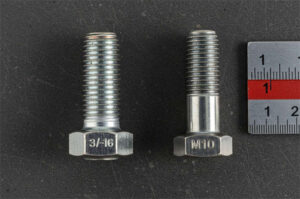
Head stamping quality: Legitimate markings are clean, evenly spaced, and precisely formed. Counterfeit stamps often appear shallow, off-center, or with inconsistent character depths — signs of post-production re-stamping rather than in-die marking during forging.
Weight: 316 stainless steel has a density of approximately 8.0 g/cm³ — virtually identical to 304 (7.93 g/cm³), so weight alone does not differentiate them. However, a bolt that feels noticeably lighter than expected for its size may be zinc-plated carbon steel (7.85 g/cm³) rather than stainless at all.
Color: Both 304 and 316 exhibit a similar silver-gray color. The Prince Fastener stainless bolt catalog notes that 316 has a very slightly warmer tone compared to 304 under natural light, but this difference is subtle enough that even experienced inspectors do not rely on it without instrumental confirmation.

Photo: Physical inspection with precision tools. Combining caliper measurements with head-marking checks catches many counterfeit bolts before they reach the jobsite. (Credit: Pexels)
Corrosion Resistance Check
If you suspect a bolt is not genuine 316, the most practical field test is a salt-spray shortcut:
Method: Soak the suspect bolt and a known-genuine 316 reference bolt together in a 5% sodium chloride (table salt) solution for 48 hours at room temperature. After 48 hours, inspect both bolts under bright light with a 10× loupe.
Expected results: Genuine 316 should show zero visible pitting, staining, or rust. 304 stainless may show slight surface discoloration in aggressive salt solutions. Carbon steel or 200-series imposters will show visible orange/brown rust spots within 24 hours. This test mimics the accelerated corrosion environment defined by ASTM B117 (salt spray/fog testing).
For definitive 316 confirmation, a molybdenum spot test kit (available for $30–$60 from lab supply companies) detects the 2–3% Mo content that defines 316. Apply a drop of the reagent to a polished spot on the bolt — a positive Mo reaction (color change per kit instructions) confirms 316. No reaction confirms 304 or lower. The Prince Fastener quality team uses this exact method as a receiving-inspection step on every incoming 316 material lot.
Seller Verification and Certifications
The most reliable protection against counterfeit 316 bolts is sourcing from verified manufacturers who provide documented traceability. Demand the following with every purchase order:
1. Mill Test Report (MTR / EN 10204 3.1): This document, issued by the steel mill, certifies the actual chemical composition and mechanical properties of the specific heat of steel used to make your bolts. A valid MTR for 316 will show Mo content between 2.0% and 3.0%. If the supplier cannot produce an MTR, consider that a red flag — especially on high-value or safety-critical orders.
2. Certificate of Conformity (CoC): Issued by the bolt manufacturer, confirming that the finished product meets the specified standard (ASTM F593, ISO 3506, DIN 267-11, etc.).
3. ISO 9001 or IATF 16949 certification: Confirms the manufacturer’s quality management system is third-party audited. Принц Застежка holds ISO 9001 certification and provides MTRs on every stainless steel order — standard practice, not an add-on service.
4. Traceability: Lot numbers on packaging that trace back to the MTR heat number. If the bolts arrive in unmarked bags with no lot coding, the supply chain is broken and verification is impossible.
Identification Methods: Weighted by Reliability
Chart: No single method is 100% reliable alone. Head markings + magnet test combined catch approximately 80% of counterfeits. Adding seller certification verification and a Mo spot test raises detection to near 100%.

Photo: Corroded bolts on an industrial structure. This is what happens when non-316 bolts are installed in environments that demand genuine marine-grade stainless. (Credit: Pexels)
Quick-Reference: 316 SS Bolt Identification Decision Table
| Шаг | Test | Tool Required | Pass Criteria | Fail Action |
|---|---|---|---|---|
| 1 | Head marking check | Eyes / magnifier | “A4-70”, “A4-80”, “F593D”, or “316” | Reject or proceed to Step 2 with caution |
| 2 | Magnet test | Neodymium magnet | Non-magnetic or very weakly attracted | Strong attraction = not austenitic SS. Reject. |
| 3 | Visual inspection | 10× loupe | Uniform finish, clean stamps, no rust | Poor finish / irregular stamps = suspect quality |
| 4 | Mo spot test | Moly reagent kit ($30–$60) | Positive Mo reaction (color change) | No Mo detected = 304 or lower. Reject as 316. |
| 5 | MTR / certification review | Documents from supplier | Mo: 2.0–3.0%, Ni: 10–14%, Cr: 16–18% | No MTR available = unverifiable. Request or reject. |
Video: Testing 304 vs 316 Stainless Steel with a Magnet
This hands-on demonstration shows how a simple magnet test works on 304 and 316 stainless steel — and where it falls short:
Video: Practical magnet test on 304 vs 316 stainless steel — watch the subtle difference in magnetic response. (Credit: YouTube)

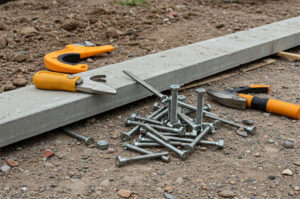
Photo: A mixed bin of industrial fasteners. Without proper identification, genuine 316 bolts are indistinguishable from lower grades. (Credit: Pexels)
Identifying genuine 316 stainless steel bolts is a five-step process that takes under two minutes per bolt — and prevents failures that cost thousands to hundreds of thousands of dollars. Start with the head marking (“A4” or “F593D”), confirm with a magnet test (should be non-magnetic or weakly magnetic), inspect the surface finish for quality indicators, run a molybdenum spot test if any doubt remains, and always demand mill test reports and certifications from your supplier.
No single test is foolproof on its own. Head markings can be forged. Magnet tests cannot distinguish 304 from 316. Visual inspection catches poor manufacturing quality but not sophisticated counterfeits. Only the combination of multiple methods — especially the Mo spot test and MTR verification — provides near-certain authentication.
The stakes are real. A genuine 316 stainless steel bolt costs roughly 30% more than a 304 bolt of the same size. But a single counterfeit bolt failure in a marine, chemical, or food-processing environment can trigger shutdowns, repairs, and liability that exceed the entire bolt order value by 100× or more. The economics are unambiguous: verify before you install.
For verified, mill-certified 316 stainless steel bolts with full traceability, explore Prince Fastener’s stainless steel fastener catalog. Every 316 bolt ships with an MTR, ISO 9001-backed quality management, and the supplier verification documentation that professional procurement teams require.
Frequently Asked Questions (FAQ)
1. How can I tell if a bolt is 316 or 304 stainless steel?
The most reliable field method is a molybdenum (Mo) spot test. Apply the reagent to a polished area of the bolt — a positive color change confirms the 2–3% molybdenum present in 316 but absent in 304. Head markings also help: “A4” indicates 316, while “A2” indicates 304. However, markings can be forged, so the Mo test provides chemical confirmation. For definitive laboratory results, XRF spectroscopy identifies the exact alloy composition in seconds.
2. Is 316 stainless steel magnetic?
In its annealed (standard) condition, 316 stainless steel is non-magnetic or very weakly magnetic. It is an austenitic grade with a face-centered cubic crystal structure that does not support ferromagnetism. However, significant cold working (bending, heading, rolling) can induce a small amount of martensite, making it very slightly attracted to a strong neodymium magnet. A bolt that sticks firmly to any magnet is almost certainly not 316.
3. What does “A4-70” stamped on a bolt head mean?
“A4” designates the steel group — specifically 316-series austenitic stainless steel (containing molybdenum). “70” indicates the minimum tensile strength class: 700 MPa. Together, “A4-70” means a 316 stainless steel bolt with at least 700 MPa tensile strength, per ISO 3506-1. “A4-80” is the same 316 grade but strain-hardened to 800 MPa.
4. What is the ASTM standard for 316 stainless steel bolts?
The primary U.S. standard is ASTM F593, which covers stainless steel bolts, hex cap screws, and studs. Within F593, 316 stainless falls under Group 2, Type 316, designated as F593D (annealed condition) or F593G (strain-hardened). The companion nut specification is ASTM F594. For metric bolts, ISO 3506-1 applies, using the A4-70 or A4-80 designation.
5. Can counterfeit stainless steel bolts be dangerous?
Yes. Counterfeit bolts may have significantly lower tensile strength, yield strength, and corrosion resistance than specified. In 2022, the U.S. Department of Energy documented incidents where suspect stainless bolts sheared during torquing at nuclear facilities. In marine and chemical environments, counterfeit bolts that corrode prematurely can cause structural failures, chemical leaks, and safety hazards. Always source from certified suppliers like Принц Застежка who provide mill test reports.
6. How long do genuine 316 bolts last in saltwater?
In typical seawater exposure (splash zone, intermittent immersion), genuine 316 stainless steel bolts last 15–25+ years before showing significant pitting — depending on chloride concentration, temperature, and crevice geometry. By comparison, 304 SS typically shows visible pitting within 1–3 years in the same environment, and carbon steel can corrode completely within months. This lifecycle difference is documented in the Prince Fastener stainless steel guide.
7. Is a magnet test enough to confirm 316 stainless steel?
No. The magnet test only confirms that the bolt is austenitic stainless steel (non-magnetic). It cannot distinguish between 304 and 316 because both grades are austenitic and respond almost identically to magnets. To confirm the specific presence of molybdenum (which defines 316), you need a Mo spot test, XRF analysis, or a verified mill test report.
8. What should I do if I suspect my 316 bolts are counterfeit?
Immediately quarantine the suspect lot. Perform a Mo spot test on 3–5 random samples. If Mo is not detected, send samples to an independent metallurgical laboratory for full chemical analysis via XRF or OES (Optical Emission Spectroscopy). Document all findings, notify the supplier, and file a complaint with the relevant standards body (e.g., ASTM) if the product is confirmed counterfeit. Do not install suspect bolts in any application.
Last updated: March 2026. Technical data sourced from ASTM A240, ASTM F593, ISO 3506-1, NACE International, and Prince Fastener quality engineering records. Always verify specifications against the governing standard for your project.



 Русский
  English
  Español
  Português do Brasil
  日本語
日本語  العربية