
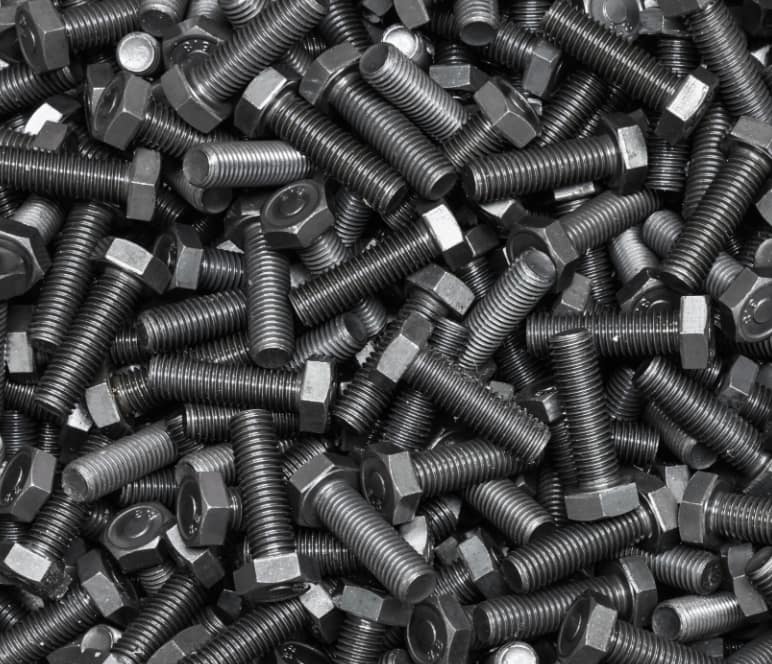
Picking the “best” black oxide carriage bolt isn’t about choosing the darkest finish or the biggest diameter—it’s about matching размер,
grade, и finish to your project’s материал, load, и окружающая среда.
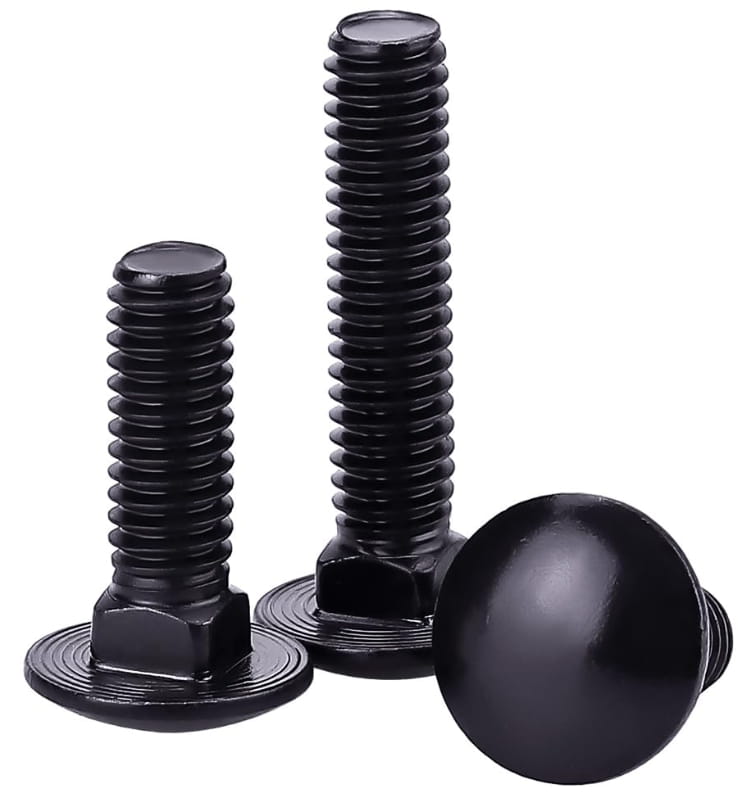
When those three variables line up, carriage bolts deliver a clean, tamper-resistant look (smooth round head) and reliable clamping—especially in wood and mixed-material assemblies.
In this guide, I’ll walk you step-by-step (in plain English) through what black oxide carriage bolts are, how to size them correctly, how to think about strength grades, and how to decide whether black oxide is a smart choice for your environment. If you’re buying for a jobsite, a production line, or a DIY build, the goal is the same: no spin-outs, no ugly rust surprises, and no “almost fits” re-orders.
You’ll also see practical tables, a quick bar chart, and a simple “decision” pie chart to help you choose faster. And yes—I’ll naturally reference Принц Застежка as a sourcing/consultation option where it makes sense, without turning this into an ad.
Start with a direct answer
The best black oxide carriage bolt for your project is the one that matches the right diameter and length (so it clamps properly),
the right grade/strength (so it won’t stretch or shear under real load), and the right finish strategy (so you’re not relying on black oxide in an environment where it’s not designed to win). When buyers get one of these wrong, the symptoms are predictable:
the bolt spins during tightening, threads don’t fully engage, joints loosen after vibration, or corrosion shows up earlier than expected.
Address the reader’s need for clarity and confidence
If you’ve ever stared at a product page wondering whether to choose 1/4″-20 or 5/16″-18, or whether “Grade 5” is overkill for a bench frame, you’re not alone. Fasteners feel simple—until they’re inside a structure you care about. The goal here is confidence: after reading, you should be able to (1) specify the bolt clearly, (2) avoid the common shopping traps, and (3) explain your choice to a contractor, purchasing teammate, or client.
Briefly introduce what black oxide carriage bolts are and their main advantages
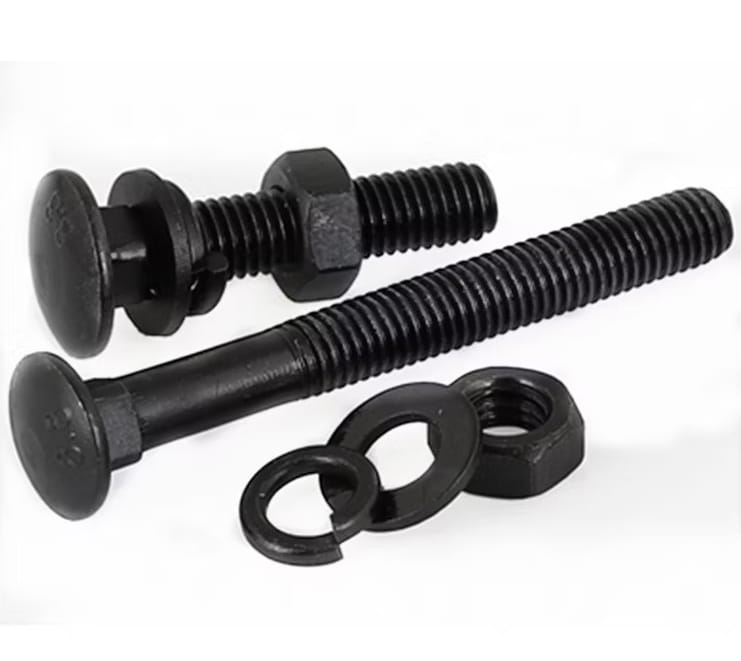
A black oxide carriage bolt is a carriage bolt (round head + square neck) that has been treated with a black oxide conversion finish. The finish is known for a clean, low-glare black appearance and for helping with lubricity and mild corrosion performance—especially when paired with oil/wax sealing in many industrial contexts. Black oxide is also valued because it adds minimal thickness, which helps keep tight tolerances. However, it’s not a “magic rust-proof” coating by itself. A technical overview of black oxide notes that corrosion resistance is improved to some extent—especially with sealing—but it remains limited in harsher environments. [Source](https://fractory.com/black-oxide-coating-explained/)
Set expectations for a practical, step-by-step guide that helps avoid common mistakes
Here’s how we’ll proceed: first, we define the hardware (so you know what you’re actually buying). Next, we size it (diameter, grip, length, thread engagement). Then we talk grades/strength in a way that relates to real projects. Finally, we address environment and material compatibility. Along the way,you’ll get quick visuals (tables + charts) and a short install video so you can sanity-check your approach before ordering in bulk.
Practical tip: If you’re ordering for production or repeated builds, treat the “best bolt” decision like a mini-spec:
diameter × length + grade + finish + washer/nut stack. If you want a second opinion on a spec, start with your supplier’s technical support—or reach out via Принц Застежка and share your material stack-up,
environment, and load case.
What Are Black Oxide Carriage Bolts?
Key Features and Visual Appeal
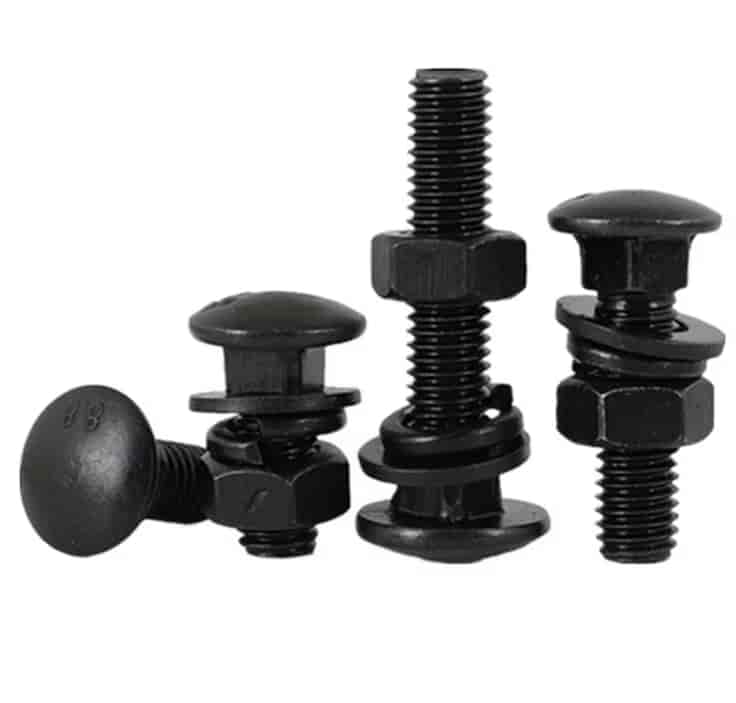
A carriage bolt is easy to spot: it has a domed, smooth head (nice on exposed surfaces) and a квадратный вырез under the head.
That square neck bites into wood (or into a square hole/plate in metal applications) to keep the bolt from spinning when you tighten the nut. This makes it a go-to fastener for fences, deck frames, gates, workbenches, and many “clean face” assemblies where you want no wrench flats showing on the exterior.
The “black oxide” part refers to a chemical conversion layer commonly associated with magnetite (Fe3O4) on ferrous metals and is
praised for its appearance, minimal dimensional change (very thin coating), and reduced glare. A technical description highlights that black oxide adds only about 1–2 micrometres of thickness, often negligible for fit, and is popular when tolerances matter. [Source](https://fractory.com/black-oxide-coating-explained/)
What you’ll notice in real projects
- Clean black look: Great for visible furniture hardware, black steel brackets, and decorative builds.
- Low glare: Better than shiny zinc when reflections look “cheap” or distract from design.
- Typically smoother tightening feel: Many builders report better “feel” vs. raw steel (depends on lubrication and nut).
Common Uses and Benefits
Black oxide carriage bolts are commonly used in:
- Wood-to-wood joints: pergolas, fences, benches, playsets.
- Wood-to-metal joints: gate hardware, brackets, equipment stands.
- Decorative exposed hardware: rustic furniture, black-on-black designs.
Why pros pick them
The square neck prevents spin during tightening, making installation more controlled. And compared with thicker coatings, black oxide’s minimal buildup can help parts fit without having to “fight the hardware.” But it’s important to treat black oxide as a finish with mild corrosion resistance rather than a heavy-duty barrier coating; the same source notes black oxide doesn’t provide exceptional corrosion resistance and can erode in harsh conditions.[Source](https://fractory.com/black-oxide-coating-explained/)
Video: Carriage bolts sizing & installation (quick overview)
Helpful if you’re unsure how the square neck seats and how to size holes. (Source video discovered via YouTube search results.)
Choosing the Right Bolt for My Project
Size and Length Selection
Start with the “stack-up” (the boring step that prevents most mistakes)
Before you pick a diameter, write down your stack-up: material A thickness + material B thickness + washers + nut height + a little extra thread for full engagement. That total informs your length. Many people choose length based on what’s “in stock,” then compensate with extra washers—this works sometimes,but it can reduce clamping quality or leave too few threads engaged.
A simple sizing workflow
- Pick diameter: based on load and hole constraints (common DIY: 1/4″, 5/16″, 3/8″).
- Pick length: based on stack-up + nut + 2–3 threads showing after tightening.
- Check head/neck fit: square neck should seat into wood fibers or a square feature to prevent rotation.
Quick table (copy/paste spec checklist)
| Spec item | What to write down | Why it matters |
|---|---|---|
| Диаметр | e.g., 5/16″-18 (or M8) | Controls shear capacity and stiffness |
| Длина | e.g., 2-1/2″ | Ensures full nut engagement and proper clamp |
| Material stack | 1.5″ wood + 0.25″ plate + washers | Prevents “too short” or excessive excess thread |
| Окружающая среда | Indoor dry / humid / outdoor / salt | Determines whether black oxide is appropriate |
Bar chart : where black oxide is commonly used
This is a simple visual (not scientific) based on typical usage patterns seen in the field—black oxide is heavily favored indoors/decorative and less so in harsh outdoor/salt exposure.
Where Prince Fastener can help (naturally)
If you’re ordering carriage bolts by the hundreds (or you’re trying to standardize a BOM), it’s worth having a supplier sanity-check your stack-up and environment assumptions. That’s the moment a fastener partner like Принц Застежка is most valuable: you provide the joint thickness, usage conditions, and your preferred appearance, and they confirm the spec so you don’t burn time on returns and rework.
Understanding Grades and Strength
Think in failure modes: stretch, shear, and joint slip
“Strength” isn’t just a bigger number. In real assemblies, you’re managing:
(1) tension/clamp load (will it stretch?), (2) shear (will it snap sideways?), and
(3) joint slip (will the joint loosen or creep under vibration?). Carriage bolts are often used in wood, where the limiting factor can be the wood fibers compressing—not the bolt snapping—so grade selection should be realistic, not just “highest possible.”
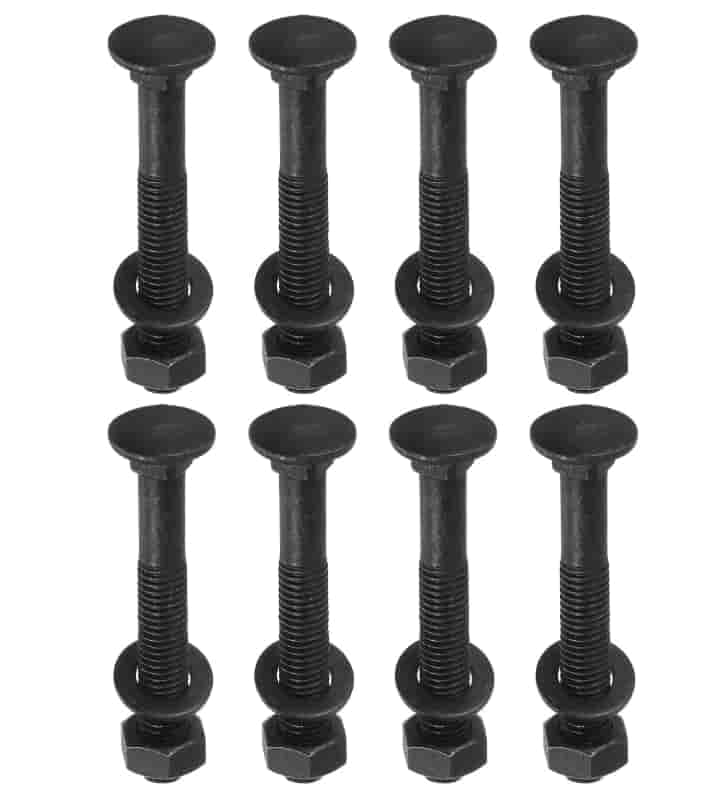
A practical grade rule-of-thumb
- General wood structures/furniture: choose a reputable, consistent grade and focus on diameter + washer bearing area.
- Dynamic loads / vibration: pay closer attention to grade and locking strategy (lock nuts, threadlocker where appropriate).
- Corrosive environments: grade alone won’t save you—material and coating choice matter more.
Mini “pie chart” showing what usually drives the choice
For most carriage-bolt projects, the decision is typically driven more by environment and fit than by maximum strength.
- 40% Environment/corrosion risk
- 30% Fit/length/stack-up
- 30% Strength/grade & locking
“Treat black oxide as a finish that preserves tolerances and improves appearance—it’s not a substitute for selecting the right base material and a corrosion strategy when the environment is harsh.”
Material and Corrosion Resistance
Indoor vs. Outdoor Applications
Indoor (dry): where black oxide shines
Indoors—especially in dry, climate-controlled spaces—black oxide carriage bolts are often a great choice: you get the clean black look and minimal coating buildup while corrosion risk is naturally lower. This is the “sweet spot” for black oxide: workshop benches, furniture frames, interior gates, racks, and decorative joinery.
Indoor (humid) and semi-protected outdoor: proceed with a plan
In humid indoor spaces (garages, basements, utility rooms) and covered outdoor use (under a roof or awning), black oxide can still work if you acknowledge what it is: a conversion layer with limited standalone corrosion resistance, often improved by sealing (oil/wax). A technical overview explicitly calls the corrosion resistance “mild” and notes that sealing is an additional step used to enhance protection by filling pores in the surface. [Source](https://fractory.com/black-oxide-coating-explained/)
Fully exposed outdoor and coastal/salt: avoid black oxide as the primary defense
If the bolt will see rain, repeated wet/dry cycles, fertilizers, road salt, or salt spray, black oxide should not be your primary corrosion strategy.
In those conditions, consider alternative materials (e.g., stainless) or higher-protection coatings. The same source emphasizes black oxide does not provide exceptional corrosion resistance and can erode, exposing the substrate. [Source](https://fractory.com/black-oxide-coating-explained/)
Compatibility with Project Materials
Wood projects: compressive bearing matters as much as bolt strength
In wood, the wood fibers can compress under the head/washer/nut, which reduces clamp load over time. That’s why using appropriately sized washers (or plates) can be as important as bolt grade. Black oxide’s low-glare finish is a nice aesthetic match for stained or charred woods and black brackets—but if the wood will be outdoors, rethink the corrosion plan first, aesthetics second.
Metal projects: focus on seating and anti-spin design
In metal-to-metal connections, a carriage bolt’s square neck usually needs either a square punched hole, a square plate, or a method to prevent spin (because metal doesn’t “bite” like wood). If you can’t provide that, a hex bolt might be a better design choice. If you do provide anti-rotation, black oxide can be attractive for indoor machinery guards, racks, and fixtures where reduced glare and appearance are valued.
Mixed materials: be cautious with corrosion expectations
Mixed-material joints (e.g., wood + steel bracket, or steel + aluminum plate) introduce more ways to fail: moisture traps, crevices, and galvanic pairs.
Black oxide is thin and can wear; once worn, base steel is exposed. If the project lives in a wet environment, consider upgrading to a more corrosion-resistant
material/coating system and treat black oxide as an indoor/decorative finish rather than an outdoor armor.
If you’re unsure, the safest way to spec is: define the environment first, then choose material/coating, then choose grade, then finalize dimensions.
For help selecting a bolt that matches both appearance and performance targets, start at
www.princefastener.com.
Benefits and Limitations of Black Oxide Finish
Durability and Wear Protection
What black oxide does well (and why builders like it)
Black oxide is a chemical conversion finish that darkens the surface without adding a thick layer on top. That “thin finish” behavior is exactly why it’s popular on precision parts and fasteners: you can keep fit and tolerances without fighting a heavy coating. It’s also widely valued for its appearance (clean black / low glare) and for holding oil or wax in its porous surface, which can improve lubricity and feel during assembly (especially on threads). A manufacturing-focused explanation notes that black oxide doesn’t add a thick coating and is often chosen where tolerances matter,and also highlights lubricity benefits due to the surface’s porosity and post-finish sealants (oil/wax). [Source](https://sendcutsend.com/blog/black-oxide-coating/)
What “durability” really means for carriage bolts
In practical carriage-bolt use, durability isn’t only the finish lasting—it’s the joint staying tight and looking good over time. Black oxide doesn’t typically chip or peel like some coatings because it’s not a film sitting on top of the metal; however, the finish can still rub off, wear, or discolor depending on handling, friction, and heat. A fastener industry guide also notes that black oxide can be rubbed off and that it may leave residue; this is one reason some users wipe hardware down before final installation. [Source](https://www.albanycountyfasteners.com/blog/what-is-black-oxide/)
“Maintenance reality”: the oil/wax is part of the system
A key point that gets missed online: black oxide by itself is not a strong corrosion barrier; the oil/wax/lacquer post-treatment is what contributes much of the corrosion protection in practice. A detailed overview calls out the common misconception that black oxide parts are corrosion resistant, explaining that without oil/wax/sealant, blackened steel can rust close to bare steel; the oil/wax is what provides the (limited) added protection.[Source](https://sendcutsend.com/blog/black-oxide-coating/)
| What you get | Why it matters for carriage bolts | Trade-off |
|---|---|---|
| Thin finish / minimal buildup | Better fit, less “binding” vs thick coatings | Not a strong barrier against moisture |
| Clean black appearance | Great for visible hardware & decorative work | May wear/discolor with abrasion/heat |
| Porous surface holds oil/wax | Improved lubricity “feel” during tightening | Needs occasional re-oiling in some settings |
When to Avoid Black Oxide Bolts
Outdoor exposure: the biggest red flag
If your carriage bolts will be fully exposed to rain, frequent wet/dry cycles, or salt, black oxide should not be treated as your corrosion solution.
One guide is blunt: black oxide is among the worst finishes for corrosion resistance, and the protection mainly comes from the oil/wax sealant.[Source](https://sendcutsend.com/blog/black-oxide-coating/)
High-heat locations (especially near engines)
Black oxide fasteners can discolor under high heat; the oil residue can turn brown and make the hardware look like it is rusting prematurely. A fastener resource specifically cautions against using black oxide bolts on or near engines for this reason. [Source](https://www.albanycountyfasteners.com/blog/what-is-black-oxide/)
When “corrosion certainty” matters more than the black look
If failure or maintenance would be costly (structural outdoor assemblies, industrial washdown areas, coastal installations), consider stainless or other corrosion-resistant systems. When you spec stainless, order to an actual fastener specification when appropriate; for example, ASTM F593 includes additional requirements such as an intergranular corrosion test that is not required when bolts are ordered simply as type 304 stainless.[Source](https://www.portlandbolt.com/technical/faqs/differences-between-stainless-steel-bolts/)
“It’s a common misconception that black oxide parts are corrosion resistant… what provides an increased level of protection is that black oxide parts are coated in oil, wax or sometimes a lacquer finish.”
Application Tips for Carriage Bolts
Wood Projects
Seat the square neck on purpose (don’t “hope” it bites)
In wood, the square neck under the head is meant to bite into the fibers and prevent rotation while you tighten from the nut side. The easiest way to make this reliable is to drill the correct round hole for the shank, then pull the square neck into the wood by tightening—sometimes with a firm tap on the head to start the bite (especially in hardwood). If the bolt spins, it usually means the hole is oversized or the wood is too soft/compromised at that spot.
Use washer strategy to prevent wood crush and loosening
For wood joints, washers are not optional if you want the joint to stay tight. A washer (or better, a larger fender washer/plate where appropriate) spreads load and reduces fiber compression. This is especially helpful with softwoods, outdoor lumber, and any joint that sees vibration or seasonal movement.
Quick micro-checklist (before you tighten)
- Hole diameter: match shank diameter (not the square neck).
- Head seating: head flush where desired; avoid crushing decorative faces.
- Нитки: aim for full nut engagement + a couple threads showing.
Metal Projects
Carriage bolts need anti-spin geometry in metal
Unlike wood, metal won’t let the square neck “sink in” unless you provide a square hole, a square plate, or some mechanical anti-rotation feature.If you can’t do that, a hex bolt or flanged bolt can be a better choice for serviceability.
Paint/coating touch points: keep the black look consistent
In indoor metal projects, black oxide’s low-glare appearance can match black brackets and frames nicely, but expect handling marks. If your finished product is customer-facing (fixtures, furniture, displays), plan for consistent touch-up or consider a black coating system designed for appearance consistency.
Decorative Uses
Match finish expectations to reality
Black oxide can look premium, but it’s not as uniform as powder coating and can vary with base metal finish and post-treatment. A detailed black oxide guide notes you shouldn’t expect it to look as uniform as powder coat and that not all black oxide finished parts will match perfectly.[Source](https://sendcutsend.com/blog/black-oxide-coating/)
Design tip: hide the nut side (or make it intentional)
The classic carriage-bolt aesthetic is the smooth head on the show face. If the nut side is visible, use a coordinated black nut/washer set (or a cap nut) so the whole assembly looks intentional.
If you’re building a repeatable decorative product line, consider standardizing one or two specs and validating them with a supplier early. This is where a partner like Принц Застежка can help: you share the design intent
(appearance + environment), and they confirm the best-fit fastener spec.
Common Mistakes When Choosing Bolts
Overlooking Load and Stress
Mistake: choosing diameter based only on “what looks right”
Carriage bolts often look “strong enough,” until you put lateral load on them (gate sag, racking on a frame, vibration on equipment stands). The fix is simple: choose diameter based on real load paths and not just aesthetics. If your joint sees shear, don’t under-size the shank. If your joint must resist loosening, focus on clamp + washer area + locking strategy, not only bolt grade.
Mistake: ignoring thread engagement
Too-short bolts force you to catch only a few threads. That can strip nuts, reduce clamp load, and loosen over time. A safe practical habit is to ensure full nut engagement and a couple threads showing after tightening. If you find yourself “making it work,” it’s usually cheaper to correct length than to deal with callbacks.
Ignoring Environmental Factors
Mistake: treating black oxide as “outdoor-rated”
The most expensive mistake is buying black oxide for a wet environment because you want the black look. A technical black oxide overview explains the core misconception: without sealant, black oxide offers little corrosion improvement; the oil/wax is what helps, and even then the improvement is limited.[Source](https://sendcutsend.com/blog/black-oxide-coating/)
Mistake: not planning maintenance where oil is expected
If your application is a tool wall, workshop fixture, or indoor hardware that sees handling, black oxide is often fine—but if you store hardware for long periods or you’re in a humid shop, plan to wipe and re-oil periodically. Industrial tool guidance makes the same point: oil-based rust preventive coatings can evaporate over time, leaving the surface more vulnerable unless re-oiled. [Source](https://www.wrighttool.com/blog/everything-you-need-to-know-about-black-oxide)
Mismatching Bolt and Material
Mistake: using carriage bolts where the square neck cannot lock
In wood, the square neck can bite. In metal, it usually cannot unless you provide the geometry. If the bolt spins in metal, it’s not “a bad bolt”—it’s a mismatch between fastener design and joint design. Fix it by switching to a bolt style that can be held with a wrench, or redesign the hole/plate to accept the square neck.
Mistake: treating stainless specs as interchangeable
If you upgrade to stainless for corrosion, spec matters. A fastener FAQ explains that ASTM F593 Group 1 (type 304 stainless) includes additional requirements beyond simply ordering “304 stainless,” including an intergranular corrosion test, which can matter depending on the application.[Source](https://www.portlandbolt.com/technical/faqs/differences-between-stainless-steel-bolts/)
Quick Checklist for Choosing Bolts
One-page checklist you can hand to purchasing (or use on a jobsite)
- Project material stack-up: thickness A + thickness B + washers + nut height
- Environment: indoor dry / indoor humid / outdoor covered / outdoor exposed / coastal-salt
- Диаметр: sized for shear + stiffness (not just looks)
- Длина: full nut engagement + 2–3 threads showing
- Anti-spin plan: square neck seats in wood OR a square hole/plate in metal
- Washer plan: prevent wood crush; consider fender washers/plates
- Finish plan: black oxide for appearance/tolerance; not for harsh corrosion
- Locking plan: lock nut / threadlocker where vibration exists
- Consistency: standardize 1–2 specs for repeat builds
Заключение
Summarize the main steps
Choosing the best black oxide carriage bolt comes down to a repeatable process: define your environment first, then confirm material/finish strategy, then size the bolt (diameter + length) based on real stack-up and load paths, and finally verify the square-neck anti-spin method for your materials. If you do those steps in order, you avoid the common failures—spin-out during tightening, too-short thread engagement, joint loosening, and “surprise rust.”
Double-check specifications and balance function + appearance
Black oxide is an excellent choice when you want a clean black look and minimal dimensional change, but it should not be treated as a corrosion-proof coating. Multiple technical references emphasize the same point: corrosion resistance is limited and often depends on oil/wax sealing, so harsher
environments call for other materials or coatings. [Source](https://sendcutsend.com/blog/black-oxide-coating/)
Call to action: make the next step easy
If you’re ready to order, don’t just buy “some black carriage bolts.” Create a simple spec line (diameter × length + material/grade + finish + washer/nut stack), then confirm it once before purchasing in bulk. For a fast sanity-check—especially if your build mixes materials or sits in humidity—start with your supplier’s technical support, or contact Принц Застежка and share:
(1) material stack-up, (2) indoor/outdoor exposure, and (3) whether the head side is decorative. That one message can prevent a full round of re-orders.
Ready to spec your bolts correctly the first time? Start here: www.princefastener.com.
FAQ (Black Oxide Carriage Bolts)
1) Are black oxide carriage bolts rust-proof?
No. A common misconception is that black oxide itself is corrosion resistant. In practice, much of the (limited) corrosion protection comes from oil/wax or similar post-treatment sealants. [Source](https://sendcutsend.com/blog/black-oxide-coating/)
2) Can I use black oxide carriage bolts outdoors?
Only with caution. In covered or low-moisture outdoor areas, they may be acceptable if you maintain them, but fully exposed outdoor or coastal environments generally call for a different corrosion strategy. [Source](https://sendcutsend.com/blog/black-oxide-coating/)
3) Why does my carriage bolt spin when tightening?
Most commonly: the hole is oversized, the wood is too soft, or (in metal) you don’t have a square hole/plate for the square neck to lock into. Carriage bolts need an anti-spin seating method to work as intended.
4) Should I oil black oxide bolts?
In many indoor/humid shop conditions, yes—light oiling can help maintain the finish and slow corrosion. Industrial tooling guidance notes oil coatings can evaporate over time and may need reapplication. [Source](https://www.wrighttool.com/blog/everything-you-need-to-know-about-black-oxide)
5) Are black oxide bolts stronger than zinc-plated bolts?
Finish doesn’t determine base strength; grade/material does. Black oxide is a finish choice primarily for appearance, tolerance, and assembly feel—not a strength upgrade.
6) Can black oxide rub off on my hands or material?
It can. Some fastener guidance mentions black residue can come off and that hardware may be wiped down before use in certain applications.[Source](https://www.albanycountyfasteners.com/blog/what-is-black-oxide/)
7) When should I choose stainless instead?
Choose stainless (or other corrosion-resistant systems) when corrosion risk is high or maintenance is costly. If you’re specifying stainless for critical applications, consider ordering to a fastener specification (e.g., ASTM F593) that includes additional testing/requirements beyond “304 stainless.”[Source](https://www.portlandbolt.com/technical/faqs/differences-between-stainless-steel-bolts/)
8) Is black oxide a “coating” or a “conversion” finish?
It’s a chemical conversion process that blackens the surface without adding a thick layer like plating or paint. [Source](https://sendcutsend.com/blog/black-oxide-coating/)
9) What’s the easiest way to avoid buying the wrong length?
Measure your stack-up (materials + washers + nut) and add enough length for full thread engagement with a couple threads showing. Avoid “making it work” with excessive washer stacking unless it’s intentionally engineered.
10) Can Prince Fastener help me choose a spec?
Yes—if you provide your application details (materials, environment, load/vibration, and appearance goals), a supplier can recommend a safe, consistent spec for production or repeat builds. Start at www.princefastener.com.






 Русский
  English
  Español
  Português do Brasil
  日本語
日本語  العربية