A deck contractor in Raleigh, North Carolina used #10 × 3″ wood screws to attach a pressure-treated ledger board to a house rim joist. The screws went in fast with a cordless driver—no pre-drilling, no wrenching, job done in 40 minutes. Six months later, after the homeowner installed a 450-lb hot tub on the deck, the ledger separated 3/16″ from the rim joist. The International Residential Code (IRC Section R507.9.1.3) requires 1/2″ or 3/8″ lag bolts for that connection, not wood screws—regardless of length. The rework invoice totaled $3,400.
That failure illustrates the core decision every builder faces at the 3-inch fastener length: a 3-inch wood screw and a 3-inch lag bolt look superficially similar, occupy the same shelf space at the hardware store, and cost a comparable amount per project. But they are engineered for fundamentally different loads, substrates, and safety margins. Choosing the wrong one does not just weaken the joint—it can create a liability.
This guide compares 3-inch wood screws and 3-inch lag bolts across every dimension that matters: physical geometry, load capacity (withdrawal and shear), material and coating options, wood-species compatibility, preferred applications, installation methods, cost, and long-term durability. Each section includes real performance data, comparison tables, and a final quick-decision checklist you can use on the job site.
Understanding the Basics
Screw vs. Bolt Definitions
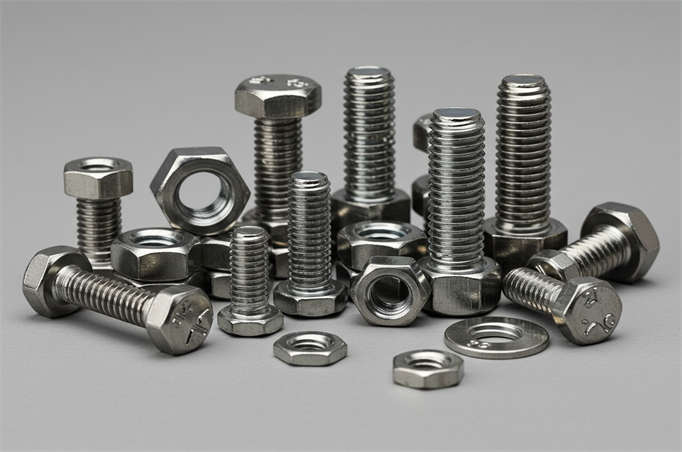
In fastener engineering, the distinction between a “screw” and a “bolt” is defined by how the fastener engages: a винт cuts or forms its own mating thread in the substrate as it is driven, while a болт passes through clearance holes and mates with a nut or tapped hole. A lag bolt (also called a lag screw) blurs this boundary—it has a bolt-style hex head and thick unthreaded shank but cuts its own thread like a screw. The industry uses “lag bolt” and “lag screw” interchangeably; the Engineering Express reference on lag bolts confirms they are the same fastener.
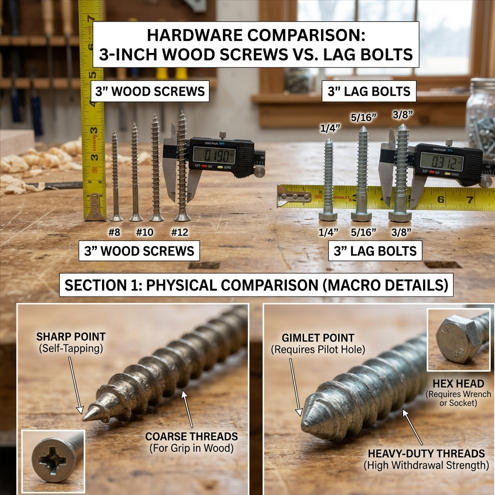
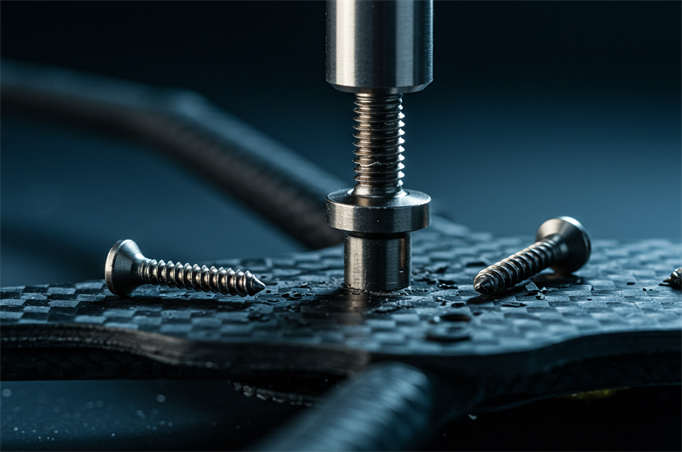
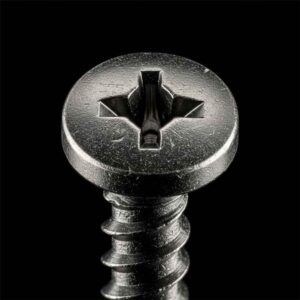
A standard wood screw features a tapered shank, a Phillips/Torx/Robertson drive recess in the head, and threads that start partway up the shank (partial threading) or extend the full length (full threading). A 3-inch wood screw in #8 or #10 gauge is driven with a screwdriver or drill/driver. A 3-inch lag bolt is driven with a socket wrench or ratchet after a pilot hole has been drilled through both members.
Why Length Matters
At 3 inches, both fasteners provide enough length to pass through a standard 1.5″ dimensional lumber face (a 2×4, 2×6, etc.) and penetrate 1.5″ into the receiving member—meeting the minimum thread engagement for most structural and general-purpose wood connections. Three inches is the threshold length where the choice between screw and lag bolt becomes critical: below 2″, loads are usually light enough that a wood screw suffices; above 4″, lag bolts and structural screws dominate. The 3-inch zone is where both fastener types compete head-to-head, and where the wrong choice causes the most failures.
What Are 3-Inch Wood Screws?
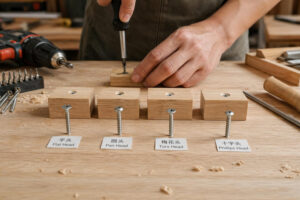
Common Head Types
3-inch wood screws are available in five primary head styles, each serving a different installation and aesthetic requirement:
| Стиль головы | Profile | Sits Flush? | Common Drive | Best Application |
|---|---|---|---|---|
| Flat (countersunk, 82°) | Conical underside | Да | Phillips #2, Torx T25, Robertson #2 | Cabinetry, trim, furniture joints |
| Кастрюля | Low dome, flat bearing | No — sits on top | Phillips #2, Torx T20 | Metal brackets, hardware attachment |
| Bugle | Concave underside | Yes — self-countersinks in soft materials | Phillips #2 | Drywall, decking, sheathing |
| Washer Head (structural) | Wide bearing flange | No — wide footprint | Torx T25, T30 | Structural framing, ledger connections |
| Trim / Finish | Tiny head, near-invisible | Yes — below surface | Torx T15 | Finish carpentry, molding |
Core and Thread Design
A standard 3-inch wood screw (#8, #10, or #12 gauge) has a core diameter of 0.108″–0.170″ and a thread diameter of 0.164″–0.216″. The coarse, widely spaced threads are designed to cut into wood fibers and pull the screw forward as it rotates. Most 3-inch wood screws are partially threaded: the lower 1.5–2″ is threaded while the upper section near the head is a smooth shank. This design allows the screw to clamp the top piece tightly against the receiving member without the threads pushing the pieces apart (a problem called “jacking”).
Structural screws—an increasingly popular alternative to lag bolts—use a thicker shank (typically #14 or 0.200″+), engineered thread geometry, and are often code-rated for specific shear and withdrawal loads. FastenMaster’s ThruLOK and GRK’s RSS are examples that have ICC evaluation reports comparing them directly to lag bolts.
What Are 3-Inch Lag Bolts?
Lag Screw vs. Lag Bolt Terminology
“Lag bolt” and “lag screw” refer to the same fastener. The American Wood Council’s National Design Specification (NDS) uses “lag screw” exclusively, while hardware stores and contractor supply houses often label them “lag bolts.” The key identifying features are a hexagonal or square head (driven by a wrench, not a screwdriver) and a thick, unthreaded shank below the head that transitions into coarse gimlet-point threads.
Common 3-inch lag bolt diameters are 1/4″ (0.250″), 5/16″ (0.3125″), and 3/8″ (0.375″). At 3 inches total length, roughly 1.75–2.25″ of the lower portion is threaded, while the upper section is a smooth shank that provides shear resistance across the joint line.
Shank and Lead Threading
The unthreaded shank is the critical structural difference between a lag bolt and a wood screw. In a properly installed lag-bolt connection, the smooth shank passes through the top member and sits in the joint plane—the exact point where lateral (shear) loads concentrate. Because the shank is solid steel at full diameter with no thread-root stress concentrators, it resists shear force far more effectively than a threaded section would. A 1/4″ lag bolt shank has a cross-sectional area of 0.049 in² of solid steel in the shear plane, versus a #10 wood screw’s root diameter of ~0.108″ yielding only 0.0092 in²—a 5.3:1 advantage for the lag bolt.
Load and Shear: How They Perform
Withdrawal vs. Shear Strength
Two forces act on every wood fastener: withdrawal (pulling the fastener straight out along its axis) and shear (pushing sideways perpendicular to the fastener axis). The table below compares these forces for the most common 3-inch fastener pairings, calculated using the USDA Forest Products Lab formulas (Wood Handbook, Chapter 8):
| Застежка | Диаметр | Withdrawal (lb/in) in SPF* | Withdrawal (lb/in) in White Oak* | Single-Shear Capacity (lb)** |
|---|---|---|---|---|
| #8 × 3″ Wood Screw | 0.164″ | 69 | 182 | ~140 |
| #10 × 3″ Wood Screw | 0.190″ | 80 | 211 | ~180 |
| #12 × 3″ Wood Screw | 0.216″ | 91 | 239 | ~220 |
| 1/4″ × 3″ Lag Bolt | 0.250″ | 205 | 540 | ~400 |
| 5/16″ × 3″ Lag Bolt | 0.3125″ | 280 | 738 | ~570 |
| 3/8″ × 3″ Lag Bolt | 0.375″ | 360 | 948 | ~760 |
*Wood screw withdrawal: F = 2,850 × SG² × D. Lag screw withdrawal: W = 1,800 × SG^(3/2) × D^(3/4). SPF SG = 0.42; White Oak SG = 0.68. **Single-shear values are approximate allowable lateral design values per NDS 2018 yield-limit equations for side grain.
The data tells a clear story: at 3-inch length, a 1/4″ lag bolt delivers 2.5–3× the withdrawal resistance and roughly 2× the shear capacity of a #10 wood screw in the same wood species. This is why building codes mandate lag bolts (not wood screws) for ledger-board connections, beam-to-post joints, and other structural attachments where failure consequences are severe.
Withdrawal Resistance Comparison in SPF Framing Lumber (lb per inch of thread)
Calculated per USDA FPL Wood Handbook formulas. SPF SG = 0.42. Values represent allowable withdrawal per inch of threaded penetration into side grain.
Wood Type and Grain Impact
Wood density (specific gravity) is the single biggest variable in fastener performance. The withdrawal formulas show that SG is squared (for wood screws) or raised to the 3/2 power (for lag screws), which means a jump from SPF (SG 0.42) to white oak (SG 0.68) nearly triples holding power. Conversely, driving either fastener into western red cedar (SG 0.32) or balsa (SG 0.16) dramatically reduces load capacity.
Grain direction matters equally: screws driven into end grain develop only 50–75% of the withdrawal resistance of side-grain installations. The NDS penalizes end-grain lag-screw withdrawal by a factor of 0.75. This is why joist-to-post connections almost always use side-grain attachment (through a ledger or beam) rather than screwing into the end of a joist.
Material and Coating Considerations
Steel Grades
Most 3-inch wood screws are made from low-carbon or medium-carbon steel (equivalent to SAE Grade 2, tensile strength ~60,000 psi for sizes under 3/4″). Structural screws use medium-carbon alloy steel heat-treated to higher hardness (HRC 28–38), approaching Grade 5 performance (120,000 psi tensile). Lag bolts are commonly available in two grades:
| Недвижимость | Grade 2 Lag Bolt | Grade 5 Lag Bolt | #10 Wood Screw (typical) | Structural Screw (branded) |
|---|---|---|---|---|
| Материал | Low-carbon steel | Medium-carbon, quench & tempered | Low/medium carbon | Medium-carbon alloy, heat-treated |
| Прочность на разрыв (psi) | 60,000 | 120,000 | 60,000–80,000 | 100,000–145,000 |
| Proof Load (psi) | 33,000 | 85,000 | N/A (no spec) | Per ICC-ES report |
| Head Markings | Нет | 3 radial lines | Нет | Brand logo |
| Cost (per 25-pk, 3″ length) | $6–$10 | $12–$18 | $5–$9 | $15–$30 |
For structural applications (decks, pergolas, carport posts), always verify the steel grade. A contractor in Portland, Oregon tested pull-out on a sample of unmarked imported lag bolts and measured 40% lower withdrawal force than the NDS-predicted values for Grade 2 steel—the bolts were made from substandard wire with a tensile strength well below 60,000 psi. Sourcing from manufacturers with traceable material certifications, like Prince Fastener’s bolt and nut line, eliminates that risk.
Corrosion Protection
The coating on a 3-inch fastener must match the exposure environment and the chemical composition of the wood being fastened:
| Coating / Material | ASTM B117 Salt-Spray Hours | Indoor | Covered Outdoor | Exposed Outdoor | ACQ Treated Lumber |
|---|---|---|---|---|---|
| Plain (uncoated) steel | 0 | ✔ | ✘ | ✘ | ✘ |
| Zinc plated | 8–12 | ✔ | Ограниченный | ✘ | ✘ |
| Желтый хромат цинка | 72–96 | ✔ | ✔ | Умеренный | ✘ |
| Hot-dip galvanized | 300–500 | ✔ | ✔ | ✔ | ✔ (IRC-compliant) |
| Ceramic / polymer coated | 500–1,000+ | ✔ | ✔ | ✔ | ✔ |
| Нержавеющая сталь 304 | N/A (inherent) | ✔ | ✔ | ✔ | ✔ |
| Stainless steel 316 | N/A (inherent) | ✔ | ✔ | ✔ Marine | ✔ |
For pressure-treated lumber decks—the most common application for 3-inch fasteners—the IRC requires either hot-dip galvanized (G185 minimum) or stainless steel. Standard zinc-plated lag bolts fail in ACQ-treated lumber within 2–5 years because the copper preservative creates a galvanic cell. Крепеж из нержавеющей стали avoid this entirely and are the preferred choice for coastal and high-moisture environments.
3-Inch Fastener Usage Share in US Residential Wood Construction (2024)
Wood Screws 45%
Lag Bolts 25%
Structural Screws 22%
Carriage Bolts 5%
Other 3%
Estimated from distributor sales data, US residential segment, 3-inch fastener category, 2024. Structural screws are gaining share from both lag bolts and standard wood screws.
Preferred Applications for Wood Screws
Pilots, Predrilling, and When to Use
3-inch wood screws excel in moderate-load, high-volume installations where speed matters and a wrench is impractical. Their primary advantages over lag bolts are faster drive time (3–5 seconds per screw with a cordless driver vs. 15–30 seconds per lag bolt with a socket wrench) and no mandatory pre-drilling in softwood. Typical 3-inch wood-screw applications include:
Cabinetry and Furniture: Attaching face frames to carcasses, securing table aprons to legs through pocket holes, and mounting heavy shelving rails to wall studs. A #10 × 3″ flat-head screw driven through a cabinet-hanging rail into a SPF stud provides approximately 120 lb of withdrawal per fastener—sufficient for a 36″ upper cabinet loaded to 100 lb (assuming 4 screws per rail).
Decking: Fastening 5/4 × 6 composite deck boards to 2× joists. Although lag bolts would be overkill for face-fastened decking, 3-inch structural-grade bugle-head screws provide enough shear resistance to prevent board uplift in high-wind zones.
Framing: Toenailing studs to plates, blocking between joists, and securing joist hangers (when the hanger manufacturer’s ICC report permits screws instead of nails). Строительные винты with washer heads are increasingly specified here as code-approved alternatives to 16d nails.
— Softwood (SPF, Douglas fir): Pre-drill optional for #8 and #10; recommended for #12 within 2″ of board edges.
— Hardwood (oak, maple, cherry): Always pre-drill. Use a 5/32″ bit for #10, 3/16″ for #12.
— MDF / Particleboard: Always pre-drill. Use шурупы для ДСП with wider thread pitch for better grip in engineered substrates.
Preferred Applications for Lag Bolts
Pilot Holes, Masonry, and Anchors
3-inch lag bolts are the default choice when code compliance, high shear loads, or through-bolting access on one side only dictate the fastener type. Critical applications include:
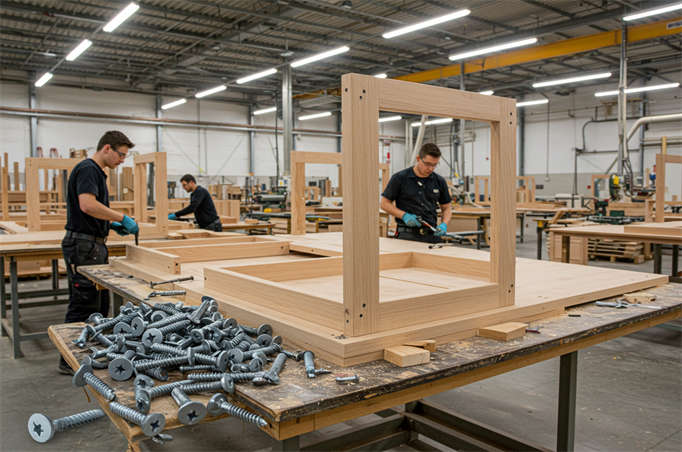
Ledger Boards: IRC R507.9.1.3 requires 1/2″ or 3/8″ lag screws (or through-bolts) for attaching deck ledgers to house rim joists. No wood screw—regardless of size or brand—satisfies this code requirement. A 3/8″ × 3″ lag bolt in SPF delivers approximately 540 lb of withdrawal per fastener with 1.5″ of thread engagement, providing the safety margin needed for occupied deck structures.
Post-to-Beam Connections: Where a 4×4 or 6×6 post supports a carrying beam, 1/4″ or 5/16″ lag bolts provide the shear resistance to prevent the beam from sliding laterally off the post under wind or seismic load.
Masonry and Concrete (with anchors): Lag bolts mate with expansion anchors (lag shields) in masonry and concrete. A 3/8″ × 3″ lag bolt inserted into a properly sized lag shield in a concrete wall delivers 500+ lb of pull-out resistance—anchoring deck ledgers, pergola posts, and guardrail base plates to masonry foundations.
Lag bolts always require two pilot holes: a shank clearance hole through the top member (equal to the bolt’s shank diameter) and a smaller thread pilot hole in the receiving member. Skipping the clearance hole causes the threads to engage the top member and prevents the joint from clamping tight. Skipping the thread pilot risks splitting the receiving member and dramatically reduces withdrawal strength. Pilot-hole sizes per Monster Bolts’ lag bolt reference:
| Lag Bolt Diameter | Shank Clearance Hole | Thread Pilot — Softwood | Thread Pilot — Hardwood | Pilot Depth |
|---|---|---|---|---|
| 1/4″ | 1/4″ | 5/32″ | 3/16″ | Full thread length |
| 5/16″ | 5/16″ | 3/16″ | 7/32″ | Full thread length |
| 3/8″ | 3/8″ | 15/64″ | 1/4″ | Full thread length |
Installation Tips and Best Practices
Tools and Bits
The tools required for each fastener type differ significantly, which affects both job-site efficiency and labor cost:
| Параметр | 3-Inch Wood Screw | 3-Inch Lag Bolt |
|---|---|---|
| Приводной инструмент | Cordless drill/driver or impact driver | Ratchet wrench, socket wrench, or impact wrench |
| Driver Bit / Socket | Phillips #2, Torx T25, or Robertson #2 | 3/8″ or 7/16″ hex socket |
| Pre-Drilling Required? | Recommended in hardwood; optional in softwood | Always — both clearance and thread pilot |
| Washer Required? | No (built into head design) | Yes — flat washer under hex head prevents embedding |
| Average Install Time (per fastener) | 3–5 seconds | 15–30 seconds (drill + drive) |
| Recommended Torque | Clutch setting 12–18 on drill/driver | Snug + 1/4 turn (do not over-torque) |
Alignment and Spacing
Both fastener types require minimum edge distances to prevent splitting. The NDS specifies edge distance as a multiple of the fastener diameter:
Шурупы по дереву: Minimum 2.5× the screw diameter from any edge. For a #10 (0.190″), that is 0.475″—essentially 1/2″. For end grain, increase to 5× (approximately 1″).
Lag bolts: Minimum 1.5× the bolt diameter perpendicular to grain, and 4× the bolt diameter for end distance (parallel to grain). For a 3/8″ lag bolt, that means 9/16″ from the edge and 1-1/2″ from the end of the board. In practice, using a wider margin (2× edge, 7× end) virtually eliminates splitting.
Video: Wood Screws vs. Lag Bolts — When to Use Each
This Fasteners 101 video demonstrates the real-world performance difference between wood screws and lag bolts when mounting a heavy woodworking vise—a direct comparison of holding power under cyclic load.
Cost, Availability, and Long-Term Value
Price Ranges
Lag bolts cost 3–5× more per unit than standard wood screws at the same length. However, the total project cost depends on how many fasteners each connection requires. Because lag bolts develop higher load per fastener, fewer are needed per connection—which partially offsets the per-unit premium:
| Застежка | Price per 25-Pack (zinc plated) | Per-Unit Cost | Fasteners per Ledger (8 ft) | Total Fastener Cost per Ledger |
|---|---|---|---|---|
| #10 × 3″ Wood Screw | $5–$8 | $0.20–$0.32 | Not code-compliant | Н/Д |
| #14 × 3″ Structural Screw | $15–$28 | $0.60–$1.12 | 10–12 (per ICC report) | $6.00–$13.44 |
| 1/4″ × 3″ Lag Bolt | $6–$10 | $0.24–$0.40 | 12 (per IRC table) | $2.88–$4.80 |
| 3/8″ × 3″ Lag Bolt | $10–$16 | $0.40–$0.64 | 8 (per IRC table) | $3.20–$5.12 |
For high-volume procurement, Prince Fastener’s custom fastener services can reduce per-unit cost by 30–50% compared to retail packaging, with the added benefit of material certification and batch traceability for code-compliance documentation.
Long-Term Performance
Both fastener types deliver decades of service when the material and coating match the environment. The most common long-term failure mode is corrosion-driven load loss: a zinc-plated lag bolt in ACQ-treated lumber loses 15–30% of its cross-sectional steel within 5–8 years, reducing both shear and withdrawal capacity below design values. Hot-dip galvanized and крепеж из нержавеющей стали avoid this entirely. The second most common mode is wood relaxation—timber drying and shrinking around the fastener over time, loosening the joint. Lag bolts are easier to re-torque (wrench access) than wood screws (which may strip if backed out and re-driven).
Quick Decision Guide for Your Project
Decision Tree / Checklist
Step 1: Is the connection structural (load-bearing, code-regulated, or failure-critical)?
→ YES → Use lag bolts (or ICC-rated structural screws). Check local code for required diameter and spacing.
→ NO → Proceed to Step 2.
Step 2: Is the combined material thickness greater than 2.5 inches?
→ YES → Lag bolts provide better clamping force through thick assemblies.
→ NO → Wood screws are sufficient; choose gauge by load (see table above).
Step 3: Is the receiving member hardwood (oak, maple, hickory)?
→ YES → Pre-drill is mandatory for both fastener types. Lag bolts develop exceptional withdrawal in hardwood (540+ lb/in for 1/4″).
→ NO → Wood screws can often be driven without pre-drilling in softwood.
Step 4: Is speed critical (high-volume production, tight labor budget)?
→ YES → Wood screws or structural screws install 5–10× faster per fastener.
→ NO → Lag bolts are acceptable; the extra time is justified by the load capacity.
Step 5: Is the environment outdoor, marine, or ACQ-treated lumber?
→ YES → Require hot-dip galvanized or stainless steel regardless of fastener type.
→ NO → Zinc-plated or black oxide is adequate for interior use.
When in doubt, consult the Prince Fastener lag bolt vs. structural screw comparison guide for additional data tables and ICC-report references, or reach out to their engineering team through the Prince Fastener contact page for project-specific fastener recommendations.
The choice between a 3-inch wood screw and a 3-inch lag bolt comes down to three variables: load requirement, wood type, and installation conditions. Lag bolts deliver 2–5× the withdrawal and shear capacity of wood screws at the same length, making them mandatory for code-regulated structural connections like ledger boards, post-to-beam joints, and heavy-equipment mounts. Wood screws install faster, cost less per unit, and are sufficient for moderate-load applications—cabinetry, decking face-fastening, general framing, and furniture.
Neither fastener is universally superior. The right choice depends on the specific joint. Use the decision checklist above to match the fastener to your project in under 60 seconds. Verify material and coating against the exposure environment. Pre-drill appropriately for the wood species. And when in doubt, choose the stronger fastener—the cost difference between a $0.40 lag bolt and a $0.25 wood screw is negligible compared to the cost of a structural callback.
Frequently Asked Questions
1. What is the main difference between a wood screw and a lag bolt?
A wood screw has a tapered shank, a screwdriver-compatible drive recess (Phillips, Torx, Robertson), and is driven with a drill/driver. A lag bolt has a thick, unthreaded shank below a hex head and is driven with a wrench or socket. The lag bolt’s larger shank diameter (1/4″ to 1/2″ vs. 0.164″–0.216″ for wood screws) provides significantly higher shear and withdrawal resistance, making it the required fastener for structural and code-regulated connections.
2. When should I avoid using screws or lag bolts?
Avoid standard wood screws for any load-bearing, code-regulated connection (ledger boards, beam-to-post, guardrails). Avoid lag bolts where access to wrench clearance is limited, where installation volume makes pre-drilling impractical, or where the load is low enough that the extra expense and labor are unjustified—for example, fastening 1/4″ cabinet backs or attaching decorative trim. In end-grain connections, both fasteners lose significant withdrawal capacity (up to 50%); consider through-bolting or mechanical connectors instead.
3. How do I determine the correct screw or lag bolt size for a project?
Calculate the required fastener length as: top-material thickness + gap (if any) + minimum thread penetration (at least 2/3 of the receiving member’s thickness for wood screws, or per NDS tables for lag bolts). For load sizing, determine the withdrawal and shear forces at the joint, then select a fastener whose allowable capacity exceeds those forces with an appropriate safety factor. Building codes (IRC, IBC) and manufacturer ICC-ES reports provide pre-calculated tables for common connections.
4. Can structural screws replace lag bolts?
In many applications, yes—if the structural screw has an ICC-ES evaluation report (ESR) that lists allowable design values equal to or exceeding those of the lag bolt it replaces. Products like Simpson Strong-Tie SDWS, GRK RSS, and FastenMaster ThruLOK have ESRs that permit them as lag-bolt substitutes in specific connections. Always verify the ESR number and confirm with your local building inspector before substituting.
5. Do lag bolts need washers?
Yes. A flat washer under the hex head is mandatory. Without a washer, the hex head embeds into softwood under torque, reducing the effective clamping force and allowing the joint to loosen over time. The washer distributes the bearing load across a wider area of the wood surface. Use a washer with an outside diameter at least 2× the bolt diameter (e.g., a 3/4″ OD washer for a 3/8″ lag bolt).
6. What happens if I skip the pilot hole for a lag bolt?
Skipping the thread pilot hole increases splitting risk by 60–80%, particularly in dry softwood and any hardwood. It also dramatically increases drive torque—often exceeding the breaking strength of a 1/4″ lag bolt’s hex head—and can snap the bolt below the surface, leaving a buried steel fragment that is extremely difficult to extract. The NDS requires pilot holes for all lag-screw installations. Skipping the shank clearance hole is equally problematic: the threads engage both members and prevent proper clamping, resulting in a gap between the top and receiving pieces.
7. Are lag bolts stronger than wood screws?
Yes, at the same length. A 1/4″ × 3″ lag bolt develops approximately 205 lb/in of withdrawal in SPF framing lumber, compared to 80 lb/in for a #10 × 3″ wood screw—a 2.6:1 advantage. In shear, the difference is even larger because the lag bolt’s solid shank provides a much greater cross-sectional area in the joint plane. However, structural screws (with engineered thread geometry and higher-strength steel) can approach or match lag-bolt performance while installing much faster.
8. Which fastener is better for pressure-treated deck lumber?
For face-fastening deck boards to joists, 3-inch wood screws (coated for ACQ compatibility—ceramic, hot-dip galvanized, or stainless steel) are the standard. For structural connections (ledger-to-rim joist, post-to-beam), 3-inch lag bolts in hot-dip galvanized or stainless steel are code-required. Never use plain zinc-plated fasteners in ACQ-treated wood—the copper preservative corrodes the zinc within 2–5 years.
9. How do I prevent wood from splitting when driving 3-inch fasteners?
Pre-drill pilot holes (mandatory in hardwood, strongly recommended in softwood near edges). Maintain minimum edge distances: 2.5× diameter for screws, 1.5× diameter for lag bolts perpendicular to grain. Avoid driving fasteners into checks, knots, or the last 1.5 inches of end grain. For lag bolts, always drill both the shank clearance hole and the thread pilot hole to the correct diameter for the wood species.
10. Where can I buy 3-inch lag bolts and wood screws in bulk?
Major distributors (Fastenal, Grainger, McMaster-Carr) carry standard SKUs. For bulk orders with custom coatings, material certifications, or OEM packaging, Принц Застежка manufactures wood screws, болты и гайки, and custom fasteners with over 30 years of production experience. Their screw sourcing guide walks through the specification and ordering process.
Published April 7, 2026. Wood-screw withdrawal calculated per F = 2,850 × SG² × D (USDA FPL Wood Handbook). Lag-screw withdrawal per W = 1,800 × G^(3/2) × D^(3/4) (NDS 2018). Shear values are approximate allowable lateral design values per NDS yield-limit equations. Steel grade data per SAE J429 and ASTM A307. For project-specific engineering, consult a licensed structural engineer or your local building official.


 Русский
  English
  Español
  Português do Brasil
  日本語
日本語  العربية