
A cabinet shop in Phoenix lost $1,400 in materials in a single week. The cause was not defective lumber or bad glue — it was 800 chipboard panels cracked during assembly because an apprentice loaded the screw gun with coarse-thread drywall screws instead of proper chipboard screws. The drywall screws’ aggressive, widely spaced threads split the MDF edges, and the brittle, case-hardened shanks snapped under lateral stress when the assembled units were moved. Every panel had to be replaced.
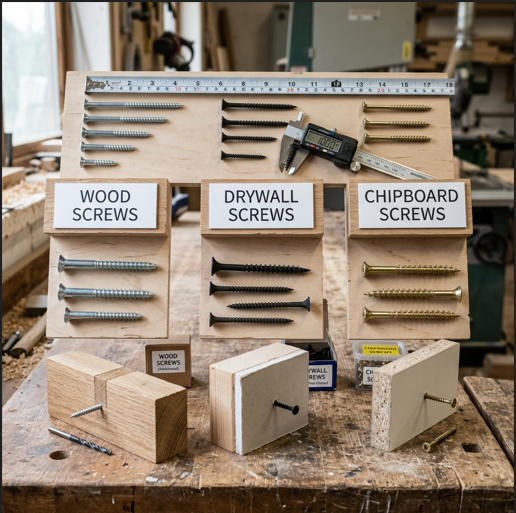
This kind of failure is preventable, but only if you understand how wood screws, drywall screws, and chipboard screws differ in thread geometry, material hardness, coating chemistry, and intended substrate. The three fasteners share a superficial resemblance — all are pointed, all are driven with a standard bit — yet they are engineered for fundamentally different jobs. Using the wrong one does not just “sort of work.” In structural and finish applications, the wrong screw type fails in predictable and costly ways.
This guide delivers the data you need: withdrawal-force numbers across six substrates, shear-strength comparisons, coating salt-spray hours, pilot-hole charts, torque settings, and a cost-per-unit breakdown — so you can pick the right screw the first time.
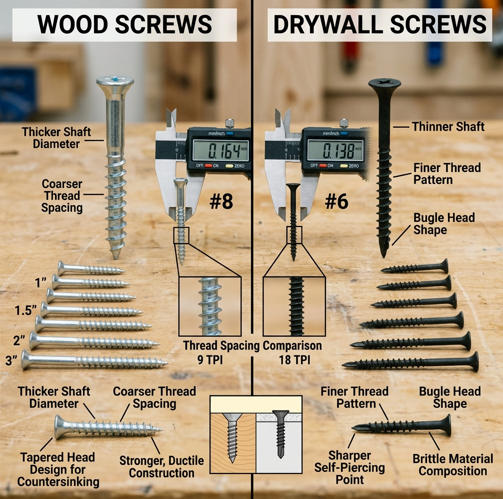
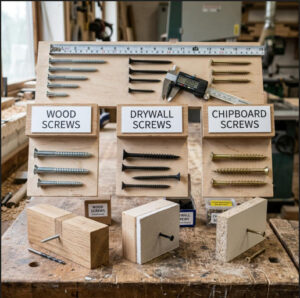
Wood screws are partially threaded with coarse pitch, designed for joining solid wood with high shear strength (280–350 lbf for #10). Drywall screws are case-hardened, brittle fasteners purpose-built for gypsum board — they snap at roughly 90 lbf in shear and should never be used structurally. Chipboard screws feature deep, full-length threads optimized for engineered sheet goods (MDF, particleboard, HDF) and deliver 25–40% higher pull-out resistance in those materials than standard wood screws.
1. What Exactly Are These Three Screws?
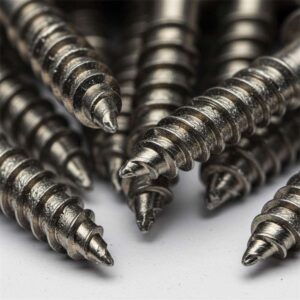
Parafusos de madeira
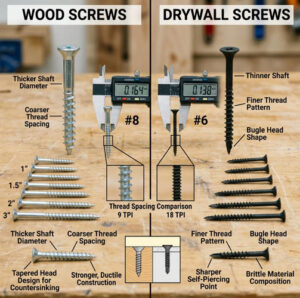
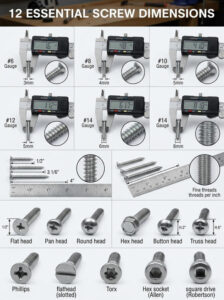
A wood screw is a tapered fastener with coarse threads that occupy roughly two-thirds of the shank length. The unthreaded upper portion acts as a smooth shoulder, pulling the top workpiece tight against the bottom piece as the threaded tip draws into the substrate. Common head styles include flat (countersunk at 82°), round, pan, and hex. Drive types range from Phillips and square (Robertson) to star (Torx). Materials are typically carbon steel with zinc plating, stainless steel (304 or 316), brass, or silicon bronze. A pilot hole is almost always required in hardwoods to prevent splitting, and recommended in softwoods for gauges #10 and larger.
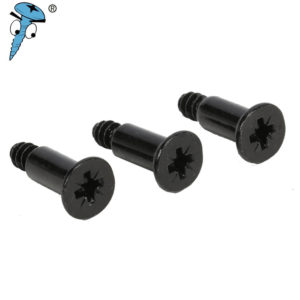
Parafusos Drywall
Drywall screws — also called wallboard screws — are case-hardened, self-tapping fasteners designed to attach gypsum board to wood or metal framing. They come in two sub-types. Coarse-thread (Type W) screws have wider-pitch threads and are used on wood studs. Fine-thread (Type S) screws have a tighter pitch and a sharper self-tapping point, suited for light-gauge metal studs up to 0.8 mm thick. The signature bugle head distributes force across the paper face of the drywall, seating flush without tearing it. The dominant coating is black phosphate, which promotes paint adhesion but offers minimal corrosion resistance (2–5 hours in ASTM B117 salt-spray testing). Over 80% of global demand centres on the 3.5 × 25 mm specification.
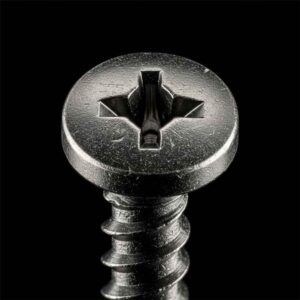
Parafusos de Aglomerado
Chipboard screws (also known as particleboard screws) are heat-treated, self-tapping fasteners engineered for brittle, low-density engineered wood: particleboard, MDF, HDF, melamine-faced board, and plywood. Their defining feature is a deep, full-length thread with a special angle that cuts cleanly without fracturing the panel’s resin-bonded particle structure. Heads are typically countersunk (often double-countersunk) or pan. Drive types favour Pozi and Torx for higher torque transfer and lower cam-out. The most common coatings are yellow zinc chromate and white zinc, which provide 72–96 hours and 8–12 hours of salt-spray protection respectively. According to DataHorizon Research, the global chipboard screw market reached approximately $1.2 billion in 2024.

2. Thread Design: The Core Difference
Thread geometry is what makes or breaks the connection between a screw and its substrate. All three screw types use coarse-category threads, but their pitch, depth, coverage, and taper differ dramatically.
Wood screws feature a partial thread — typically 60–67% of the shank. The unthreaded shoulder is critical: it allows the top workpiece to be clamped against the bottom piece without the threads pushing the two apart (a phenomenon called “jacking”). Thread pitch is medium (roughly 1.8–2.5 mm on #8–#12 gauges), and the taper is gradual, matching the fibre structure of solid wood.
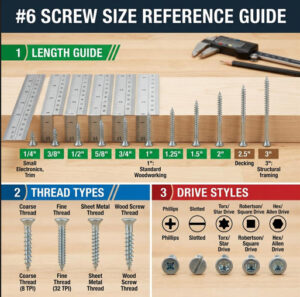
Drywall screws come in two thread variants. Coarse-thread (Type W) has a pitch of approximately 2.0–2.5 mm with a single-lead spiral, driving fast into wood studs. Fine-thread (Type S) has a tighter pitch around 1.0–1.4 mm with twin-lead threads, gripping metal studs without over-spinning. Neither type has an unthreaded shoulder — threads run the full length because drywall is a single-layer, non-structural material that does not require clamping force.
Chipboard screws have full-length threads like drywall screws, but their thread profile is deeper (up to 40% deeper than equivalent-gauge drywall threads) and the thread angle is more acute. This deeper cut creates a larger mechanical interlock inside the loose particle matrix of MDF or particleboard, producing 25–40% higher withdrawal resistance compared to a standard wood screw in the same engineered-wood substrate. Some premium chipboard screws also include a “ribs-under-head” feature — small serrations beneath the countersink that ream a clean pocket in the panel face and prevent surface cracking.
3. Strength Data: Shear, Withdrawal, and Where Each Screw Fails
Numbers matter more than generalities. The table and charts below consolidate lab-tested and field-verified data from the USDA Wood Handbook (FPL-GTR-190), Engineering Toolbox, and manufacturer spec sheets.
Comprehensive Specification & Performance Table
| Especificação | Wood Screw (#10 × 3″) | Drywall Screw (3.5 × 41 mm) | Chipboard Screw (4 × 50 mm) |
|---|---|---|---|
| Diâmetro principal | 0.190 in (4.83 mm) | 0.138 in (3.51 mm) | 0.157 in (4.0 mm) |
| Thread Coverage | ~65% of shank | 100% (full length) | 100% (full length) |
| Passo de linha | 2.1 mm (coarse) | 2.3 mm coarse / 1.2 mm fine | 1.8 mm (deep profile) |
| Thread Depth | 0.5–0.7 mm | 0.4–0.6 mm | 0.7–1.0 mm |
| estilo de cabeça | Flat, pan, round, hex | Bugle (Phillips) | Countersunk / double CSK |
| Tipo de drive | Phillips, Robertson, Torx | Phillips #2 | Pozi #2, Torx T20 |
| Material | Carbon steel / SS 304 / SS 316 | Case-hardened carbon steel | Heat-treated carbon steel |
| Common Coating | Zinc, yellow zinc, ceramic | fosfato preto | cromato de zinco amarelo |
| Salt-Spray Hours (ASTM B117) | 8–500+ (varies by coating) | 2–5 hr (phosphate) | 72–96 hr (yellow zinc) |
| Shear Strength (lbf) | 280–350 | ~90 (brittle snap) | 180–260 |
| Withdrawal – Solid Oak (lb/in) | 211 | 120* | 165 |
| Withdrawal – SPF Softwood (lb/in) | 80 | 52* | 70 |
| Withdrawal – MDF 18 mm (lb/in) | 55 | 38* | 75–90 |
| Withdrawal – Particleboard (lb/in) | 40 | 28* | 60–70 |
| Pilot Hole Required? | Yes (hardwood); recommended (softwood) | No | Optional (recommended for edges) |
| Structural Use Permitted? | Yes (with correct grade) | No — IRC R2508.5 | No (non-structural panel joining) |
| Typical Cost (USD per 100) | $6–$14 | $3–$7 | $5–$11 |
*Drywall screw values in wood/MDF are informational; these are not approved substrates for drywall screws. Data: USDA FPL-GTR-190, Engineering Toolbox, manufacturer testing.
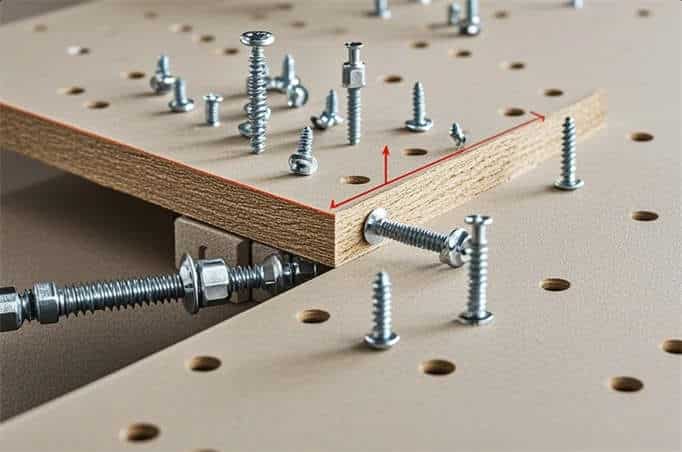
Withdrawal Force by Substrate (lb per inch of penetration)
The bar chart reveals a critical pattern: chipboard screws outperform both wood screws and drywall screws in MDF and particleboard — the substrates they are designed for. In MDF, a #8 chipboard screw delivers approximately 82 lb/in of withdrawal resistance versus only 55 lb/in for a comparable wood screw and 38 lb/in for a drywall screw. The deep, full-length thread profile of the chipboard screw creates a much larger engagement surface within the panel’s resin-bonded particles.
Conversely, in solid oak, wood screws dominate at 211 lb/in — their tapered, coarse threads grip long-grain fibres efficiently. Drywall screws trail at every substrate and should never be relied upon for anything beyond attaching gypsum board.
4. Market Share & Global Demand
Understanding how the industry uses these fasteners puts their roles in perspective. Based on distributor sales data, market research from Grand View Research, e Intel Market Research, the following pie chart shows the approximate global market valuation by screw category in 2024–2025.
Global Screw Market by Category (2024–2025 est.)
Chipboard
The structural/wood screw segment holds the largest share at approximately $4.8 billion globally, driven by residential construction’s 60.6% end-use dominance (per Grand View Research). Drywall screws represent about $2.4 billion, with over 80% of volume concentrated on a single specification (3.5 × 25 mm). The chipboard screw market, at $1.2 billion, is the fastest-growing segment thanks to the expansion of flat-pack furniture manufacturing and engineered-wood construction in Europe and Asia-Pacific.
5. Coating & Corrosion Protection
Coating choice directly controls how long a fastener lasts in its environment. Here is what matters for each screw type.
Drywall screws overwhelmingly use black phosphate. Phosphate is not a corrosion barrier — it is a conversion coating that creates a micro-porous surface for paint and joint-compound adhesion. It provides only 2–5 hours of salt-spray protection per ASTM B117. This is acceptable for interior drywall behind latex paint but entirely inadequate for bathrooms, basements, or any damp environment. For wet-area drywall (like cement board backing), galvanized or zinc-plated drywall screws should be specified.
Wood screws offer the widest coating spectrum. Standard clear zinc provides 8–12 hours of salt-spray protection — fine for interior furniture and cabinet work. Yellow zinc chromate steps up to 72–96 hours, suitable for sheltered outdoor applications like covered porches. Hot-dip galvanised coatings reach 300–500 hours, making them the minimum standard for deck screws in contact with ACQ pressure-treated lumber. Ceramic and polymer coatings (such as those marketed under brand names like Climaseal or Dacromet) push past 1,000 hours and are the choice for coastal or industrial-chemical environments. Stainless steel 304 and 316 bypass the coating question entirely, offering inherent corrosion resistance — though at 2.5–5× the cost of coated carbon steel.
Chipboard screws most commonly use yellow zinc chromate, which balances cost and performance for indoor furniture and cabinetry. For outdoor composite decking or garden structures, prendedor de príncipe supplies chipboard screws in stainless steel and hot-dip galvanised finishes, ensuring long-term hold in weather-exposed engineered wood.
6. Pilot Holes, Torque Settings & Installation Best Practices
Pilot Hole Guide
| Screw Type & Gauge | Hardwood Pilot Hole | Softwood Pilot Hole | MDF / Particleboard |
|---|---|---|---|
| Wood Screw #8 (4.2 mm) | 11/64″ (4.4 mm) | 1/8″ (3.2 mm) | 9/64″ (3.6 mm) |
| Wood Screw #10 (4.8 mm) | 13/64″ (5.2 mm) | 9/64″ (3.6 mm) | 5/32″ (4.0 mm) |
| Drywall Screw 3.5 mm | No pilot hole — driven directly into drywall and stud | ||
| Chipboard Screw 4.0 mm | 7/64″ (2.8 mm)* | Not typically used | 3/32″ (2.4 mm) at edges; none at centre |
| Chipboard Screw 5.0 mm | 1/8″ (3.2 mm)* | Not typically used | 7/64″ (2.8 mm) at edges; none at centre |
*Chipboard screws are rarely used in solid hardwood; values shown are for occasional cabinet-back attachment. Source: Bolt Depot pilot-hole chart, manufacturer data.
Torque Recommendations
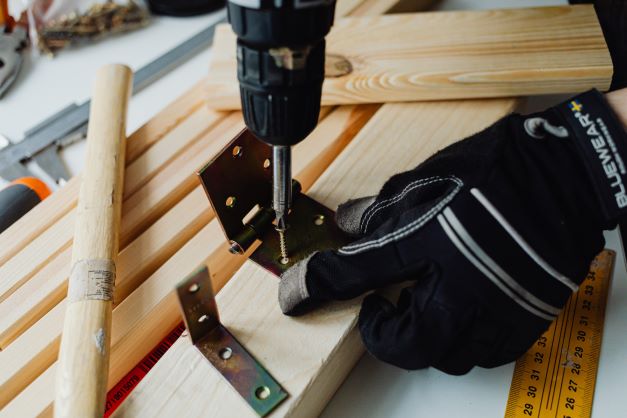
Over-driving is the number-one installation error across all three screw types. For drywall screws, the head should sit just below the paper surface — approximately 0.5–1.0 mm recessed. Most drywall screw guns have an adjustable depth-stop nose piece for this reason. Set the clutch on a cordless driver to its lowest setting (typically position 1–3) when first testing.
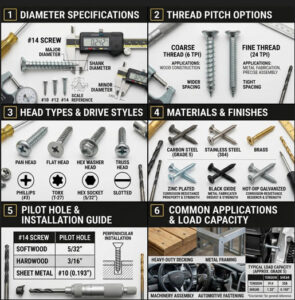
For wood screws in softwood, a torque range of 15–25 inch-pounds prevents stripping the thread pocket. In hardwood, 25–45 inch-pounds is typical for #8–#10 gauges. Always use the correct bit — Phillips #2 for most drywall screws, Pozi #2 or Torx T20 for chipboard screws, and Robertson #2 or Torx T25 for #10 wood screws.
Chipboard screws in MDF require care at the final turn. The panel’s face layer is denser than its core, and over-driving pushes the head past the face into the softer core, destroying holding power. A clutch setting of 4–8 (depending on your driver) usually seats the screw flush without breakthrough.
7. When to Use Each Screw: The 5-Step Decision Flowchart
Rather than memorising tables, apply this logic at every joint:
Step 1 — Identify the substrate. Solid wood (softwood or hardwood)? Gypsum board? Engineered sheet goods (MDF, particleboard, plywood, melamine)? Metal stud?
Step 2 — Define the load type. Is the joint structural (load-bearing wall, deck ledger, beam header) or non-structural (trim, panels, drywall, shelving)?
Step 3 — Select the screw family. Solid wood + structural = wood screw (or structural screw for high loads). Gypsum board + non-structural = drywall screw. Engineered sheet goods + non-structural = chipboard screw. Never cross these boundaries for primary fastening.
Step 4 — Size the screw. The threaded portion must penetrate the receiving member by at least ⅝″ (16 mm) for wood studs, 3 full thread pitches for metal studs, and at least 2× the panel thickness for sheet goods. Example: joining two 18 mm MDF panels face-to-edge requires a chipboard screw at least 36 mm + 18 mm ≈ 50 mm long.
Step 5 — Choose the coating. Interior dry environment = standard zinc or phosphate. Interior damp (bathrooms, laundries) = yellow zinc or galvanised. Exterior = hot-dip galvanised, ceramic, or stainless steel. ACQ-treated lumber = always hot-dip galvanised or stainless — standard zinc reacts with the copper in ACQ treatment.
8. Common Costly Mistakes (and How to Avoid Them)
Mistake 1: Using drywall screws as “general-purpose” wood screws. Drywall screws are cheap (as low as $0.03/unit) and universally available, which tempts DIYers and even some professionals to use them for everything from cabinet installation to deck framing. Their brittle, case-hardened steel is designed to resist the torsional stress of high-speed screw guns in gypsum — not the shear and bending loads of structural wood joints. A #6 drywall screw snaps at roughly 90 lbf in shear. A comparable wood screw handles 280–350 lbf. The FastenMaster engineering team documents multiple deck-collapse investigations where drywall screws were the root cause.
Mistake 2: Driving chipboard screws too close to panel edges. MDF and particleboard have negligible edge tensile strength. Placing a screw closer than 25 mm (1″) to an edge in 18 mm MDF nearly guarantees a blowout. Use a pilot hole and maintain at least 1.5× the panel thickness as an edge distance.
Mistake 3: Using black phosphate drywall screws in wet areas. Phosphate provides 2–5 hours of salt-spray protection. In a bathroom or below-grade basement, those screws begin rusting within weeks, creating brown bleed-through stains on painted drywall. Specify zinc-coated drywall screws or cement board screws for wet-area applications.
Mistake 4: Omitting pilot holes in hardwood. Driving a #10 wood screw into white oak or hard maple without a pilot hole generates enough radial stress to split the workpiece — especially within 2″ of the end grain. A 13/64″ pilot hole eliminates splitting and actually increases withdrawal resistance by ensuring full thread engagement.
Mistake 5: Mixing stainless-steel screws with galvanised hardware. When stainless steel contacts galvanised steel in the presence of moisture, galvanic corrosion dissolves the zinc coating first — then attacks the base steel. Either use all stainless or all galvanised in a single connection.

9. YouTube: Visual Screw-Type Comparison
For a hands-on demonstration of different screw types, thread designs, and when to use each, watch this comprehensive video guide:
10. Where to Source Quality Screws in Bulk
For contractors and furniture manufacturers purchasing thousands of units per order, supply chain reliability and consistent quality control matter as much as unit price. prendedor de príncipe — a fastener manufacturer with over 30 years of industrial experience — supplies parafusos de aglomerado, drywall screws in bulk, self-tapping wood screws, e fixadores de aço inoxidável with OEM/ODM customisation. Their product range covers DIN, ANSI, and ISO standards, with coatings from black phosphate through ceramic polymer. For specification questions or custom orders, their technical team responds within 24 hours.
For retail quantities, Home Depot e Lowe’s stock major brands in-store. For industrial-grade fasteners with mill certifications, McMaster-Carr e Fecho provide same-day or next-day shipping on most #6–#14 screw sizes.

11. Frequently Asked Questions (FAQ)
1. Can I use drywall screws instead of wood screws for hanging cabinets?
No. Drywall screws are case-hardened and brittle — they snap at roughly 90 lbf in shear, while a loaded upper cabinet can impose 150–300 lbf of sustained downward force on each screw. Use #8 or #10 wood screws (or cabinet installation screws) rated for the load. The IRC prohibits drywall screws for structural connections.
2. What makes chipboard screws better than wood screws for MDF?
Chipboard screws have deeper, full-length threads with a more acute angle specifically designed for the resin-bonded particle matrix of MDF and particleboard. In 18 mm MDF, a chipboard screw delivers approximately 75–90 lb/in of withdrawal resistance versus 55 lb/in for a standard wood screw — a 36–64% improvement. The deeper threads also reduce the risk of edge splitting in these brittle materials.
3. Are drywall screws and chipboard screws interchangeable?
No. They share a visual similarity (both are often countersunk with full-length threads), but drywall screws have shallower threads, bugle-style heads, and a phosphate coating optimised for gypsum board. Chipboard screws have deeper threads, double-countersunk heads, and yellow zinc coating designed for engineered wood. Using drywall screws in particleboard typically reduces pull-out strength by 40–55% and increases edge cracking risk.
4. Do I need a pilot hole for chipboard screws in MDF?
For face screwing into the centre of an MDF panel, a pilot hole is usually optional — the self-tapping point handles it. However, for edge screwing (driving into the narrow edge of the board) or when placing a screw within 25 mm of any edge, always drill a pilot hole 60–70% of the screw’s root diameter to prevent the panel from splitting.
5. Which coating should I choose for bathroom drywall screws?
Black phosphate drywall screws are not suitable for high-moisture areas — they offer only 2–5 hours of salt-spray protection and will rust within weeks in a humid bathroom. Use zinc-plated drywall screws (8–12 hours salt spray) at minimum, or better yet, cement board screws with ceramic coating (500+ hours) when fastening through tile backer board.
6. What is the shear strength difference between drywall screws and wood screws?
A standard #6 drywall screw fails in shear at approximately 90 lbf due to its brittle, case-hardened steel. A #10 ductile wood screw handles 280–350 lbf in shear — roughly 3× more. Wood screws bend before breaking, providing a visual warning; drywall screws snap without warning.
7. Can I use chipboard screws for decking?
Standard yellow-zinc chipboard screws are not rated for outdoor exposure. For composite or timber decking, use purpose-built deck screws with hot-dip galvanised or ceramic coating rated for ground contact. If you must use chipboard screws outdoors, select stainless steel 304 or 316 variants — Prince Fastener offers these in their stainless steel product line.
8. How do I calculate withdrawal force for a wood screw?
The USDA Wood Handbook provides the formula F = 2,850 × SG² × D, where F is the allowable withdrawal load in pounds per inch of thread penetration, SG is the specific gravity of the oven-dry wood species, and D is the screw shank diameter in inches. For example, a #10 wood screw (D = 0.190″) in Douglas Fir (SG = 0.50) yields F = 2,850 × 0.25 × 0.190 ≈ 135 lb/in.
9. Why do chipboard screws use Pozi drive instead of Phillips?
Pozi drive transmits approximately 20–30% more torque than Phillips before cam-out because of its additional contact surfaces (8 points versus 4). Since chipboard screws are driven into dense, resin-bonded panels that resist penetration, the higher torque transfer reduces stripped heads and installation failures. Torx (star) drive is even better, with near-zero cam-out rates.
10. Where can I buy chipboard, drywall, and wood screws in bulk?
For factory-direct bulk purchasing with OEM customisation, Prince Fastener’s wholesale programme covers all three screw types in DIN, ANSI, and ISO standards. For retail or mid-volume orders, major distributors such as Fastenal, Grainger, and McMaster-Carr stock standard gauges and lengths with next-day shipping across North America.
Published: April 7, 2026. Data sources: USDA Forest Products Laboratory (FPL-GTR-190), Engineering Toolbox, Grand View Research, DataHorizon Research, Intel Market Research, ASTM B117, manufacturer testing. This guide is for informational purposes; always verify load calculations with a licensed engineer for structural applications.


 Português do Brasil
  English
  Español
  Русский
  日本語
日本語  العربية