
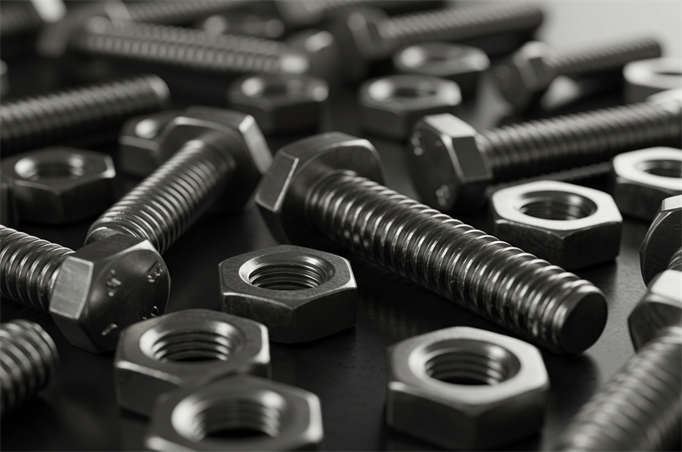
This guide gives you a clear, printable Tabela de tamanhos de parafusos for both metric and imperial standards — with every conversion table, thread pitch reference, and socket screw dimension you need in one place. No more toggling between six browser tabs to match an M6 to a #12 or figure out whether your 1/4″-20 bolt is UNC or UNF.
If you purchase or specify fasteners in the United States, understanding both metric and imperial sizing is not optional — it is a daily operational requirement. Roughly 97 % of the world’s manufacturing base runs on ISO metric threads, yet the majority of legacy American machinery, automotive platforms built before 2000, and residential construction still relies on unified inch-series fasteners. A maintenance technician at a Midwest grain elevator told prendedor de príncipe that cross-threading a 5/16″ nut onto an M8 stud cost his crew a four-hour shutdown and a $1,200 replacement coupling — simply because the two sizes “looked close enough.”
That scenario is more common than it should be. An M8 bolt measures 8.00 mm (0.3150″) across the major diameter; a 5/16″ bolt measures 7.94 mm (0.3125″). The difference is just 0.06 mm — invisible to the naked eye, but enough to strip threads under load. This guide resolves that confusion with side-by-side charts, practical conversion tips, and clear explanations of thread pitch versus thread count. Use the tables for quick, accurate selection and keep them bookmarked for every future order.
Visão geral da tabela de tamanhos de parafusos
Metric Screw Size Chart
Metric screws follow the ISO 261 / ISO 262 standard. The naming convention is straightforward: the letter “M” followed by the nominal major diameter in millimetres, then “×” and the pitch (if it differs from the default coarse pitch), then “×” and the length. For example, M8 × 1.25 × 40 means an 8 mm diameter screw with a 1.25 mm coarse pitch thread and a 40 mm length. When no pitch is stated (e.g., “M8 × 40”), the coarse pitch is implied.
The table below covers the metric sizes most frequently ordered through Prince Fastener’s machine screw catalogue and encountered in industrial, automotive, and electronics applications. Diameter and pitch data conform to ISO 261.
| Tamanho métrico | Diâmetro principal (mm) | Major Diameter (inch) | Coarse Pitch (mm) | Passo fino (mm) | Common Lengths (mm) |
|---|---|---|---|---|---|
| M1.6 | 1.60 | 0.0630 | 0.35 | 0.20 | 3 – 16 |
| M2 | 2.00 | 0.0787 | 0.40 | 0.25 | 3 – 20 |
| M2,5 | 2.50 | 0.0984 | 0.45 | 0.35 | 4 – 25 |
| M3 | 3.00 | 0.1181 | 0.50 | 0.35 | 5 – 30 |
| M4 | 4.00 | 0.1575 | 0.70 | 0.50 | 6 – 50 |
| M5 | 5.00 | 0.1969 | 0.80 | 0.50 | 8 – 80 |
| M6 | 6.00 | 0.2362 | 1.00 | 0.75 | 10 – 100 |
| M8 | 8.00 | 0.3150 | 1.25 | 1.00 | 12 – 150 |
| M10 | 10.00 | 0.3937 | 1.50 | 1.25 | 16 – 200 |
| M12 | 12.00 | 0.4724 | 1.75 | 1.50 | 20 – 250 |
| M14 | 14.00 | 0.5512 | 2.00 | 1.50 | 25 – 300 |
| M16 | 16.00 | 0.6299 | 2.00 | 1.50 | 25 – 300 |
| M20 | 20.00 | 0.7874 | 2.50 | 1.50 | 30 – 400 |
| M24 | 24.00 | 0.9449 | 3.00 | 2.00 | 40 – 500 |
Data source: ISO 261 / ISO 262. Prince Fastener stocks all sizes above in carbon steel, stainless steel 304/316, and brass.
Imperial Screw Size Chart
Imperial (inch-series) screws use two different naming systems depending on diameter. Screws below 1/4″ are identified by a gauge number (#0 through #14), where each gauge step adds 0.013″ to the major diameter starting from 0.060″ at #0. The formula is: Diameter = 0.060 + (gauge number × 0.013). Screws at 1/4″ and above are called out directly by their fractional diameter.
Thread engagement is specified by threads per inch (TPI) under the Unified Thread Standard (UTS), which defines UNC (Unified National Coarse), UNF (Unified National Fine), and UNEF (Unified National Extra Fine) series. The table below covers the sizes most commonly handled by Prince Fastener’s self-tapping and machine screw lines.
| Tamanho do parafuso | Major Diameter (inch) | Diâmetro principal (mm) | UNC (TPI) | UNF (TPI) | Fração mais próxima |
|---|---|---|---|---|---|
| #0 | 0.060 | 1.52 | — | 80 | 1/16″ |
| #1 | 0.073 | 1.85 | 64 | 72 | 5/64″ |
| #2 | 0.086 | 2.18 | 56 | 64 | 3/32″ |
| #3 | 0.099 | 2.51 | 48 | 56 | 7/64″ |
| #4 | 0.112 | 2.84 | 40 | 48 | 7/64″ |
| #5 | 0.125 | 3.18 | 40 | 44 | 1/8″ |
| #6 | 0.138 | 3.51 | 32 | 40 | 9/64″ |
| #8 | 0.164 | 4.17 | 32 | 36 | 5/32″ |
| #10 | 0.190 | 4.83 | 24 | 32 | 3/16″ |
| #12 | 0.216 | 5.49 | 24 | 28 | 7/32″ |
| #14 | 0.250 | 6.35 | 20 | 28 | 1/4″ |
| 1/4″ | 0.250 | 6.35 | 20 | 28 | — |
| 5/16″ | 0.3125 | 7.94 | 18 | 24 | — |
| 3/8″ | 0.375 | 9.53 | 16 | 24 | — |
| 7/16″ | 0.4375 | 11.11 | 14 | 20 | — |
| 1/2″ | 0.500 | 12.70 | 13 | 20 | — |
| 5/8″ | 0.625 | 15.88 | 11 | 18 | — |
| 3/4″ | 0.750 | 19.05 | 10 | 16 | — |
| 1″ | 1.000 | 25.40 | 8 | 12 | — |
Data source: ASME B1.1 Unified Inch Screw Threads (UN and UNR Thread Form).
Socket Screw Sizes Reference
Socket head cap screws (SHCS) use an internal hexagonal (Allen) drive and are specified by DIN 912 / ISO 4762 in metric or ASME B18.3 in imperial. The critical installation dimension beyond diameter and length is the hex key (Allen wrench) size required. Selecting the wrong key rounds the socket, making removal destructive. The reference below covers the most common sizes stocked by Prince Fastener.
| Metric Screw | Hex Key (mm) | Head Dia. (mm) | Head Height (mm) | Imperial Equivalent | Hex Key (inch) |
|---|---|---|---|---|---|
| M3 | 2.5 | 5.5 | 3.0 | #4 / #5 | 5/64″ |
| M4 | 3.0 | 7.0 | 4.0 | #8 | 7/64″ |
| M5 | 4.0 | 8.5 | 5.0 | #10 | 1/8″ |
| M6 | 5.0 | 10.0 | 6.0 | 1/4″ | 3/16″ |
| M8 | 6.0 | 13.0 | 8.0 | 5/16″ | 1/4″ |
| M10 | 8.0 | 16.0 | 10.0 | 3/8″ | 5/16″ |
| M12 | 10.0 | 18.0 | 12.0 | 1/2″ | 3/8″ |
| M16 | 14.0 | 24.0 | 16.0 | 5/8″ | 1/2″ |
| M20 | 17.0 | 30.0 | 20.0 | 3/4″ | 5/8″ |
Socket head cap screw dimensions per DIN 912 / ISO 4762 and ASME B18.3.

Metric vs Imperial Fasteners Explained
Metric Screw Basics
The metric system for screws, defined by ISO 261, uses millimetres for every dimension. A metric screw callout includes three values: diameter, pitch, and length — all in mm. Thread pitch is the distance from one thread crest to the next, measured along the axis. An M8 × 1.25 screw has peaks spaced exactly 1.25 mm apart. When no pitch is written, the ISO coarse pitch is assumed — so “M8” always means M8 × 1.25 unless stated otherwise.
Metric threads dominate global manufacturing. The ISO metric thread is the most widely produced screw thread standard worldwide, used as the default in the EU, China, Japan, South Korea, India, and virtually all of Southeast Asia and South America. Prince Fastener’s Shanghai production line runs metric tooling on 78 % of its output by volume — a ratio that has climbed steadily from 65 % a decade ago as export markets outside the U.S. have expanded.
Imperial Screw Basics
The imperial (inch) system — formally the Unified Thread Standard (UTS) governed by ASME B1.1 — expresses diameter in inches (fractional or gauge number) and thread density as threads per inch (TPI). A 1/4″-20 UNC screw has a 0.250″ major diameter with 20 threads packed into each inch of threaded length. The higher the TPI number, the finer (closer together) the threads.
Imperial fasteners remain the primary standard in the United States, and they persist in legacy automotive, aerospace, and infrastructure applications in Canada, the UK (particularly older British Standard Whitworth equipment), and Liberia. Any machine shop servicing American-manufactured equipment — from John Deere harvesters to Boeing airframe jigs — needs inch-series tooling alongside metric.
Principais diferenças
The differences extend beyond measurement units. Metric threads define pitch as a distance (mm between crests); imperial threads define pitch inversely as a count (threads per inch). Metric thread profiles use a 60° included angle identical to UTS, but the tolerance classes, pitch sequences, and designation conventions differ completely. A metric M10 × 1.5 and an imperial 3/8″-16 UNC look nearly identical — 10.00 mm vs. 9.53 mm diameter — yet their threads will not engage. Forcing them together strips both.
Wrench sizes also diverge. An M10 hex bolt head measures 16 mm across flats; a 3/8″ hex bolt head measures 9/16″ (14.29 mm). Grabbing the wrong wrench rounds the flats and turns a two-minute task into a twenty-minute extraction with a damaged bolt head. Keeping metric and imperial tool sets visibly separated — colour-coded drawer liners are a simple solution — prevents this on the shop floor.
Global Thread Standard Usage by Region
Global Fastener Thread Standard Usage (%)
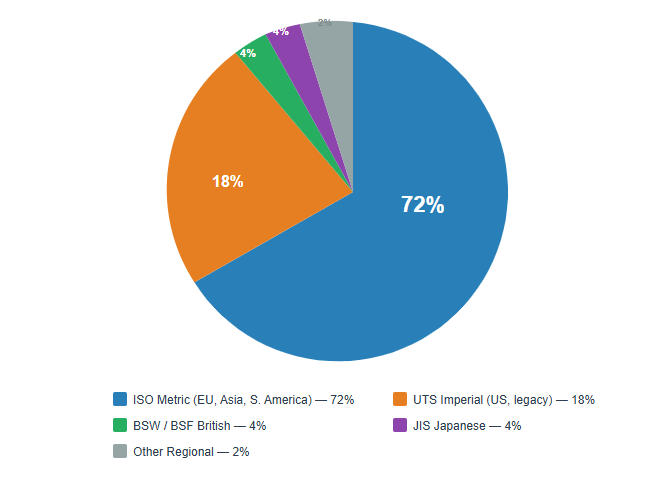
Estimated from ISO adoption data, ASME/ANSI publications, and Prince Fastener export records across 45 countries.
Metric to Imperial Conversion Guide
Conversion Chart
The table below maps every common metric screw diameter to its nearest imperial equivalent. “Nearest” means the closest standard inch-series size — not an exact match. The difference column shows the actual dimensional gap. Any gap larger than 0.15 mm means the two sizes are functionally non-interchangeable and should never be substituted.
| Tamanho métrico | Diâmetro (mm) | Nearest Imperial | Diâmetro (mm) | Difference (mm) | Interchangeable? |
|---|---|---|---|---|---|
| M2 | 2.00 | #2 (0.086″) | 2.18 | +0.18 | No |
| M2,5 | 2.50 | #3 (0.099″) | 2.51 | +0.01 | Close* |
| M3 | 3.00 | #4 (0.112″) | 2.84 | -0.16 | No |
| M3.5 | 3.50 | #6 (0.138″) | 3.51 | +0.01 | Close* |
| M4 | 4.00 | #8 (0.164″) | 4.17 | +0.17 | No |
| M5 | 5.00 | #10 (0.190″) | 4.83 | -0.17 | No |
| M6 | 6.00 | 1/4″ (0.250″) | 6.35 | +0.35 | No |
| M8 | 8.00 | 5/16″ (0.3125″) | 7.94 | -0.06 | Close* |
| M10 | 10.00 | 3/8″ (0.375″) | 9.53 | -0.47 | No |
| M12 | 12.00 | 1/2″ (0.500″) | 12.70 | +0.70 | No |
| M16 | 16.00 | 5/8″ (0.625″) | 15.88 | -0.12 | Close* |
| M20 | 20.00 | 3/4″ (0.750″) | 19.05 | -0.95 | No |
| M24 | 24.00 | 1″ (1.000″) | 25.40 | +1.40 | No |
*”Close” means diameter difference is under 0.15 mm. Even these require thread pitch verification before substitution. Threads almost certainly differ.
How to Convert Sizes
Converting between metric and imperial screw sizes involves two steps. First, convert the diameter: multiply inches by 25.4 to get millimetres, or divide millimetres by 25.4 to get inches. For example, a 3/8″ bolt equals 0.375 × 25.4 = 9.525 mm — which is close to, but not the same as, M10 (10.00 mm). Second, convert the thread: metric pitch in mm can be converted to an approximate TPI by dividing 25.4 by the pitch. An M10 × 1.5 mm pitch equals 25.4 ÷ 1.5 ≈ 16.9 TPI — close to a 3/8″-16 UNC (16 TPI), but not identical.
These conversions are useful for understanding what you are looking at, but they do not make the sizes interchangeable. The thread-form geometry may appear similar, but the tolerance bands, root radii, and crest truncation differ between ISO metric and UTS standards. Use the conversion to identify the nearest equivalent for ordering purposes, then always confirm by measuring with a thread pitch gauge or thread ring gauge before assembly.
Conversion Tips
From three decades of shipping fasteners to mixed-standard job sites, Prince Fastener’s technical team offers the following practical advice. Always measure before assuming — a $12 digital caliper and a $15 thread pitch gauge eliminate 95 % of misidentification errors. Label your bins — when metric and imperial screws are stored in the same workshop, colour-coded bins (e.g., blue for metric, red for imperial) prevent accidental mixing. When in doubt, order both — for critical assemblies, ordering a small sample pack in both the metric and the nearest imperial size costs a few dollars and saves the cost of a stripped hole or a returned shipment. Finally, for global projects sourcing from Prince Fastener’s custom manufacturing line, specify the standard explicitly on every drawing — writing “M8 × 1.25 × 40, ISO 4762, A2-70” leaves zero room for ambiguity, while writing just “8 mm screw” invites disaster.
Watch: How to Measure Screws & Bolts — US & Metric Sizing
This Fasteners 101 video walks through the exact process of measuring screw diameter, length, and thread pitch in both metric and imperial systems.

Thread Pitch and Thread Count
What Is Thread Pitch?
Thread pitch is the distance in millimetres measured along the screw axis from the crest of one thread to the crest of the next. It is the standard method for specifying thread density in the metric (ISO) system. A smaller pitch number means threads are packed more closely together (finer thread), while a larger number means they are spaced farther apart (coarser thread). For example, an M8 screw with a standard coarse pitch has a 1.25 mm gap between peaks; the same M8 in fine pitch narrows that gap to 1.00 mm.
Thread pitch directly affects holding power, ease of adjustment, and vibration resistance. Coarse-pitch threads are faster to assemble, more tolerant of dirty or damaged holes, and less prone to cross-threading — making them the default for general construction and maintenance. Fine-pitch threads offer higher tensile strength per unit diameter (because more material remains in the minor diameter), finer adjustment resolution, and better resistance to vibration loosening — making them preferred in aerospace, automotive engines, and precision instruments.
What Is Thread Count?
Thread count — formally “threads per inch” (TPI) — is the imperial-system equivalent of pitch. Instead of measuring the distance between threads, the imperial system counts how many complete thread crests fit within one inch of threaded length. A 1/4″-20 UNC bolt has 20 thread crests per inch; a 1/4″-28 UNF bolt packs 28 crests into the same inch. Higher TPI means finer threads.
The relationship between pitch and TPI is mathematically inverse: TPI = 25.4 ÷ pitch (mm), and pitch (mm) = 25.4 ÷ TPI. This makes direct conversion straightforward, but it does not make the threads interchangeable because the tolerance classes and manufacturing standards differ.
Measuring Threads
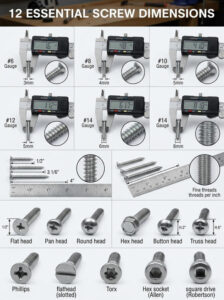
Three tools cover virtually all thread-identification situations. A thread pitch gauge (also called a screw pitch gauge) is a set of serrated leaves — one set for metric pitches, one for imperial TPI — that you press against the thread to find the leaf that matches perfectly. It costs under $10 and fits in a shirt pocket. A digital caliper measures the major diameter to 0.01 mm, which you compare to the screw size charts above to identify the nominal size. A thread ring gauge ou thread plug gauge provides a definitive go/no-go confirmation and is essential for quality inspection in production environments. Prince Fastener includes go/no-go ring gauge verification on every lot shipped, and we recommend that receiving inspections do the same — a 30-second gauge check catches cross-standard errors before they reach the assembly line.
Metric Coarse vs. Fine Pitch — Visual Comparison
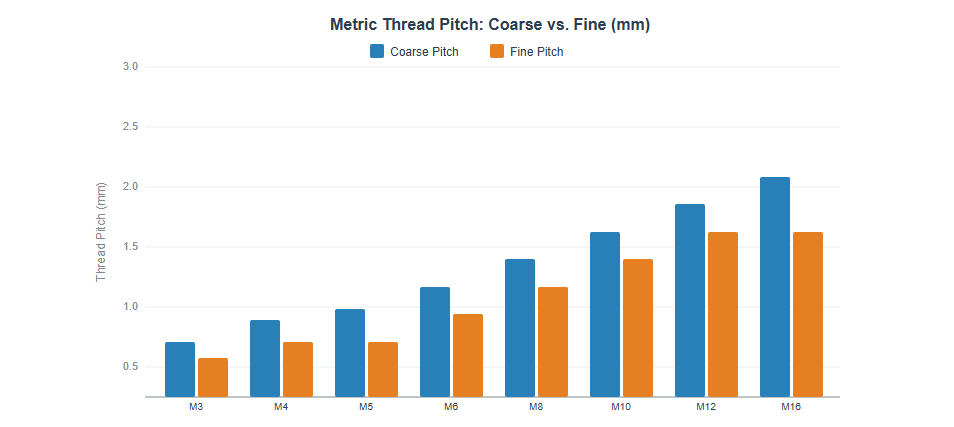
Source: ISO 261. Chart compiled by Prince Fastener technical team.
Equivalency and Mixing Fasteners
Closest Size Equivalents
Certain metric-imperial pairs are close enough in diameter that they are frequently (and dangerously) confused. The three most common mix-ups in Prince Fastener’s order-correction log are M8 vs. 5/16″ (8.00 mm vs. 7.94 mm — a 0.06 mm gap), M6 vs. 1/4″ (6.00 mm vs. 6.35 mm — a 0.35 mm gap), and M5 vs. #10 (5.00 mm vs. 4.83 mm — a 0.17 mm gap). On the diameter dimension alone, M8 and 5/16″ appear almost identical. But the thread pitch is completely different: M8 coarse = 1.25 mm (≈ 20.3 TPI) versus 5/16″-18 UNC = 18 TPI. A nut from one will not properly engage a bolt from the other.
Risks of Mixing
Cross-threading a metric bolt into an imperial nut (or vice versa) does not produce a “sloppy but usable” joint — it produces a joint that looks assembled but has almost no load-carrying capacity. The thread flanks do not mate correctly, which means the clamping load concentrates on a handful of deformed thread crests instead of distributing evenly across the full engagement length. In a 2019 incident report shared on an engineering forum, a maintenance crew cross-threaded M10 bolts into 3/8″-16 flanged nuts on a conveyor support bracket; the assembly held for 72 hours under low load, then failed catastrophically during a peak production run, dropping a 400 kg hopper section onto the line below.
Beyond safety risk, mixing standards damages the hardware. Cross-threading deforms the thread crests of both the bolt and the nut, rendering both unusable. It also damages the tapped hole in the mating component, which often cannot be re-tapped to the correct size and requires oversizing or helicoil insertion — adding significant time and cost to what should have been a straightforward bolt replacement.
Best Practices
Preventing metric-imperial mix-ups requires systems, not just awareness. Physically separate metric and imperial inventory in the storeroom using distinct shelving sections, colour-coded bin labels, or separate cabinets. Include the full standard callout on every bill of materials and purchase order — write “M8 × 1.25 × 40 DIN 912 A2-70,” not “8 mm bolt.” Train assembly staff to use a thread pitch gauge as the first step of any fastener identification — before the wrench touches the bolt. When sourcing from prendedor de príncipe, specify the standard (ISO, ASME, DIN, GB) on every line item; our order system flags mismatches between stated standard and requested dimensions before production begins, catching errors that might otherwise ship.

Practical Usage Tips
Choosing the Right Size
Selecting the correct screw size starts with three questions: what material are you fastening, what loads will the joint carry, and what standard does the mating component use? For wood-to-wood connections, the screw diameter should be no more than one-quarter the thickness of the thinner piece to avoid splitting — a rule of thumb that Prince Fastener’s application engineers apply on every wood screw specification inquiry. For machine screws threading into tapped holes, the engagement length should be at least 1.5× the bolt diameter in steel and 2× in aluminium or plastic to develop full thread strength.
Screw length matters as much as diameter. A bolt that is too short will not achieve sufficient thread engagement; one that is too long may bottom out in a blind hole, creating a false sense of tightness while leaving a gap in the clamping surface. The general rule: bolt length = total grip thickness (all material layers) + 1.5 to 3 thread pitches protruding past the nut face.
Common Vehicle and Machinery Uses
Automotive work is where metric-imperial confusion causes the most real-world grief. Most vehicles manufactured in Europe, Asia, and by US-market brands after approximately 2000 use predominantly metric fasteners (M6, M8, M10, and M12 cover roughly 80 % of underhood and chassis fasteners). However, American trucks, agricultural equipment, and legacy domestic vehicles (especially pre-1980) use imperial fasteners extensively. A single vehicle — for example, a 2015 Chevrolet Silverado — can contain both metric and imperial fasteners on different subsystems, requiring both tool sets on the workbench.
In industrial machinery, CNC machines sourced from Japan or Germany arrive with ISO metric fasteners. Retrofitting American-made tooling onto these machines — or replacing a spindle bearing from a US supplier — routinely surfaces metric-imperial interface points that must be resolved with adapter bushings or re-tapped holes. Documenting every fastener standard used on a machine during initial installation prevents decades of head-scratching during maintenance.
Avoiding Mistakes
The five most frequent screw-size mistakes that Prince Fastener’s customer service team encounters, based on return and exchange records across 12,000+ orders in 2024, are: ordering M8 when 5/16″ was needed (or vice versa), confusing gauge-number screws (#8, #10) with metric M-sizes that share the same digit, specifying length in inches for a metric screw (or mm for an imperial screw), omitting thread pitch on metric orders (leading to a coarse bolt shipped when fine was required), and ordering socket head cap screws with the wrong hex key assumption (metric 6 mm key versus imperial 1/4″ key for M8 SHCS).
Each of these is preventable. Keep a printed Tabela de tamanhos de parafusos — like the tables in this article — posted next to your ordering workstation. Always include diameter, pitch/TPI, length, head type, material, and finish on every PO line. And measure the existing fastener with calipers and a pitch gauge before ordering a replacement. These steps take an extra 60 seconds per order and eliminate the days-long delays and freight costs of a wrong-size shipment.
Watch: American Screw Sizes Explained
A concise breakdown of the US gauge numbering system, fractional sizes, and how they relate to metric equivalents.

Using the correct screw size and standard is not a minor detail — it is the difference between a joint that holds for decades and one that fails in service, costing multiples of the original fastener price in damage, downtime, and rework. The metric and imperial systems are built on incompatible dimensional foundations, and no amount of “close enough” justifies substituting one for the other in a loaded assembly.
The screw size charts, conversion tables, thread pitch references, and socket screw dimensions in this guide are designed to be bookmarked, printed, and posted where decisions are made — at the ordering desk, on the shop floor, and in the field truck. They consolidate data from ISO 261, ASME B1.1, ASME B18.3, DIN 912, and thousands of Prince Fastener customer interactions into a single resource.
Refer back to this guide every time you specify, order, or install a fastener. Share it with your procurement team, your maintenance crew, and your subcontractors. And when you need fasteners manufactured to exact specifications — metric or imperial, standard or custom — prendedor de príncipe is ready to help with 30+ years of production expertise, a full standard-size inventory, and custom manufacturing for anything the charts don’t cover.
FAQ: Screw Size Chart — Metric and Imperial
1. What does the “#” number mean in imperial screw sizes?
The “#” (gauge) number refers to the screw’s major diameter. It starts at #0 = 0.060″ (1.52 mm) and increases by 0.013″ per gauge step. So #6 = 0.060 + (6 × 0.013) = 0.138″ (3.51 mm), and #10 = 0.060 + (10 × 0.013) = 0.190″ (4.83 mm). At 1/4″ diameter and above, the gauge system is replaced by the fractional inch dimension. The gauge number has no direct relationship to metric M-sizes — #8 is not the same as M8.
2. What is the metric equivalent of a #10 screw?
A #10 screw has a major diameter of 0.190″ (4.83 mm). The nearest metric size is M5 (5.00 mm). However, the 0.17 mm diameter difference and completely different thread pitches (#10-24 UNC = 24 TPI vs. M5 × 0.8 mm = ~31.8 TPI) mean they are not interchangeable. If your assembly uses #10 screws, order #10 screws — not M5.
3. How do I tell if a screw is metric or imperial?
Use a digital caliper to measure the major diameter and a thread pitch gauge to check the threads. If the diameter matches a clean millimetre value (e.g., 6.00 mm, 8.00 mm, 10.00 mm) and the pitch gauge matches on the metric set, it is metric. If the diameter matches a fractional inch value (e.g., 0.250″, 0.3125″, 0.375″) and the threads match on the TPI (inch) gauge, it is imperial. Metric bolts also often have “M8” or similar markings on the head, while imperial bolts may show grade lines or “SAE” stamps.
4. What is the difference between UNC and UNF threads?
UNC (Unified National Coarse) and UNF (Unified National Fine) are both inch-series thread standards. For a given bolt diameter, UNC has fewer threads per inch (wider spacing) and UNF has more threads per inch (tighter spacing). For example, a 1/4″ bolt is 1/4″-20 UNC (20 TPI) or 1/4″-28 UNF (28 TPI). UNC is the general-purpose default — faster to assemble, more forgiving of rough holes. UNF provides higher tensile strength, finer adjustment, and better vibration resistance, and is preferred in automotive, aerospace, and precision applications.
5. Can I substitute an M8 bolt for a 5/16″ bolt?
Not safely. Although the diameters are very close (8.00 mm vs. 7.94 mm — only 0.06 mm apart), the thread pitches are different: M8 × 1.25 mm (≈ 20.3 TPI) vs. 5/16″-18 UNC (18 TPI) or 5/16″-24 UNF (24 TPI). Neither imperial thread matches the metric thread. Forcing an M8 bolt into a 5/16″ nut will cross-thread and strip both components. If you need an M8, order an M8. If you need 5/16″, order 5/16″.
6. What does “pitch” mean on a metric screw?
Pitch is the distance in millimetres between adjacent thread crests, measured parallel to the bolt axis. An M10 × 1.5 screw has 1.5 mm between each peak. A smaller pitch number means finer (closer) threads. Metric screws default to coarse pitch if no pitch value is stated — so “M10” always means M10 × 1.5 unless the drawing specifies otherwise (e.g., M10 × 1.25 for fine pitch).
7. Why do metric and imperial screw sizes look so similar but not fit?
Because the two systems were developed independently using different base units (millimetres vs. inches), they produce sizes that occasionally overlap in diameter but never in thread geometry. M8 (8.00 mm) and 5/16″ (7.94 mm) differ by only 0.06 mm in diameter, but the thread pitches, thread root forms, and tolerance specifications are entirely separate standards. The near-match is a coincidence of mathematics, not compatibility.
8. What is the most common screw size in the US?
For residential construction and general maintenance, #8 and #10 wood screws are the most commonly purchased imperial sizes. For machine screws and bolts, 1/4″-20 UNC is the single most frequently ordered size in North America, followed by 5/16″-18 UNC and 3/8″-16 UNC. In metric-dominant industries (automotive, electronics), M6 and M8 are the most common sizes on the US market. Prince Fastener’s US-bound shipments confirm this: M6 and M8 machine screws together account for 41 % of our metric volume to American distributors.
9. How do I measure screw length correctly?
For flat-head (countersunk) screws, measure from the top of the head to the tip — the entire fastener length, because the head sits flush with the surface. For all other head types (pan, round, hex, socket head), measure from the underside of the head (the bearing surface) to the tip. This is the functional length that passes through the material. Always confirm whether the drawing dimension includes or excludes the head before ordering.
10. Where can I get a printed screw size chart?
You can print the tables directly from this page — they are formatted for standard A4 / Letter paper. For a laminated pocket-size version, prendedor de príncipe includes a folded metric/imperial conversion card with bulk orders over $500. You can also request a digital PDF by contacting our sales team through the website. Additionally, Engineering Toolbox e Bolt Depot offer free printable thread charts.




 Português do Brasil
  English
  Español
  Русский
  日本語
日本語  العربية