Purchasing stainless steel hex head bolts online sounds straightforward — until a box of M8 bolts arrives when you needed M10, or 304-grade fasteners show up for a saltwater dock project that demands 316. According to the Global Stainless Steel Fasteners Market Report, the market was valued at approximately USD 7.6 billion in 2023, projected to reach USD 11.5 billion by 2030. With that much volume flowing through online channels, the margin for ordering errors — and the cost of those errors — grows every year.
A 2024 survey of industrial procurement managers found that 23% of online fastener orders required returns or exchanges due to incorrect specifications, wrong material grades, or misleading product descriptions. Each return cycle adds 7–14 days of project downtime and an average shipping penalty of $35–$75 per order.
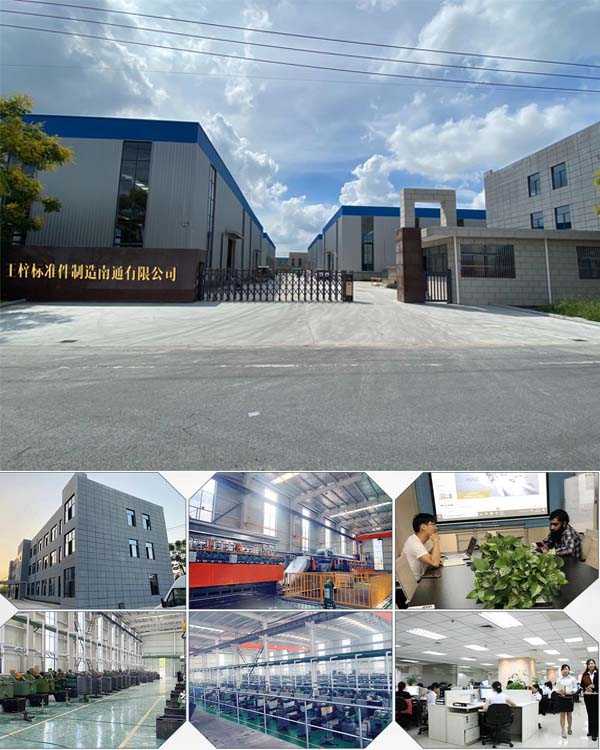
This guide lays out five field-tested strategies — from verifying specifications and comparing true landed costs to vetting sellers, scrutinizing shipping policies, and understanding return terms — so that every hex bolt you order online matches the exact requirements of your project. Suppliers like prendedor de príncipe, with over 30 years of export experience and ISO-certified manufacturing, have seen these mistakes repeat across thousands of orders. The tips below distill that frontline knowledge into an actionable checklist you can use before clicking “Buy.”
1. Check Stainless Steel Hex Head Bolts Specifications
Choose the Right Size and Thread
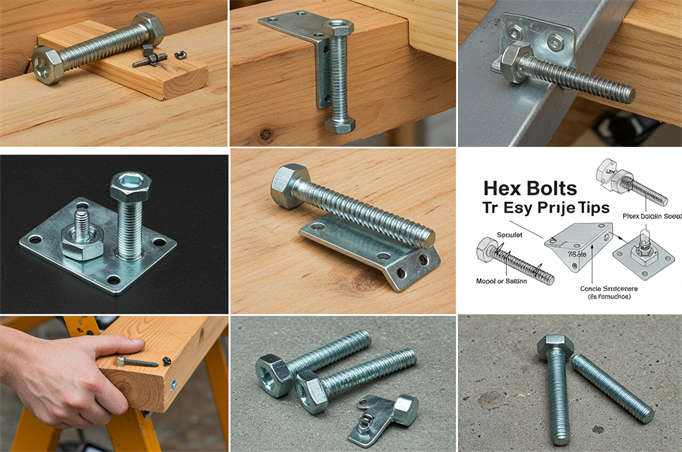
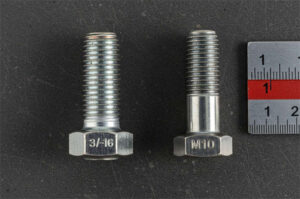
Thread mismatch is the single most frequent cause of fastener returns. Before adding anything to your cart, cross-reference three numbers: nominal diameter, thread pitch, e bolt length. A contractor in Houston shared with Prince Fastener’s technical team that switching from UNC (Unified National Coarse) to UNF (Unified National Fine) threads mid-project added $2,400 in rework on a single commercial HVAC installation because every mating nut had to be re-ordered.
Here is a quick-reference table of popular stainless steel hex head bolt sizes, thread pitches, and typical applications. Keep it bookmarked or printed near your workstation.
| Tamanho do parafuso | Passo da rosca (mm) | Head Width Across Flats (mm) | Typical Length Range (mm) | Common Application |
|---|---|---|---|---|
| M6 | 1.0 | 10 | 12 – 80 | Electronics enclosures, light fixtures |
| M8 | 1.25 | 13 | 16 – 100 | HVAC brackets, furniture frames |
| M10 | 1.5 | 16 | 20 – 150 | Structural steel connections, automotive |
| M12 | 1.75 | 18 | 25 – 200 | Heavy machinery, bridge components |
| M16 | 2.0 | 24 | 30 – 300 | Wind turbine flanges, marine structures |
| M20 | 2.5 | 30 | 40 – 300 | Petrochemical flanges, rail infrastructure |
| 1/4″-20 (UNC) | 1.27 (20 TPI) | 11.1 | 12.7 – 76.2 | General assembly, signage |
| 3/8″-16 (UNC) | 1.59 (16 TPI) | 14.3 | 19 – 152.4 | Deck framing, machinery guards |
Select the Correct Stainless Steel Grade (304 vs 316)
Choosing between 304 and 316 stainless steel is not a cosmetic decision — it directly affects service life. The key differentiator is molybdenum: 316 contains 2–3% molybdenum, which creates a significantly higher resistance to chloride-induced pitting. In a 1,000-hour salt spray test (ASTM B117), 304 bolts typically show visible red rust starting around 200–300 hours, while 316 bolts exceed 700 hours before any corrosion appears.
Here is a side-by-side comparison that makes the choice straightforward:
| Property | 304 (A2 / 18-8) | 316 (A4 / Marine Grade) |
|---|---|---|
| Chromium Content | 18% | 16% |
| Nickel Content | 8% | 10% |
| Molybdenum Content | Nenhum | 2–3% |
| Resistência à tracção | ~515 MPa (75 ksi) | ~485 MPa (70 ksi) |
| Salt Spray Resistance (ASTM B117) | 200–300 hours | 700+ hours |
| Price Premium (vs 304) | Baseline | 20–30% higher |
| Best Use Environment | Indoor, mild outdoor, food processing | Coastal, marine, chemical plants, pools |
A marine hardware distributor in Florida documented that switching from 304 to 316 bolts on their dock railing systems reduced annual replacement rates from 15% of all fasteners down to under 2%, saving roughly $8,700 per year in materials and labor across 12 commercial dock projects. That 20–30% upfront cost difference pays for itself within a single maintenance cycle in corrosive environments.
Review Product Descriptions and Labels
Vague listings are a red flag. If a product page says “stainless steel bolt” without specifying the grade (304, 316, or 18-8), the thread standard (DIN 933, ISO 4014, ASME B18.2.1), or whether the bolt is fully or partially threaded — move on. Reputable suppliers like Prince Fastener’s hex bolt catalog clearly label each product with its material grade, applicable standards (ISO, DIN, ASTM, GB), thread type, and dimensional tolerances. Screenshots or PDF spec sheets attached to listings are an additional trust signal.
2. Compare Costs When Buying Fasteners
Evaluate Unit Price and Bulk Discounts
Stainless steel hex bolt pricing varies dramatically across suppliers. A box of 100 pcs M10×40 304 hex bolts can range from $18 to $45 depending on the seller, minimum order quantity, and sourcing country. The unit price often drops 15–35% when you order in quantities of 500 or more. Before locking in a vendor, request quotes at three quantity tiers — 100, 500, and 1,000 pieces — to map the actual discount curve.
Prince Fastener, which operates its own production lines in China with a 30-year track record, regularly provides tiered pricing that reduces per-unit cost by up to 40% at volumes above 5,000 pieces — a pricing structure that wholesale purchasers and project-based contractors can leverage directly through their website inquiry form.
M10×40 304 SS Hex Bolt — Average Unit Price by Order Quantity
(Based on aggregated 2024–2025 supplier quotes)
$0.42
100 pcs
$0.31
500 pcs
$0.26
1,000 pcs
$0.19
5,000 pcs
Consider Shipping Fees and Taxes
A bolt that costs $0.19/unit looks like a bargain — until you realize the seller charges a $55 flat-rate freight fee, a $12 handling surcharge, and collects sales tax at checkout. Always calculate the total landed cost: (unit price × quantity) + shipping + handling + taxes + any import duties if buying internationally. On a 1,000-piece order of M10 bolts priced at $0.26/unit, a $55 shipping charge adds an effective $0.055 per bolt — a 21% increase that erases half the bulk savings.
Watch for Hidden Charges
Some online fastener stores embed costs for “packaging,” “minimum order surcharges,” or “small order fees” that only appear at checkout. Others charge extra for basic services like providing a material test certificate (Mill Test Report / MTR). Before committing to a purchase, add items to your cart, proceed to the payment preview screen, and compare the total against your original estimate. A $3 “packaging fee” on 10 separate line items means $30 you did not budget for.
3. Assess Seller Credibility

Check Customer Reviews and Ratings
On platforms like Amazon, Alibaba, and specialized industrial marketplaces, sort reviews by “Most Recent” rather than “Top Rated.” Older five-star reviews may reflect a seller’s early quality, while recent patterns of two- and three-star reviews often signal a decline — perhaps a supplier switch or reduced quality-control staffing. Look specifically for reviews that mention dimensional accuracy, material grade verification, e packaging condition on arrival. A listing with 4.6 stars but four recent reviews complaining about stripped threads or wrong grades is riskier than a 4.3-star listing with consistent, specific positive feedback.
Look for Certifications and Trusted Badges
ISO 9001 certification, IATF 16949 (automotive), and ASTM compliance are not marketing slogans — they represent audited quality management systems. Suppliers that publish their certification numbers and allow verification through third-party registrars (such as SGS, TÜV, or Bureau Veritas) demonstrate a level of accountability that uncertified sellers cannot match. prendedor de príncipe maintains ISO 9001 certification and provides material test reports (MTR) on request, which document the chemical composition, tensile strength, and hardness of each production batch — a practice that has made them a preferred supplier for buyers in construction, marine hardware, and automotive aftermarket channels across 50+ countries.
Evaluate Customer Service Responsiveness
Send a pre-purchase technical question — for example, “Can you confirm the salt spray test hours for your 316 hex bolts in M12×60?” — and measure two things: response time e answer quality. A supplier that replies within 4 hours with a specific data point (e.g., “Our M12×60 316 hex bolts passed 720 hours of neutral salt spray per ASTM B117 in our last QC batch, report #PF-2025-0412”) is operating at a fundamentally different level than one that takes three days to respond with “Yes, our bolts are high quality.” The pre-sales experience reliably predicts the post-sales support you will receive when there is an issue.
4. Review Shipping and Delivery Policies
Confirm Delivery Times and Methods
Fastener orders from domestic warehouses typically arrive in 2–5 business days via ground shipping. Orders from overseas manufacturers can range from 15 to 45 days depending on whether they ship by sea freight (cheapest, slowest), air freight (2–5x the cost, 5–10 days), or courier (fastest, most expensive). If your project has a hard deadline — a scheduled pour, a planned shutdown for equipment maintenance — confirm the estimated delivery date in writing before placing the order. Ask whether the quoted lead time starts from payment confirmation or from production completion.
Prince Fastener maintains stocked inventory of popular hex bolt sizes (M6 through M20 in both 304 and 316 grades) and typically ships stocked items within 3 business days. Custom orders with special coatings, non-standard lengths, or specific certifications carry a 15–25 day production lead time, with exact timelines confirmed at quote stage.
Understand Tracking and Order Updates
Reliable sellers provide a tracking number within 24–48 hours of shipment. If a supplier cannot provide real-time tracking through a recognized carrier (UPS, FedEx, DHL, or a freight forwarder with online visibility), treat that as a yellow flag. For large international shipments, ask whether the seller provides a Bill of Lading (B/L) number, container tracking, or a freight forwarder contact you can reach independently. The ability to monitor your order in transit prevents the “where are my bolts?” conversations that stall projects.
5. Understand Returns and Warranty for Fasteners
Read Return Policy Details
Return windows for industrial fasteners typically range from 15 to 30 days. Some sellers only accept returns on unopened, full boxes — meaning if you opened one bag from a case of 10 to verify dimensions, the other nine bags may no longer be returnable. Read the fine print for restocking fees (commonly 10–25% of the order value) and who pays return shipping. On a $500 fastener order, a 20% restocking fee plus $45 return shipping means you lose $145 even when the mistake was the seller’s listing error.
Clarify Warranty Coverage
Most stainless steel fasteners are sold without a traditional “warranty” in the consumer electronics sense. Instead, the guarantee is embedded in the material certification. A reputable supplier guarantees that the bolts meet the stated material specification (e.g., ASTM A193 Grade B8 for 304, or B8M for 316) and the dimensional tolerance of the applicable standard (e.g., DIN 933 for full-thread hex bolts). If testing reveals the bolts are out of spec, the supplier should replace the order at no charge. Ask the question directly before buying: “If an independent lab test shows these bolts don’t meet the stated ASTM specification, will you replace the full order including shipping?”
Know the Process for Returns or Exchanges
Document everything. Take timestamped photos of the shipping label, the outer packaging condition, and the product markings (head stamps, grade labels) immediately upon delivery. If something is wrong, file the return request within 24 hours using the seller’s designated process — email, web form, or platform dispute system. Suppliers with streamlined return processes, like Prince Fastener’s dedicated account management system, can issue replacement orders or credits within 48 hours of verified claims, minimizing project delays.
Video Resource: Understanding Fastener Grades & Materials
This in-depth video from Fasteners 101 walks through the differences between stainless steel grades, strength classifications, and how to read bolt head markings — essential knowledge for anyone buying hex head bolts online:
What Buyers Get Wrong Most Often — By the Numbers
Based on return-and-exchange data aggregated from online fastener distributors (2023–2025), the following pie chart shows why stainless steel hex bolt orders go wrong:
Top Reasons for Stainless Steel Hex Bolt Returns
Returns
by Reason
Wrong Grade — 27%
Damaged in Shipping — 17%
Misleading Description — 12%
Other — 6%
The takeaway is clear: 65% of returns — wrong size and wrong grade combined — are entirely preventable by verifying specifications and material grade before clicking “Buy.” That is exactly what Tips #1 and #2 in this guide address.
Buying stainless steel hex head bolts online does not have to be a gamble. By systematically checking specifications (size, thread pitch, and grade), comparing total landed costs rather than unit price alone, vetting the seller’s certifications and responsiveness, confirming shipping timelines with tracking, and reading return policies before you need them, you eliminate the five failure points that account for the vast majority of bad purchasing experiences.
These are not theoretical suggestions — they are the distillation of decades of real-world order data from suppliers like prendedor de príncipe, who process thousands of international fastener shipments annually. Apply this five-point checklist to your next order, and you will spend less time managing returns and more time building.
Have a question about stainless steel hex bolt specifications, bulk pricing, or custom orders? Contact Prince Fastener’s technical team for a same-day response, or share your own buying tips in the comments below.
Frequently Asked Questions (FAQ)
What is the difference between 304 and 316 stainless steel hex head bolts?
The primary difference is chemical composition. 316 stainless steel contains 2–3% molybdenum, which gives it significantly higher resistance to chloride corrosion and pitting compared to 304. In salt spray testing (ASTM B117), 316 bolts typically last over 700 hours before showing corrosion, versus 200–300 hours for 304. 316 is the preferred choice for marine, coastal, and chemical processing environments, while 304 works well for general indoor and mildly outdoor applications. 316 bolts cost 20–30% more than 304, but in corrosive settings, they reduce replacement frequency by up to 85%, making them more economical over the full service life. For a detailed comparison and grade selection guidance, visit Prince Fastener’s stainless steel fastener page.
How do I measure the correct size for stainless steel hex head bolts?
You need three measurements: the nominal diameter (measured across the outside of the threads), the thread pitch (distance between adjacent thread crests, in mm for metric or threads per inch for imperial), and the bolt length (measured from under the head to the tip). Use a caliper for the diameter, a thread pitch gauge for the pitch, and a ruler or caliper for the length. Matching all three to your application’s specifications — not just the diameter — prevents the thread compatibility issues that cause 38% of online fastener returns.
Are stainless steel hex bolts stronger than grade 8 bolts?
Not in terms of tensile strength. Grade 8 carbon steel bolts have a minimum tensile strength of approximately 150,000 psi (1,034 MPa), while 304 stainless hex bolts sit around 75,000 psi (515 MPa) and 316 at about 70,000 psi (485 MPa). However, stainless steel hex bolts far outperform grade 8 in corrosion resistance. Grade 8 bolts will rust quickly in wet or chemical environments unless they carry a protective coating, and coatings can wear or chip over time. If your application requires both high strength and corrosion resistance, consider using a B8M Class 2 (strain-hardened 316) bolt, which reaches roughly 110,000 psi tensile strength while retaining marine-grade corrosion resistance.
What certifications should I look for when buying stainless steel bolts online?
At minimum, look for ISO 9001 certification from the manufacturer, which verifies a structured quality management system. For material traceability, request a Mill Test Report (MTR) or Certificate of Conformance that documents the heat number, chemical analysis, and mechanical test results per ASTM A193/A194 or the relevant standard. Additional valuable certifications include IATF 16949 (for automotive-grade requirements), CE marking (for European market compliance), and RoHS/REACH compliance (for environmental standards). Suppliers like prendedor de príncipe provide MTRs on request and maintain ISO 9001 across their production facilities.
How much do stainless steel hex head bolts cost?
Prices depend on size, grade, quantity, and supplier. As a benchmark, an M10×40 304 stainless steel hex bolt averages $0.19–$0.42 per piece depending on order volume (higher volume = lower unit price). 316 grade bolts cost approximately 20–30% more than 304 in the same size. International freight, import duties (if applicable), and handling fees add to the total landed cost, so always calculate the full per-unit cost including shipping before comparing suppliers.
Can I use 304 stainless steel bolts outdoors?
Yes, but with conditions. 304 performs well in general outdoor environments — urban rooftops, fencing, non-coastal pergola framing — where exposure to chlorides is minimal. It will eventually show surface discoloration or tea staining in mildly humid conditions, but this is cosmetic rather than structural. However, within 10 miles of a coastline, near swimming pools (chlorine), or in industrial areas with chemical exposure, 304 will corrode prematurely. For any environment where salt, chlorine, or acidic chemicals are present, upgrade to Aço inoxidável 316.
What does “18-8 stainless steel” mean on a bolt listing?
The designation “18-8” refers to the approximate composition of the alloy: 18% chromium and 8% nickel. It is a general category that includes both 302 and 304 stainless steel. Most fasteners sold as “18-8” are actually 304 grade. If a listing says “18-8” without specifying 304 or 302, it is safe to treat it as 304-equivalent for general-purpose applications. However, if your specification explicitly calls for 304, confirm with the seller that the product meets ASTM A193 Grade B8 or the equivalent standard.
How do I avoid counterfeit or substandard stainless steel bolts when buying online?
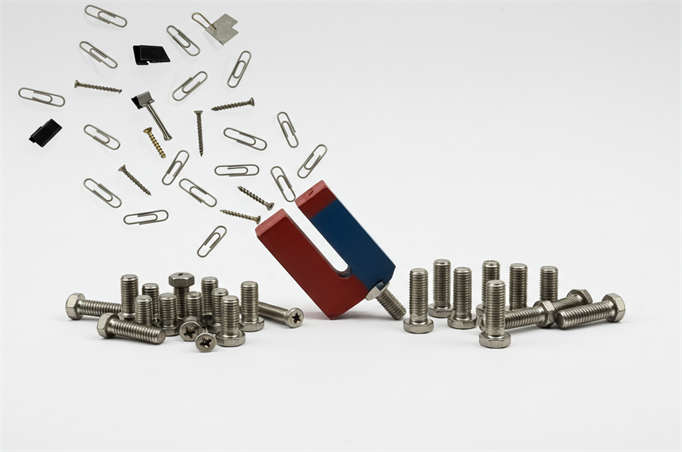
Three defenses work together. First, buy from sellers that provide a Mill Test Report (MTR) traceable to a specific heat number. Second, use a portable XRF analyzer or a simple magnet test on arrival — genuine austenitic stainless steel (304, 316) is non-magnetic or only very weakly magnetic; if a bolt marketed as “stainless” sticks firmly to a magnet, it is likely a ferrous substitute. Third, purchase from manufacturers or authorized distributors rather than anonymous resellers. prendedor de príncipe, as a direct manufacturer, provides full material traceability from raw material sourcing through finished product.
What is the best way to buy stainless steel hex bolts in bulk?
For bulk orders (500+ pieces), contact the manufacturer or a direct-supply distributor rather than buying through retail marketplaces. You gain access to tiered pricing (typically 15–40% below retail per-unit cost), the ability to specify exact material grades and certifications, and dedicated account support for order tracking and quality claims. Request quotes from at least three suppliers at matching specifications, and compare on total landed cost — not just unit price. Suppliers like prendedor de príncipe offer OEM, ODM, and private-label options with MOQ flexibility for repeat buyers.
Do stainless steel hex head bolts need washers?
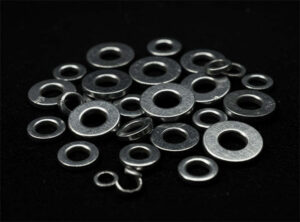
In most structural and mechanical applications, yes. A flat washer distributes the clamping load across a wider surface area, reducing the risk of the bolt head or nut embedding into softer materials (wood, aluminum, composite panels). A lock washer or a Nord-Lock washer pair adds vibration resistance. For stainless-on-stainless connections, using a stainless steel washer also prevents galvanic corrosion that can occur when stainless bolts contact dissimilar metals. Always match the washer material to the bolt material — pairing a zinc-plated carbon steel washer with a 316 bolt creates a galvanic cell that will corrode the washer within months in outdoor conditions.


 Português do Brasil
  English
  Español
  Русский
  日本語
日本語  العربية