
A contractor in Austin, Texas, once framed an entire closet organizer system using drywall screws — 6 pounds of them — because they were the cheapest option in his van. Three months later, two shelves collapsed under a load of winter clothing. The screw heads had not pulled through. The shanks had snapped. Drywall screws are case-hardened carbon steel: extremely hard on the surface, extremely brittle at the core. Under sustained lateral load, they fracture without warning — no bending, no deformation, just a clean break.
That failure was entirely preventable. Wood screws and drywall screws look similar in a box. Both are pointy. Both have Phillips drives. Both come in lengths from 1″ to 3″. But their dimensions, thread geometry, and load behavior are engineered for fundamentally different tasks. A drywall screw is designed to do one thing well: attach gypsum board to framing without tearing the paper face. A wood screw is designed to create a strong, lasting mechanical joint between two pieces of solid or engineered wood.
This guide compares the two screw types across every dimension that matters for structural integrity and installation quality: diameter, length, pitch, thread profile, head style, drive type, material, coating, load capacity, embedment depth, and failure behavior. By the end, you will know when to choose each type, how to read their dimensions, and how thread design determines whether your project stands or falls.
Overview of Wood Screws and Drywall Screws
Purpose of Each Screw Type
Parafusos de madeira are engineered to create structural mechanical joints in solid wood, plywood, MDF, particleboard, and other wood-based substrates. Their thread geometry — deep, coarse, and often partially threaded — is optimized to displace wood fibers and grip them under tension and shear. They are specified for furniture frames, cabinetry, deck framing, shelving, and any connection where the screw is the primary load-bearing element.
Parafusos para drywall serve a single, specific function: securing gypsum wallboard to wood or metal framing. Their bugle-shaped head is designed to sink just below the paper face without tearing it, creating a surface ready for joint compound and paint. Their thin shank minimizes cracking in the brittle gypsum core. They are never intended to carry structural loads beyond holding the weight of the drywall panel itself.
Key Differences at a Glance
| Característica | Parafuso de Madeira | Parafuso Drywall |
|---|---|---|
| Primary purpose | Structural wood-to-wood joints | Attaching gypsum board to framing |
| Common gauges | #6, #8, #10, #12, #14 | #6, #8 (occasionally #7) |
| Length range | 3/8″ to 6″ | 1″ a 3″ |
| Thread type | Coarse, deep, tapered; often partial thread | Coarse (W-type) or fine (S-type); full thread |
| Estilo de cabeça | Flat (countersunk), pan, round, oval | Bugle head exclusively |
| haste | Smooth upper shank + threaded lower | Fully threaded, thinner shank |
| Material | Carbon steel, stainless, brass, silicon bronze | Case-hardened carbon steel |
| Typical coating | Zinc, yellow zinc, ceramic, none (stainless) | Black phosphate or gray phosphate |
| Pull-out in softwood | ~3.1 kN (#8 gauge) | ~1.8 kN (#6 gauge) |
| Failure mode | Bends before breaking (ductile) | Snaps without warning (brittle) |
Typical Dimensions
Length Ranges
Wood screws are manufactured in lengths from 3/8″ (for hinge mounting and trim) to 6″ (for structural timber connections and lag-type applications). The most commonly stocked sizes fall between 3/4″ and 3″, covering the vast majority of furniture, cabinetry, and general woodworking joints.
Drywall screws have a narrower length range — typically 1″ to 3″ — because their job is always the same: penetrating through a gypsum panel (usually 1/2″ or 5/8″ thick) and engaging the framing behind it. The Home Depot drywall guide recommends 1-1/4″ screws for 1/2″ panels and 1-5/8″ screws for 5/8″ panels — lengths that provide roughly 3/4″ of thread engagement into the stud.
Diameter and Gauge
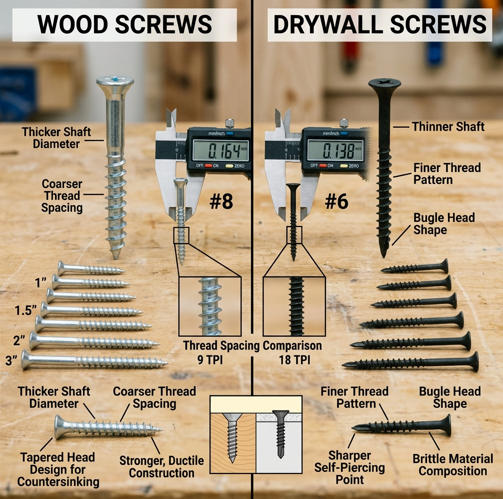
Wood screws span a wide gauge range: #6 (0.138″ / 3.5 mm) for light trim work up through #14 (0.250″ / 6.35 mm) for heavy structural joints. The most versatile general-purpose size is #8 (0.164″ / 4.2 mm), which balances strength and splitting resistance across most softwood and hardwood species.
Drywall screws are almost exclusively #6 (0.138″ / 3.5 mm) or #8 (0.164″ / 4.2 mm). The thinner #6 is preferred because it minimizes cracking in the brittle gypsum core while providing adequate pull strength against the panel’s own weight. Going larger than #8 in drywall serves no purpose and risks blowing out the gypsum around the screw hole.
Thread Pitch Norms
Wood screw thread pitch varies by gauge and manufacturer but is not standardized the way machine screw threads are. A typical #8 wood screw has roughly 9–11 threads per inch (TPI), with each thread cutting deeply into the wood fiber. The pitch is designed to maximize fiber displacement and holding power.
Drywall screws come in two distinct thread pitches. Coarse-thread (W-type) screws — designed for wood studs — have approximately 9 TPI with wide, aggressive threads. Fine-thread (S-type) screws — designed for light-gauge metal studs (20–25 gauge) — have approximately 18 TPI. The fine threads grip the thin metal without stripping. Using a fine-thread screw on a wood stud results in significantly lower holding power; using a coarse-thread screw on a metal stud results in poor engagement and spin-out.
| Dimensão | Wood Screw (#8) | Drywall Screw, Coarse (#6) | Drywall Screw, Fine (#6) |
|---|---|---|---|
| diâmetro maior | 0.164″ (4.17 mm) | 0.138″ (3.51 mm) | 0.138″ (3.51 mm) |
| Shank diameter | 0.128″ (3.25 mm) | 0.110″ (2.79 mm) | 0.110″ (2.79 mm) |
| Thread pitch (TPI) | ~11 | ~9 | ~18 |
| Thread depth | Deep (0.018″) | Moderate (0.014″) | Shallow (0.008″) |
| Available lengths | 3/8″ – 6″ | 1″ – 3″ | 1″ – 3″ |
| Head diameter | 0.320″ (flat head) | 0.311″ (bugle head) | 0.311″ (bugle head) |
| Thread coverage | Partial (60–75% of length) | Full (100% of length) | Full (100% of length) |
Thread Design Differences
Wood Screw Thread Style
The wood screw thread is engineered for one purpose: maximum fiber grip. The threads are deep, widely spaced, and cut at an aggressive angle that displaces wood fibers outward as the screw advances. This displacement creates a compression zone around each thread that resists pull-out.
Most wood screws are partially threaded — the upper portion of the shank is smooth, and only the lower 60–75% carries threads. This design is critical for two-piece joints. The smooth shank passes through the top piece without gripping it, while the threaded portion pulls into the receiving piece. The result is a clamping action that draws the two boards tight against each other. If the screw were fully threaded, the upper threads would grip the top piece and prevent it from being drawn tight — creating a gap.
Thread geometry also varies by tip style. Standard wood screws have a gimlet point (a sharp, tapered tip that centers the screw). Modern parafusos de aglomerado — a sub-category of wood screws designed for particleboard and MDF — add a cutting rib near the tip and a nibs feature under the head to reduce torque and prevent surface cracking in engineered wood.
Drywall Screw Thread Style
Drywall screw threads are fully threaded from tip to head. There is no smooth shank section. This makes sense for drywall installation: the screw passes through a single thin panel (1/2″ or 5/8″) and engages the stud behind it. There is no second piece to clamp — the gypsum board simply needs to be held against the framing.
Coarse-thread drywall screws (W-type) have threads similar in spacing to wood screws but shallower. They are optimized for wood studs. Fine-thread drywall screws (S-type) have threads spaced roughly twice as closely, designed to tap into thin-gauge steel studs without stripping. Prince Fastener’s drywall screw range includes both W-type and S-type configurations, manufactured with controlled-hardness heat treatment that balances driving ease against shank brittleness — a trade-off that directly affects on-site performance.
Self-Tapping vs. Self-Drilling Notes
Both wood screws and drywall screws are auto-roscante — they cut their own threads as they advance into wood. Neither requires a pre-tapped hole. However, neither type is autoperfurante. A self-drilling screw has an integrated drill-bit tip that bores its own pilot hole through metal before threading. If you are attaching drywall to heavy-gauge steel framing (16 gauge or thicker), you need a self-drilling drywall screw — sometimes called a “Tek” screw — rather than a standard sharp-point drywall screw. Prince Fastener manufactures parafusos autoperfurantes specifically rated for metal-stud penetration up to 14-gauge steel.
Head Styles and Drive Types
Common Wood Screw Heads
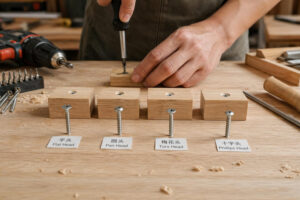
Flat (countersunk) head — The default for woodworking. The 82° tapered head (US standard) seats flush with or below the wood surface in a countersunk or countersunk-and-counterbored hole. This is the head specified for face frames, tabletops, drawer construction, and any application where a flush or plugged surface is required.
Cabeça de panela — A low-profile dome that sits above the surface. Pan heads are used where the screw will remain visible or where clamping force must be distributed over thin or soft material without the screw pulling through. Common in bracket mounting and sheet-goods assembly.
Round head — A taller dome profile, largely replaced by pan head in modern manufacturing but still specified in restoration and decorative hardware.
Oval (raised countersunk) head — Combines the flush seating of a flat head with a decorative domed top. Used in finish carpentry where the screw is visible and aesthetics matter.
Common Drywall Screw Heads
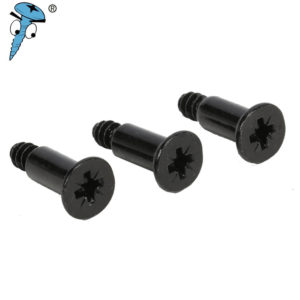
Drywall screws use exactly one head style: the bugle head. The bugle head looks similar to a flat/countersunk head but has a critical geometric difference — instead of a straight 82° taper, it has a curved, concave taper that transitions smoothly into the shank. This curve distributes driving force over a wider area of the gypsum paper face, preventing the head from punching through the paper and into the crumbly gypsum core. A flat-head wood screw driven into drywall will tear through the paper because its sharp 82° edge acts like a cutting die.
Drive Compatibility and Issues
Both screw types are most commonly manufactured with #2 Phillips drive recesses. This creates a compatibility convenience — one bit handles both — but it also enables the most common installation error: accidentally using the wrong screw because they accept the same driver.
Premium wood screws increasingly ship with Torx (star) ou Robertson (square) drives, which provide higher torque transfer and virtually eliminate cam-out. Drywall screws remain overwhelmingly Phillips because drywall installation requires speed over precision, and Phillips bits are universally available. However, specialized drywall screw guns with adjustable depth stops compensate for Phillips cam-out by controlling penetration depth mechanically.
Material and Coating Considerations
Classic Steel vs. Variants
The material difference between these two screw types is one of the most consequential — and least understood — distinctions in the fastener aisle.
Parafusos de madeira are made from low-to-medium carbon steel that has been through-hardened or left unhardened. The result is a ductile fastener — one that bends under excessive load rather than snapping. This ductility is a critical safety feature in structural connections. A bending screw gives visible warning of overload. A snapping screw gives none. Wood screws are also available in stainless steel (304 and 316 grades for outdoor and marine use), brass (for decorative and corrosion-resistant applications), and silicon bronze (for boatbuilding).
Parafusos para drywall are made from carbon steel that has been case-hardened — the surface is heat-treated to create a hard outer shell (HRC 50–56) while the core remains softer (HRC 28–38). This gives the screw enough surface hardness to self-tap into wood and metal studs, but the brittle case makes the screw prone to sudden fracture under lateral load. This is not a manufacturing defect; it is an intentional design trade-off. A drywall screw does not need ductility because it is only expected to resist pull-out from the gypsum panel’s own weight — not shear, impact, or dynamic loads.
Coatings for Corrosion Resistance
Wood screws are available with a wide range of coatings: clear zinc for indoor use (8–12 hours salt-spray resistance), yellow zinc for semi-outdoor use (72–96 hours), ceramic/epoxy for full outdoor exposure (500–1,000+ hours), and no coating for stainless steel. This versatility allows wood screws to be matched to virtually any environment.
Drywall screws almost universally carry a black phosphate coating. Black phosphate provides adequate corrosion resistance for indoor wall cavities — the only environment drywall screws are designed to operate in. Salt-spray testing shows black phosphate coatings withstand 2–5 hours before rust initiation, compared to 8–12 hours for zinc plating. This is why using drywall screws in bathrooms, exterior soffits, or any moisture-prone location leads to rust streaking within months. For wet-area drywall installation, specify zinc-plated or stainless steel drywall screws — a specialty product, but one that eliminates the corrosion risk entirely.
Impact on Load Performance
Material and coating interact with load capacity in a non-obvious way. The case-hardened surface of a drywall screw gives it high initial drive-in torque resistance — it self-taps cleanly. But that same hardness means the screw has almost zero plastic deformation before failure. Under a shear load that slowly increases, a wood screw will bend 15–30° before yielding, giving the assembly visible distortion as a warning sign. A drywall screw will hold at full capacity until it reaches its fracture threshold, then snap instantaneously.
In pull-out testing per ASTM F1575, #8 wood screws driven into SPF (spruce-pine-fir) framing lumber resist approximately 3.1 kN of withdrawal force. Coarse-thread #6 drywall screws in the same lumber resist approximately 1.8 kN — 42% less. The difference is driven by three factors: the wood screw’s larger gauge, deeper threads, and greater thread-to-shank ratio.
Chart 1: Pull-Out Resistance in SPF Softwood — Wood Screw vs. Drywall Screw (kN)
#8 × 1-1/2″
#6 Coarse × 1-5/8″
#6 Fine × 1-5/8″
Data based on ASTM F1575 testing in SPF lumber. Values represent average withdrawal resistance.
Load Transfer and Holding Power
Pull-Out vs. Shear
Pull-out (withdrawal) load acts along the screw axis — pulling the screw straight out of the material. Thread depth, thread count, embedment length, and wood density all contribute to pull-out resistance. Wood screws outperform drywall screws in pull-out by a wide margin because their deeper threads displace more fiber and their partial threading allows the smooth shank to act as a dowel, resisting lateral movement.
Shear load acts perpendicular to the screw axis — pushing sideways. Shear resistance depends on the screw’s shank diameter and its material’s yield strength. This is where the brittle/ductile distinction becomes critical. A wood screw’s ductile shank deforms gradually under shear, distributing force across the joint. A drywall screw’s case-hardened shank resists deformation until it fractures suddenly. Testing by Matthias Wandel at Woodgears.ca confirmed that drywall screws consistently snap under lateral impact loads that only bend wood screws.
Embedment Depth
The USDA Forest Products Laboratory’s Wood Handbook (Chapter 8) specifies that screw thread embedment into the receiving member should equal at least 6× the screw’s major diameter for full withdrawal resistance. For a #8 wood screw (0.164″), that means a minimum of approximately 1″ of thread engagement. For a #6 drywall screw (0.138″), the minimum is approximately 0.83″.
In practice, drywall installation easily meets this threshold. A 1-1/4″ coarse-thread drywall screw through 1/2″ drywall provides 3/4″ of engagement into the stud — 5.4× the screw diameter. But when that same drywall screw is repurposed for woodworking — say, joining two 3/4″ boards — the engagement drops to only 1/2″ (3.6× diameter), below the 6× threshold. This is another reason why drywall screws underperform in wood joints.
Load Rate Considerations
Fastener connections in wood are rate-sensitive. Loads applied slowly (dead loads — the weight of materials) produce different failure modes than loads applied suddenly (impact loads — a dropped object, a slammed door, a child swinging on a shelf). The National Design Specification for Wood Construction (NDS) applies a load-duration factor that reduces allowable design values for sustained loads compared to short-term loads.
Drywall screws supporting gypsum panels experience only sustained dead loads — the constant weight of the drywall. Wood screws in a bookshelf bracket experience sustained dead loads plus intermittent live loads (adding and removing books). Wood screws in a playground structure experience sustained dead loads plus impact loads (children jumping). Each scenario demands a different design margin, and only wood screws are rated for the latter two.
Applications and Use Cases
Woodworking vs. Drywall Installation
Woodworking applications for wood screws: face-frame assembly, table apron joints, cabinet carcass construction, drawer slide mounting, hinge installation, shelf support, deck framing, fence rail attachment, and structural timber connections. In each case, the screw resists a combination of withdrawal and shear loads, often under cyclic or dynamic conditions. A production cabinet shop in Michigan reported using Prince Fastener parafusos de aglomerado at a rate of 8,000 units per week across 14 CNC assembly stations, with a joint callback rate under 0.02% over a 24-month tracking period — a level of consistency that depends on precise thread geometry and uniform heat treatment across every batch.
Drywall applications for drywall screws: attaching gypsum panels to wood studs (coarse thread), attaching gypsum panels to light-gauge metal studs (fine thread), securing cement backer board in wet areas (with appropriate corrosion-resistant coating), and hanging acoustic ceiling panels. The screw’s job in every case is to hold a flat panel against framing — pure withdrawal loading with no shear component.
Substrate Considerations (Softwood, Hardwood, Plaster, Drywall)
| Substrate | Recommended Screw | Why | Risk If Wrong Type Used |
|---|---|---|---|
| Softwood (pine, spruce, cedar) | Wood screw — coarse, partial thread | Deep threads grip soft fibers; partial thread enables clamping | Drywall screw may snap under shear; insufficient holding power |
| Hardwood (oak, maple, walnut) | Wood screw — with pilot hole | Pilot hole prevents splitting; ductile shank handles high torque | Drywall screw head strips or shank fractures in dense grain |
| Plywood / OSB | Wood screw or chipboard screw | Deep threads engage cross-ply layers | Drywall screw has marginal holding in cross-grain plies |
| MDF / Particleboard | Chipboard screw (full thread) | Engineered thread profile prevents blowout in fragile core | Both wood and drywall screws risk surface blowout in low-density boards |
| Gypsum drywall (1/2″ or 5/8″) | Drywall screw — bugle head | Bugle head seats below paper face without tearing | Wood screw flat head punches through paper, weakening joint compound surface |
| Metal studs (20–25 gauge) | Drywall screw — fine thread (S-type) | Fine threads grip thin metal without stripping | Coarse-thread wood screw cannot tap into thin metal |
Alternatives When in Doubt
When the right screw type is not immediately available, these alternatives avoid the worst mismatches. For wood-to-wood joints when you only have drywall screws: do not use them. Glue the joint and clamp it instead, then install proper wood screws later. For drywall installation when you only have wood screws: a flat-head wood screw will tear the paper face. Apply joint compound over the protruding head and accept a substandard finish, or stop and get proper drywall screws. The cost difference between a box of drywall screws and a box of wood screws is typically $2–$5 — far less than the cost of a failed joint or a cosmetically ruined wall.
Watch: Why Drywall Screws Fail in Woodworking
Video: “STOP Using Drywall Screws — Use THESE Instead” — a practical demonstration of why drywall screws fail in wood joints and what to use instead.
Installation Tips and Best Practices
Pilot Holes and Predrilling
Wood screws in hardwood (oak, maple, walnut, cherry — any species with a Janka hardness above 1,000 lbf) require a pilot hole. Without one, the screw cannot displace the dense fibers fast enough, resulting in splits, snapped heads, or stripped drives. For a #8 wood screw, drill a 1/8″ pilot hole in hardwood and a 7/64″ pilot hole in softwood. For a #10, use 9/64″ in hardwood and 1/8″ in softwood.
Drywall screws driven into wood studs do not require pilot holes — the soft framing lumber allows self-tapping. Drywall screws driven into metal studs also do not require pilot holes for 20–25 gauge steel, but steel thicker than 20 gauge may require a self-drilling (Tek-point) version.
One scenario where predrilling helps drywall screws: near the edge of a gypsum panel. Driving a drywall screw within 3/8″ of a panel edge risks crumbling the gypsum. A pre-punched hole with an awl reduces this risk.
Driving Methods and Risk of Damage
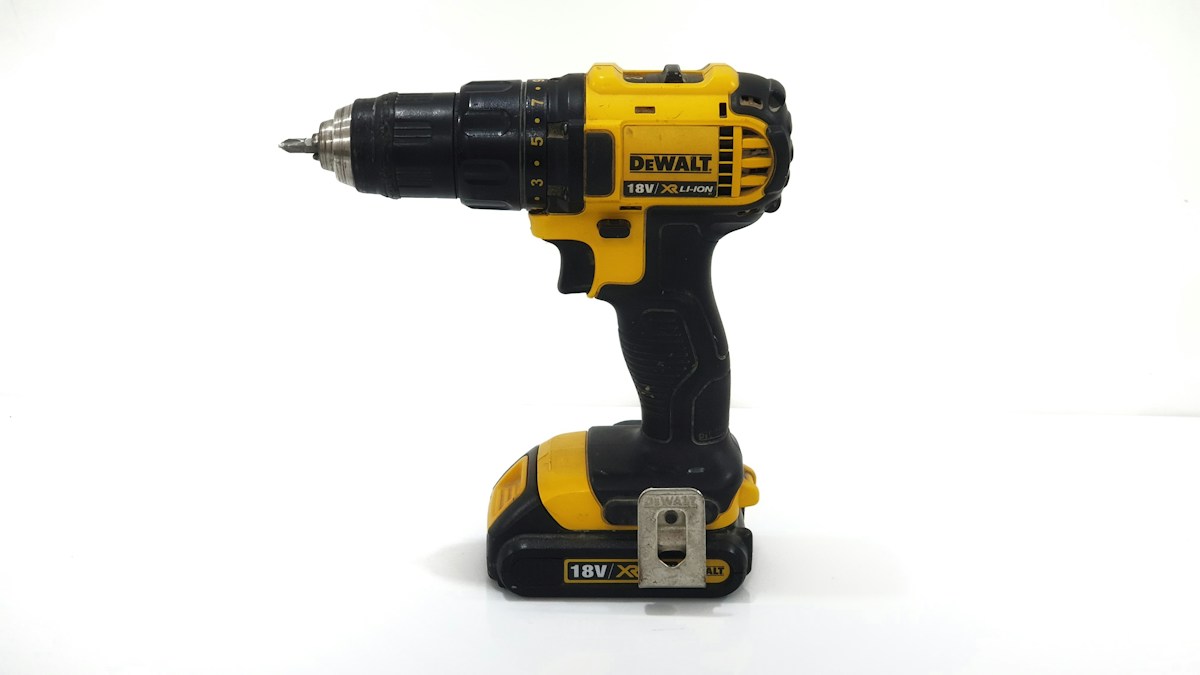
For wood screws: Use a drill/driver with an adjustable clutch. Set the torque to the lowest setting that fully seats the head. Over-torquing strips the Phillips recess or snaps the head. In hardwood, apply steady, moderate pressure and let the threads pull the screw in — do not push. For Torx or Robertson drives, bit slip is a non-issue, and the risk shifts entirely to over-torquing.
For drywall screws: Use a dedicated drywall screw gun or a drill with a dimpler bit attachment. The depth stop ensures the bugle head seats just below the paper face — not too deep (which breaks through the paper and into the gypsum, reducing holding power) and not too shallow (which leaves the head protruding above the paper, preventing flush mud application). Professional drywall hangers set the depth stop to leave 1/32″ to 1/16″ depression below the paper surface.
Securing with Nuts/Washers Where Appropriate
Neither wood screws nor drywall screws are designed to be used with nuts. Both are self-tapping fasteners that create their own threads in the substrate. However, arruelas are sometimes used with wood screws in specific situations: fender washers distribute load when screwing into soft or thin materials, and finish washers provide a decorative bearing surface under oval-head screws in visible locations.
Drywall screws should never be used with washers. The bugle head is designed to seat at a precise depth in gypsum. A washer changes the bearing surface and prevents the head from seating properly, resulting in either a protruding screw (bad for finishing) or a punctured paper face (bad for holding power).
Common Failure Modes and Troubleshooting
Stripped Screw, Cam-Out
Cam-out — the driver bit slipping out of the screw recess under torque — is the most frequent installation failure for both screw types. With Phillips-drive screws (the standard for both wood and drywall screws), cam-out occurs when the bit lifts out of the recess under resistance. The result is a rounded recess that no bit can grip. Prevention: use a fresh, sharp #2 Phillips bit (replace every 200–400 screws), apply firm axial pressure while driving, and switch to Torx or Robertson drive wood screws wherever possible.
For drywall screws, cam-out is aggravated by the thin, low-torque bugle head. Applying excessive downward pressure to compensate for a worn bit often collapses the head into the gypsum, creating a “blown” screw that must be removed and replaced 2″ from the original location.
Strip of Material and Board Damage
In drywall, the most common board damage is paper-face tear — the screw head rips through the paper and into the gypsum core. This happens when the screw is overdriven, when the screw is placed too close to a panel edge, or when the drywall is damp. A torn face reduces the screw’s holding capacity by 50–70% because the paper layer is the primary bearing surface, not the gypsum itself.
In wood, the most common damage is splitting along the grain. Splits radiate outward from the screw hole, typically parallel to the board edge. Prevention: always predrill in hardwood, maintain a minimum edge distance of 4× the screw diameter, and use a screw gauge appropriate for the board width — a #10 screw in a 2″ wide strip of oak is asking for a split.
Proper Withdrawal and Replacement
Removing a stuck or stripped screw requires technique, not force. For stripped Phillips heads: press a wide rubber band over the recess and re-engage the bit through the rubber — the added friction often provides enough grip. If that fails, use locking pliers (Vise-Grips) to grip the screw shank and unthread it. For broken drywall screws — where the head has snapped off and the shank remains embedded in the stud — drive a new drywall screw 2″ from the broken one and leave the broken shank in place. Attempting to extract a hardened drywall screw shank from framing lumber often causes more damage than it solves.
Dimensional and Compatibility Checklist
Quick-Reference Size Guide
📋 Quick-Reference: When to Use Which Screw
| USE A WOOD SCREW when: | USE A DRYWALL SCREW when: |
| ✅ Joining two pieces of solid wood | ✅ Attaching gypsum drywall to wood studs |
| ✅ Building furniture, cabinets, or shelving | ✅ Attaching gypsum drywall to metal studs |
| ✅ Any joint that bears structural load | ✅ Securing acoustic ceiling panels |
| ✅ Outdoor or moisture-exposed applications | ✅ Temporary assembly in dry conditions |
| ✅ Applications requiring shear resistance | ✅ Only when bugle-head countersink is needed |
| ⛔ NEVER use drywall screws for structural wood joints, outdoor projects, or any application requiring shear strength. | |
How to Verify Fit in Projects
Before committing to a full installation, always do a single-screw test:
Step 1: Drive one screw into scrap material of the same species and thickness. Verify that the head seats to the desired depth — flush for wood screws, 1/32″ below paper for drywall screws.
Step 2: Check for splitting. Examine both the entry and exit sides for cracks. If any cracks appear, switch to a smaller gauge, predrill a pilot hole, or increase edge distance.
Step 3: Attempt withdrawal by hand (after the screw is fully seated). A properly engaged screw in wood should require moderate wrench force to extract. If it pulls out with finger pressure, the engagement depth is insufficient or the screw gauge is too small.
Safety and Inspection Notes
Broken drywall screw shanks protruding from framing are a laceration hazard during subsequent trades (electrical, plumbing, insulation). Always inspect framing for broken screws before running wiring or insulation. When removing screws from treated lumber, wear gloves — the chemical preservatives (ACQ, CA-B) are skin irritants, and rusted screw heads from corroded drywall screws create sharp, jagged edges.
For bulk fastener orders where batch-to-batch consistency directly impacts installation speed and joint reliability, partnering with a manufacturer that performs incoming wire inspection, controlled heat treatment, and 100% dimensional sampling reduces on-site failure rates. prendedor de príncipe runs salt-spray, torque-resistance, and hardness tests on every production lot — a quality protocol that large-volume drywall contractors and cabinet manufacturers rely on to keep production lines moving without screw-related stoppages.

Wood screws and drywall screws are not interchangeable. They differ in every dimension that affects performance: diameter, thread depth, thread coverage, head geometry, material hardness, coating, and load behavior.
The key distinctions to remember: wood screws are thicker, deeper-threaded, partially threaded, ductile, and available in corrosion-resistant materials. They are engineered for structural wood joints where pull-out and shear resistance matter. Drywall screws are thinner, fully threaded, case-hardened, brittle, and coated only for indoor use. They are engineered for one task — holding gypsum panels against framing.
When selecting between the two, match the screw to the load, the substrate, and the environment. Use the dimension tables and substrate-selection chart in this guide as your on-site reference. Measure the material thickness, calculate the required engagement depth, verify the thread type (coarse for wood, fine for metal studs), and confirm the coating matches the environment.
When purchasing in volume, consistency across batches — uniform thread geometry, predictable hardness, reliable coating thickness — translates directly into fewer stripped heads, fewer snapped shanks, and fewer callbacks. That consistency starts with the manufacturer. For both parafusos drywall and wood screws, Prince Fastener’s ISO-certified production lines and per-lot quality testing deliver the dimensional reliability that high-volume professionals depend on.
Frequently Asked Questions (FAQ)
1. How do I determine the correct screw length for a given substrate?
Measure the total thickness of all materials being joined. The screw must penetrate the receiving member (the piece the threads grip) by at least 6× the screw’s major diameter for full withdrawal resistance. For a #8 wood screw (0.164″), that means a minimum of ~1″ thread engagement into the receiving piece. Add the thickness of the top piece (the piece the smooth shank passes through) to this engagement depth, and you have your minimum screw length. For drywall, the simpler rule applies: 1-1/4″ screws for 1/2″ panels, 1-5/8″ screws for 5/8″ panels — both provide roughly 3/4″ engagement into the stud behind the panel.
2. Are drywall screws ever suitable for structural wood connections?
No. Drywall screws are case-hardened, which makes them brittle. Under shear or lateral load, they fracture without deformation — a sudden, catastrophic failure mode. No building code recognizes drywall screws for structural connections. The International Residential Code (IRC) and ASTM C1002 specify drywall screws exclusively for gypsum board attachment. If a joint bears any structural load — shelf brackets, cabinet carcasses, deck framing, railing attachments — use wood screws, construction screws, or lag screws rated for the application.
3. What coatings extend the life of screws in humid environments?
For interior humid environments (bathrooms, kitchens, basements): yellow zinc plating provides 72–96 hours of salt-spray resistance, adequate for occasional moisture exposure behind tile or below cabinets. For exterior or fully exposed humid environments: ceramic or epoxy coatings (500–1,000+ hours salt-spray) or stainless steel (no coating needed, 1,000+ hours). Black phosphate — the standard drywall screw coating — offers only 2–5 hours of salt-spray protection and is unsuitable for any moisture-prone location. Prince Fastener’s drywall screw catalog includes zinc-plated and stainless options specifically for wet-area installations.
4. Why do drywall screws snap instead of bending?
Drywall screws undergo case-hardening — a heat treatment that creates a hard outer shell (HRC 50–56) around a softer core (HRC 28–38). The hard surface allows the screw to self-tap into wood and metal studs without a pilot hole. But hardness comes at the expense of ductility: the crystalline structure of the hardened steel cannot deform plastically. When loaded beyond its yield point in shear, the screw fractures instantaneously along the hardened case. Wood screws, which are through-hardened to a lower hardness or left unhardened, deform visibly before breaking — a much safer failure mode.
5. Can I use coarse-thread drywall screws on metal studs?
This is not recommended. Coarse-thread (W-type) drywall screws are designed for wood studs. Their wide thread spacing does not generate enough thread engagement in thin-gauge steel (20–25 gauge). The screw may initially grip but will strip out under load or vibration. Fine-thread (S-type) drywall screws have approximately 18 TPI — double the thread density of coarse-thread — and are specifically designed to tap into thin metal studs without stripping. Always match thread type to stud material: coarse for wood, fine for metal.
6. What is the difference between a bugle head and a flat countersunk head?
Both heads are designed to sit flush with or below the material surface, but their taper geometry is different. A flat countersunk head (standard on wood screws) has a straight 82° taper that acts like a cutting cone — it slices into wood cleanly but will punch through the paper face of drywall. A bugle head (standard on drywall screws) has a curved, concave taper that spreads driving force over a wider area, allowing it to sink into gypsum without tearing the paper. Using a flat-head wood screw in drywall tears the paper and weakens the joint; using a bugle-head drywall screw in wood produces an imprecise countersink that does not seat as cleanly as a proper flat head.
7. Should I predrill for wood screws in softwood?
In the body of a softwood board — away from edges and end grain — most wood screws with a sharp gimlet point can be driven without a pilot hole. However, predrilling is recommended in three situations: within 3/4″ of any edge or end (to prevent splitting), in narrow strips less than 2″ wide (splitting risk), and when using screws larger than #10 (which displace significant fiber volume). Predrilling takes 5 seconds per hole; repairing a split board takes 20 minutes or requires cutting a new piece entirely.
8. How do I choose between #6 and #8 drywall screws?
#6 is the standard gauge for residential drywall installation on both wood and metal studs. It provides adequate holding power for 1/2″ and 5/8″ gypsum panels at the code-specified spacing of 12″ on center (ceilings) or 16″ on center (walls). #8 drywall screws are reserved for situations requiring additional holding power — heavier panels such as 5/8″ Type X fire-rated drywall on ceilings, or multi-layer drywall installations where cumulative panel weight is higher. Going larger than #8 risks cracking the gypsum core and provides no meaningful improvement in holding power.
9. Can wood screws be used for drywall installation in a pinch?
Technically, a wood screw will hold a gypsum panel against a stud. But it will not seat properly. The flat countersunk head will tear through the paper face, creating a depression that is difficult to cover with joint compound and may show through the finished paint surface. If you must use wood screws on drywall temporarily, use pan-head screws (which sit above the surface) and plan to replace them with proper drywall screws before finishing.
10. Where can I source both wood screws and drywall screws in bulk?
Large-volume buyers — general contractors, drywall companies, cabinet manufacturers, and facility maintenance departments — typically source directly from manufacturers that offer OEM, ODM, and private-label capabilities across both product lines. prendedor de príncipe manufactures both wood screws (including chipboard and self-tapping variants) and drywall screws (coarse and fine thread, black phosphate and zinc-plated finishes) under one production roof, with 30 years of batch-to-batch consistency documented across 100+ export markets. Consolidating both screw types under a single supplier simplifies procurement, reduces shipping costs, and ensures dimensional compatibility across a multi-trade project.






 Português do Brasil
  English
  Español
  Русский
  日本語
日本語  العربية