What mistakes should you avoid when selecting stainless steel anchor bolts? The most critical errors include underestimating load requirements, ignoring environmental corrosion factors, choosing the wrong bolt type for the application, overlooking building code compliance, and failing to plan for site constraints, project timelines, and long-term maintenance. Any one of these oversights can compromise the safety, durability, and performance of an entire structural assembly.
Stainless steel anchor bolts are foundational fasteners — literally. They secure structural columns to concrete, attach heavy equipment to foundations, and hold critical infrastructure in place against wind, seismic forces, and everyday operational loads. Selecting the wrong anchor bolt does not simply result in a minor inconvenience; it can lead to catastrophic structural failure, expensive rework, or chronic maintenance headaches that drain project budgets for years.
The key to getting it right is evaluating every project-specific factor: the actual loads the bolt must carry, the geological and environmental conditions at the site, the applicable industry standards, spatial constraints, procurement lead times, and the total cost of ownership — not just the upfront price per bolt. If you are unsure at any point in the selection process, consult a structural engineer or an experienced fastener supplier like prendedor de príncipe, which has over 30 years of expertise in manufacturing and supplying stainless steel bolts for demanding applications worldwide.
This guide walks through each mistake in detail so you can avoid every one of them on your next project.
Load Requirements for Anchor Bolts
Assessing Load Needs
Every anchor bolt selection process must begin with a thorough structural load analysis. The bolt must resist all anticipated forces — tensile (pulling), shear (sliding), and combined loading — under both normal service conditions and extreme events such as earthquakes, hurricanes, or blast loads. The mistake many buyers make is sizing bolts based on rough estimates or rules of thumb rather than engineering calculations. A structural engineer should determine the design loads using methods prescribed by ACI 318 (for concrete anchorage) and the applicable building code, whether that is the International Building Code (IBC), Eurocode, or a regional standard.
Factors that must be quantified include the dead load (permanent weight of the structure), live loads (occupants, equipment, stored materials), wind loads, seismic loads, thermal expansion forces, and any dynamic or vibratory loads from machinery. The bolt’s embedment depth, diameter, and spacing must be engineered to carry these forces with the required safety factor — typically ranging from 2.0 to 4.0 depending on the loading type and code provisions. Prince Fastener’s SS Bolts 101 guide provides a useful reference on stainless steel bolt grades and their mechanical properties.
Risks of Incorrect Load Selection
Under-sizing an anchor bolt is the most dangerous mistake you can make. A bolt that is too small, too short, or installed at insufficient embedment depth will fail under load — sometimes suddenly and without warning. Concrete cone breakout, bolt pullout, bolt fracture, and pryout failure are all possible modes of collapse when load requirements are not properly assessed. The consequences range from equipment damage and project delays to structural collapse and loss of life.
Over-sizing, while less immediately dangerous, introduces its own problems. Larger bolts require larger holes, deeper embedments, and heavier base plates, increasing both material costs and installation complexity. In some cases, over-sized bolts can actually reduce the capacity of the concrete by placing too many anchors too close together, causing overlapping stress cones that weaken the foundation. The table below illustrates how common anchor bolt sizes relate to typical load capacities in normal-weight concrete.
Stainless Steel Anchor Bolt – Typical Load Capacities (Normal-Weight Concrete, f’c = 4,000 psi)
| Bolt Diameter | Embedment Depth | Approx. Tensile Capacity (lbs) | Approx. Shear Capacity (lbs) | Common Application |
|---|---|---|---|---|
| 3/8″ | 3.5″ | 2,800 | 3,200 | Light equipment, handrails |
| 1/2″ | 5″ | 5,500 | 5,900 | Column base plates, sign poles |
| 5/8″ | 6″ | 8,200 | 8,800 | Medium structural columns |
| 3/4″ | 7″ | 11,500 | 12,400 | Heavy structural, bridge bearing |
| 1″ | 9″ | 19,000 | 20,500 | Industrial machinery, towers |
| 1-1/4″ | 12″ | 28,000 | 30,500 | Heavy industrial, seismic zones |
Note: Values are approximate and based on single-anchor capacities in uncracked concrete per ACI 318 Appendix D methodology. Actual design capacities must be calculated by a licensed engineer considering all site-specific conditions.
Environmental and Geological Factors
Corrosion Environment
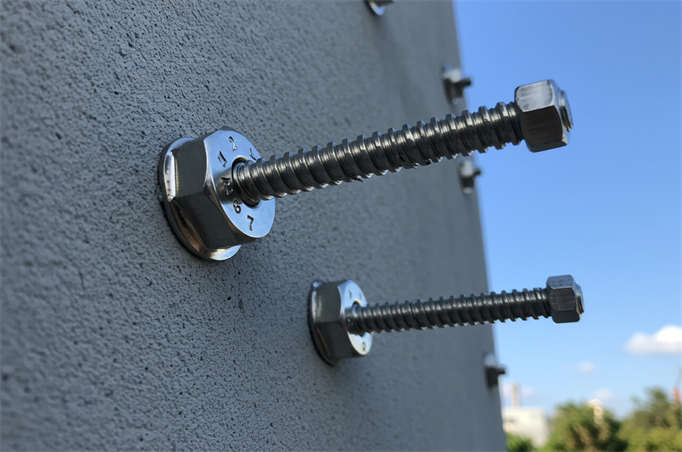
Stainless steel is chosen specifically for its corrosion resistance, but not all stainless steels perform equally in every environment — and this is where one of the costliest selection mistakes occurs. Grade 304 (A2) stainless steel provides good general-purpose corrosion resistance and works well in most indoor, urban, and mildly industrial atmospheres. Grade 316 (A4), which contains molybdenum, is required for marine and coastal environments, chemical processing facilities, wastewater treatment plants, and anywhere chloride concentrations are elevated. Using 304 in a saltwater environment is a common and expensive error that leads to pitting corrosion, crevice corrosion, and ultimately bolt failure — often within just a few years. Prince Fastener’s 304 vs. 316 comparison guide provides a detailed breakdown of which grade to use in which environment.
Beyond the stainless steel grade, you must consider galvanic corrosion. If the anchor bolt contacts a dissimilar metal — such as a carbon steel base plate or an aluminum bracket — an electrochemical reaction will accelerate corrosion of the less noble metal. Isolation bushings, dielectric washers, or matching all metals in the assembly to the same alloy family are essential preventive measures. Additionally, concrete itself can be aggressive; chloride-contaminated concrete (from road de-icing salts or coastal exposure) and high-sulfate soils attack even stainless steel over long service lives.
Geological Conditions
The geology of your project site directly affects anchor bolt performance. Soil type, groundwater chemistry, seismic classification, and foundation concrete quality all influence the selection process. In seismic zones, anchor bolts must meet additional ductility and embedment requirements per OSHA 1926.755 and the seismic provisions of ACI 318. Ductile anchor bolt designs — which deform before failure rather than snapping suddenly — are required in high-seismic-risk areas to allow the structure to absorb energy during an earthquake.
Expansive clay soils can exert lateral pressure on foundations and shift anchor bolt positions. Reactive or acidic soils (pH below 5.5) accelerate corrosion of both the concrete and the embedded steel. High water tables may keep anchor bolts permanently submerged, requiring marine-grade stainless steel and careful attention to crevice corrosion at the concrete-to-air interface. Before specifying any anchor bolt, review the project’s geotechnical report and work with the structural engineer to incorporate geological conditions into the design.
Relative Corrosion Rate of Stainless Steel Anchor Bolts by Environment
This chart underscores why selecting the correct stainless steel grade for your environment is not optional — it can mean the difference between decades of reliable service and premature failure within years.
Choosing the Right Stainless Steel Anchor Bolts
Anchor Bolt Types
Stainless steel anchor bolts come in several distinct configurations, and selecting the wrong type for your application is a surprisingly common mistake. The primary types include cast-in-place headed bolts (set into wet concrete before it cures), L-shaped and J-shaped bent-bar bolts (also cast in place, with the bent end providing mechanical anchorage), wedge anchors (post-installed by drilling into cured concrete and expanding a wedge clip), sleeve anchors (post-installed with a threaded expansion sleeve), drop-in anchors (female-threaded inserts hammered into drilled holes), and adhesive (chemical) anchors (bonded into drilled holes with epoxy or vinyl ester resin).
Cast-in-place bolts — headed, L-shaped, or J-shaped — provide the highest and most reliable pullout resistance because they are mechanically interlocked with the concrete. They must be positioned accurately during formwork before the concrete pour. Post-installed anchors (wedge, sleeve, drop-in, adhesive) offer flexibility because they can be placed after the concrete has hardened, but each type has different load limits, edge distance requirements, and sensitivity to hole tolerances. Prince Fastener’s bolt type guide is a good starting point for understanding the full range of options.
Matching Fastener to Application
The type of anchor bolt must match the application’s structural demands, installation sequence, and environmental exposure. For new concrete foundations supporting structural steel columns, cast-in-place headed anchor bolts per ASTM F1554 are the standard choice. For retrofitting equipment to existing concrete slabs, wedge anchors or adhesive anchors in stainless steel are commonly specified. For light-duty overhead hangers or conduit supports, sleeve anchors may be sufficient.
A critical mistake is using a post-installed mechanical anchor (like a wedge anchor) in cracked concrete zones without verifying that the anchor is rated for cracked concrete performance per ACI 355.2. Similarly, adhesive anchors must not be used in continuously submerged conditions unless the adhesive system is specifically tested and approved for underwater curing. The table below compares anchor bolt types at a glance.
Anchor Bolt Type Comparison
| Anchor Type | Instalação | Capacidade de carga | Ajustabilidade | Melhor para |
|---|---|---|---|---|
| Headed (Cast-in-Place) | Before concrete pour | Muito alto | None after pour | Structural columns, heavy machinery |
| L-Bolt (Cast-in-Place) | Before concrete pour | Alta | None after pour | Sill plates, light structural |
| J-Bolt (Cast-in-Place) | Before concrete pour | High (20-30% > L-bolt) | None after pour | Foundations, sign poles |
| Wedge Anchor | Post-installed (drilled) | Alta | Limitada | Equipment retrofit, guardrails |
| Sleeve Anchor | Post-installed (drilled) | Médio | Moderate (removable) | Light-medium duty, conduit, hangers |
| Drop-In Anchor | Post-installed (drilled) | Medium-High | High (threaded insert) | Overhead applications, sprinklers |
| Adhesive (Chemical) Anchor | Post-installed (drilled + resin) | Muito alto | None after cure | Close edge distances, rebar doweling |
Compliance and Standards Requirements
Industry Codes
Anchor bolt selection is not a matter of personal preference — it is governed by building codes and engineering standards that carry the force of law. In the United States, the International Building Code (IBC) references ACI 318 Chapter 17 for the design of anchors in concrete. ASTM F1554 specifies three strength grades for anchor bolts (Grade 36, Grade 55, and Grade 105), with specific requirements for stainless steel variants. In Europe, EN 1993 (Eurocode 3) and EOTA (European Organisation for Technical Assessment) guidelines govern anchor design. Failing to comply with these codes can result in failed inspections, project shutdowns, and legal liability.
For stainless steel specifically, the material must meet the appropriate ASTM material standards — typically ASTM A193 (Grade B8 for 304, Grade B8M for 316) for high-temperature or pressure applications, or ASTM F593 for general stainless steel bolts. The mechanical properties (tensile strength, yield strength, elongation) must be verified through mill test reports (MTRs) provided by the manufacturer. Always request MTRs from your bolt supplier — reputable manufacturers like prendedor de príncipe provide these as standard documentation with every order.
Certified Anchor Bolts
In many jurisdictions and for certain applications, anchor bolts must be third-party certified or tested. Post-installed anchors used in structural applications typically require an ICC-ES Evaluation Service Report (ESR) in the United States or an ETA (European Technical Assessment) in Europe. These reports confirm that the anchor has been tested per the relevant standard (ACI 355.2 for mechanical anchors, ACI 355.4 for adhesive anchors) and provide the published design values engineers rely on for their calculations.
Using uncertified or unverified anchor bolts — even if they look identical to a certified product — is a code violation that compromises safety and exposes you to liability. This is especially true in seismic design categories C through F, where anchor bolts must meet specific ductility criteria. Always verify that the anchor bolts you purchase come with full traceability, material certifications, and the applicable evaluation reports.
Site Constraints and Accessibility
Space Limitations
Real-world jobsites rarely offer the clean, open conditions assumed in design drawings. Congested reinforcement in concrete footings can block the placement of cast-in-place anchor bolts. Close edge distances and narrow concrete pedestals limit the types of post-installed anchors that can be used, because mechanical expansion anchors require minimum edge distances to prevent concrete splitting. Overhead or hard-to-reach installations may require special tools or anchor types that can be installed in tight spaces.
The mistake here is finalizing the anchor bolt specification without reviewing the actual site conditions. Conduct a site visit or request detailed as-built drawings before ordering. If edge distances are tight, adhesive anchors are generally more tolerant than mechanical expansion anchors. If reinforcement congestion is severe, ground-penetrating radar (GPR) scanning of the existing concrete can reveal rebar locations before you start drilling.
Installation Challenges
Installation quality has as much impact on anchor bolt performance as the bolt’s material and size. Common installation errors include drilling oversized holes (which reduce the grip of expansion anchors), insufficient embedment depth (failing to drill deep enough), improper torquing (over-tightening can crack the concrete or damage the bolt), failure to clean the drilled hole before installing adhesive anchors (dust and debris prevent proper bonding), and installing adhesive anchors at temperatures outside the resin’s specified range.
Every anchor bolt system has manufacturer-specified installation procedures, and deviating from them voids the product’s certified load ratings. Provide installation training for field crews, use torque wrenches calibrated to the specified values, and conduct pull-test verification on a percentage of installed anchors — particularly for adhesive anchors, which are sensitive to installation technique.
Project Timelines and Procurement

Lead Times
Stainless steel anchor bolts — especially in large diameters, non-standard lengths, or 316 grade — often have significantly longer lead times than carbon steel equivalents. Standard 304 stainless wedge anchors in common sizes may be available from stock, but cast-in-place headed anchor bolts in F1554 Grade 55 stainless with full certifications may require 6 to 12 weeks for manufacturing, depending on the supplier and current market conditions. Custom lengths, special threading, or unusual grades (such as duplex stainless steel 2205) can push lead times even longer.
The mistake is waiting until the last minute to order. Stainless steel pricing is also more volatile than carbon steel, as it is tied to nickel and molybdenum commodity markets. Place orders early, confirm delivery dates in writing, and build buffer time into your procurement schedule. Suppliers with in-house manufacturing capabilities, such as prendedor de príncipe, can often offer more competitive lead times and pricing stability than middlemen who source from third-party mills.
Installation Scheduling
Anchor bolt installation must be coordinated with the broader construction schedule. Cast-in-place bolts must be positioned before the concrete pour — if the pour happens and the bolts are not there, the only option is to switch to post-installed anchors, which may require a redesign. Post-installed anchors cannot be installed until the concrete has reached its specified design strength (typically 28 days for full strength, though many adhesive anchor systems are approved for use at 75% of design strength). Adhesive anchors have cure time requirements (ranging from 30 minutes to 24 hours depending on the resin system and ambient temperature) before they can be loaded.
Build these timing dependencies into the project schedule explicitly. A missed anchor bolt installation window can delay the entire structural steel erection sequence by days or weeks.
Cost-Effectiveness in Choosing Fastener
Balancing Price and Performance
Stainless steel anchor bolts cost significantly more than carbon steel or galvanized equivalents — typically two to five times more, depending on the grade and size. This price premium tempts buyers to cut costs by using a lower-grade stainless steel, a smaller diameter than specified, or a carbon steel bolt with a “protective” coating instead of true stainless. All three of these shortcuts are mistakes that lead to higher long-term costs.
The right approach is to evaluate cost on a lifecycle basis, not a per-bolt basis. A 316 stainless steel anchor bolt that costs $15 and lasts 50 years without maintenance is far more cost-effective than a galvanized carbon steel bolt that costs $4 but requires replacement every 10 years — involving concrete removal, re-drilling, downtime, and labor costs that far exceed the original bolt price. The benefits of stainless steel bolts and nuts become particularly clear when you factor in the total cost of ownership.
Long-Term Value
The long-term value of properly selected stainless steel anchor bolts includes reduced maintenance frequency, elimination of corrosion-related failures, extended structural service life, and compliance with increasingly stringent environmental and sustainability standards. In many critical applications — water treatment plants, bridge structures, coastal infrastructure, food processing facilities — stainless steel is not merely the “premium” choice; it is the only choice that meets the 50- to 100-year design life required by modern codes.
Lifecycle Cost Breakdown: Stainless Steel vs. Galvanized Carbon Steel Anchor Bolts (50-Year Horizon)

While the initial purchase price of stainless steel is higher, the elimination of replacement cycles and reduced maintenance costs make it significantly cheaper over a 50-year project life.
Maintenance and Inspection Requirements
Frequência de inspeção
Even stainless steel anchor bolts require periodic inspection to verify continued structural integrity. The inspection frequency depends on the environment, loading conditions, and criticality of the application. As a general guideline, anchor bolts in benign indoor environments may be inspected every 5 to 10 years. Bolts in outdoor, industrial, or marine environments should be inspected annually. Bolts in critical life-safety applications (such as fall-protection anchors or seismic bracing) should be inspected per the schedule mandated by OSHA or the applicable regulatory authority — often semi-annually or after any significant seismic event.
Inspection should include visual examination for corrosion (discoloration, pitting, rust staining from adjacent carbon steel), torque verification using a calibrated torque wrench, measurement of any gap between the base plate and the concrete (which indicates bolt elongation or concrete degradation), and assessment of the concrete surrounding the bolt for cracking, spalling, or erosion.
Signs of Wear
Knowing what to look for during an inspection can prevent catastrophic failure. The most common signs of anchor bolt deterioration include visible rust or staining (which on stainless steel may indicate contamination from nearby carbon steel or an incorrect grade), surface pitting (small holes caused by chloride attack — a clear sign that the stainless grade is inadequate for the environment), thread galling (seizure of the nut-to-bolt threads caused by friction welding — common in stainless steel if anti-seize compound was not used during installation), concrete cracking radiating from the anchor location (indicating overload, corrosion-induced expansion, or concrete deterioration), and loose or rattling bolts (indicating loss of pre-load from vibration, creep, or embedment failure).
If any of these signs are detected, the bolt should be assessed by a structural engineer before the structure is returned to service. Prince Fastener’s do’s and don’ts for stainless steel includes useful guidance on preventing galling and contamination, which are the two most common maintenance issues with stainless anchor bolts.
Consulting Experts for Anchor Bolts

When to Seek Advice
You should consult a structural engineer or experienced fastener specialist whenever the anchor bolt application involves structural loads or life-safety functions, seismic design categories C through F, marine or chemically aggressive environments, non-standard bolt sizes or materials, close edge distances or congested reinforcement, retrofit or renovation of existing structures, or any situation where you are uncertain about the correct specification. The cost of professional consultation is trivial compared to the cost of a failed anchor bolt — both financially and in terms of human safety.
Avoiding DIY Mistakes
The most dangerous DIY mistake in anchor bolt selection is treating it as a hardware-store decision rather than an engineering decision. Anchor bolts are structural elements, and their design is governed by the same codes and safety factors as beams, columns, and foundations. Selecting a bolt based solely on its physical dimensions (“it fits the hole”) without verifying its material grade, mechanical properties, embedment requirements, and code compliance is a recipe for failure.
Other common DIY mistakes include reusing old anchor bolts during renovation (they may be fatigued or corroded internally), mixing stainless steel and carbon steel components in the same assembly (galvanic corrosion), using a hammer drill on the “hammer only” setting for adhesive anchors (which can damage the hole walls and prevent proper bonding), and failing to apply anti-seize lubricant to stainless steel threads before torquing (which causes galling and makes future inspection or replacement impossible).
When in doubt, contact a qualified manufacturer such as prendedor de príncipe, which offers both product supply and technical consulting. Their engineering team can help you specify the correct stainless steel grade, bolt type, size, and finish for your specific application — avoiding the costly mistakes outlined in this guide.
Video: Anchor Bolt Basics – What, Why, and How
This video explains the fundamentals of anchor bolt function, loading mechanics, and installation — essential viewing before specifying any anchor bolt system.
Selecting stainless steel anchor bolts is an engineering decision that demands careful evaluation of every relevant factor — from load requirements and environmental exposure to code compliance, site constraints, procurement timelines, and total lifecycle cost. The mistakes outlined in this guide are common across the construction and industrial sectors, but every one of them is avoidable with proper planning, professional consultation, and the use of high-quality, certified products.
Always start with a structural load analysis and geotechnical evaluation. Choose the correct stainless steel grade for your specific corrosion environment — 304 for general use, 316 for marine, coastal, and chemical exposure. Verify that the anchor bolt type matches the application and meets all applicable building codes and testing standards. Account for site constraints, installation procedures, and realistic procurement lead times. And never sacrifice long-term reliability for short-term cost savings — the lifecycle economics of stainless steel overwhelmingly favor the higher-quality material.
If you need expert guidance or want to source certified stainless steel anchor bolts in any grade, size, or configuration, prendedor de príncipe has more than 30 years of manufacturing experience and a global distribution network. Visit their stainless steel bolt catalog to explore the full product range, or contact their engineering team for project-specific recommendations.
For additional technical resources, consult ACI (American Concrete Institute), ASTM International, e AISC (American Institute of Steel Construction).
Frequently Asked Questions (FAQ)
1. What is the most common mistake when selecting stainless steel anchor bolts?
The most common mistake is choosing the wrong stainless steel grade for the environment. Using 304 stainless steel in a marine or high-chloride environment leads to pitting and crevice corrosion, causing premature bolt failure. Always use 316 (A4) grade stainless steel for coastal, marine, chemical, and wastewater applications. Prince Fastener’s 304 vs 316 comparison explains the differences in detail.
2. Can I use 304 stainless steel anchor bolts near the ocean?
It is not recommended. Grade 304 lacks molybdenum, which makes it vulnerable to chloride-induced pitting and crevice corrosion in coastal environments. Grade 316 stainless steel, which contains 2–3% molybdenum, is the minimum specification for any application within approximately 1 mile of saltwater. For fully submerged marine applications, consider duplex stainless steel 2205 or higher alloys.
3. What standards govern stainless steel anchor bolt design?
In the United States, anchor bolt design is governed by ACI 318 Chapter 17 (for concrete anchorage), ASTM F1554 (for anchor bolt material specifications), and the IBC (International Building Code). Post-installed anchors must also comply with ACI 355.2 (mechanical anchors) or ACI 355.4 (adhesive anchors) and typically require an ICC-ES ESR evaluation report. Material specifications for stainless steel bolts fall under ASTM A193, ASTM F593, or ASTM A320 depending on the application.
4. How do I prevent galling on stainless steel anchor bolt threads?
Thread galling is a common problem with stainless steel fasteners caused by friction welding during tightening. To prevent it, always apply an anti-seize lubricant (molybdenum disulfide or nickel-based) to the threads before installation. Tighten slowly and steadily — never use impact wrenches on stainless steel without lubrication. Alternatively, use anchor bolts with waxed or pre-lubricated threads. Prince Fastener’s stainless steel do’s and don’ts covers this topic thoroughly.
5. What is the difference between cast-in-place and post-installed anchor bolts?
Cast-in-place anchor bolts (headed bolts, L-bolts, J-bolts) are set into the concrete formwork before the pour and cure in place. They provide the highest load capacities and most reliable performance. Post-installed anchors (wedge, sleeve, drop-in, adhesive) are installed into hardened concrete by drilling a hole. They offer greater placement flexibility but generally have lower load capacities and require careful installation per manufacturer specifications.
6. How often should stainless steel anchor bolts be inspected?
Inspection frequency depends on the environment and application criticality. Indoor, benign environments: every 5–10 years. Outdoor industrial environments: annually. Marine and coastal environments: annually or semi-annually. Life-safety applications (fall protection, seismic bracing): per OSHA requirements, typically semi-annually or after any significant event. Inspections should check for corrosion, torque verification, concrete cracking, and bolt looseness.
7. Is it okay to mix stainless steel anchor bolts with carbon steel nuts or washers?
No. Mixing stainless steel bolts with carbon steel nuts, washers, or base plates creates a galvanic corrosion cell that will accelerate deterioration of the carbon steel components — and can contaminate the stainless steel surface, compromising its corrosion resistance. Always use matching stainless steel hardware throughout the assembly, or use isolation materials (dielectric washers, protective sleeves) to prevent metal-to-metal contact.
8. What is the typical lead time for stainless steel anchor bolts?
Common sizes of 304 stainless steel wedge anchors and sleeve anchors are often available from stock with lead times of 1–2 weeks. Custom cast-in-place headed anchor bolts in 316 stainless steel per ASTM F1554, especially in large diameters or long lengths, may require 6–12 weeks. Non-standard alloys like duplex 2205 can require even longer. Place orders early in the project lifecycle. prendedor de príncipe offers both stock and custom manufacturing with competitive lead times.
9. Are stainless steel anchor bolts worth the extra cost over galvanized?
Yes, for most environments where longevity matters. Over a 50-year lifecycle, stainless steel anchor bolts typically cost 40–50% less than galvanized carbon steel when you factor in replacement cycles, downtime, labor, and maintenance. In corrosive environments, the savings are even more dramatic because galvanized coatings deteriorate and require bolt replacement every 10–15 years, while stainless steel bolts can last the full design life of the structure without intervention.
10. Where can I buy certified stainless steel anchor bolts for structural projects?
prendedor de príncipe is a leading global manufacturer and supplier of stainless steel bolts, including anchor bolt configurations in 304, 316, and specialty alloys. They provide full material certifications (MTRs), comply with ASTM, ISO, and DIN standards, and offer both stock and custom manufacturing. Other reputable sources include Parafuso de Portland, Fixador Birmingham, and specialty distributors listed on the Industrial Fasteners Institute (IFI) directory.


 Português do Brasil
  English
  Español
  Русский
  日本語
日本語  العربية