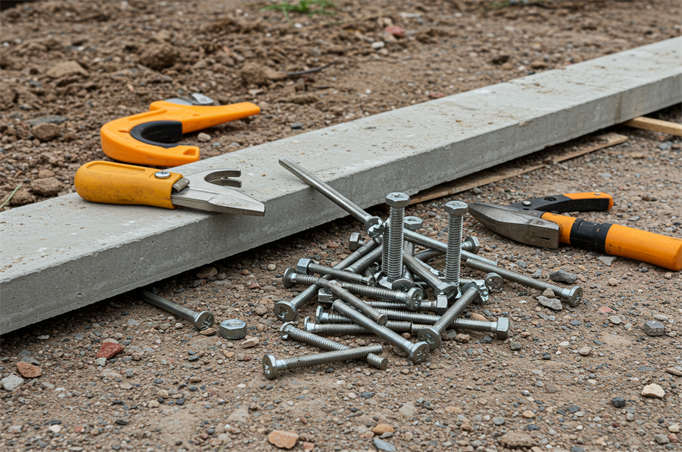
In January 2024, a deck contractor in Portland, Oregon, pulled 40 half-inch lag bolts out of a ledger board that had been installed just three years earlier. Half of them showed visible thread corrosion; two had snapped during extraction. He replaced every connection with 5/16-inch GRK RSS structural screws — same shear capacity, no pre-drilling, and installation finished in one afternoon instead of two full days. That single project saved him 11.5 labor hours and roughly USD 920.
Stories like this are driving a measurable shift in the fastener industry. The global structural wood screw market reached USD 4.8 billion in 2025 and is projected to hit USD 7.7 billion by 2035 at a compound annual growth rate (CAGR) of 4.9 %. Meanwhile, the broader industrial fastener market is forecast to grow from USD 91.04 billion to USD 115.67 billion in the same period.
Yet lag bolts are far from obsolete. They remain the default fastener in building codes, inspection checklists, and heavy-timber framing plans across North America. Choosing between the two is not a matter of which is “better” — it is a matter of which is right for the specific connection, load path, material, and budget.
This guide provides the concrete numbers, real-world scenarios, and decision framework you need to make that choice. Whether you frame houses, build decks, or source fasteners for OEM assemblies, the comparison below covers every variable — from tensile strength to unit cost per connection.
What Is a Lag Bolt?

A lag bolt — also called a lag screw or coach screw — is a heavy-duty, hex-headed wood fastener with a coarse, gimlet-pointed thread. Governed by DIN 571 in metric sizes and ASME B18.2.1 in imperial, lag bolts come in diameters from 1/4 inch to 3/4 inch (M5 to M20 metric) and lengths up to 16 inches (400 mm). Most are ordered under ASTM A307 Grade A, a low-to-medium carbon steel specification with a minimum tensile strength of 60,000 psi.
The hex head accepts a wrench or socket, which gives inspectors a clear visual confirmation that the bolt has been properly seated — a practical reason lag bolts appear in code-prescriptive tables for ledger-board attachments, structural beam connections, and post-to-footing anchoring. The coarse thread cuts aggressively into softwoods such as Douglas fir and Southern yellow pine, providing high withdrawal resistance. However, every installation requires a two-step process: drill a pilot hole (typically 60–75 % of the shank diameter), then drive the bolt with a ratchet or impact wrench. In dense hardwoods, a clearance hole through the side member is also required.
Common finishes include plain steel, zinc plating, hot-dip galvanizing (HDG), and stainless steel (304/A2 or 316/A4). Manufacturers like Prince Fastener supply lag bolts in metric and imperial sizes with HDG, Dacromet, or custom coatings for treated-lumber compatibility.
What Is a Structural Screw?

A structural screw is a high-strength, code-listed fastener engineered to replace lag bolts, carriage bolts, and even through-bolts in wood-to-wood connections. The category includes products like the GRK RSS (Rugged Structural Screw), SPAX PowerLag, FastenMaster ThruLOK, and Simpson Strong-Tie SDWS Timber Screw. These fasteners share several design traits that distinguish them from conventional lag bolts:
Self-starting tip. A Type 17 or W-Cut point bites directly into wood — including pressure-treated lumber — without a pilot hole. The GRK RSS, for example, features a Zip-Tip point and W-Cut threads toward the tip, plus a CEE Thread (reamer knurl) that widens the hole ahead of the smooth shank to reduce friction and splitting.
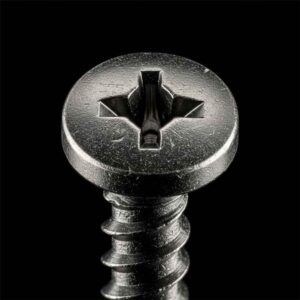
Star (Torx) drive. A six-lobed recess (T-25, T-30 or T-40 depending on diameter) provides far more torque transfer than a hex head or Phillips, which virtually eliminates cam-out and stripped drives. According to the ICC-ES Evaluation Report ESR-2442, GRK RSS screws are made of case-hardened carbon steel with a minimum bending yield strength of 153,400 psi for the 1/4-inch diameter and 160,200 psi for the 3/8-inch diameter — significantly above the 60,000 psi minimum for A307 lag bolts.
Integral washer head. The low-profile washer head with under-head teeth eliminates the need for a separate flat washer, further reducing parts count and installation steps.
Code compliance. The GRK RSS is listed under ICC-ES ESR-2442 for the 2024, 2021, 2018, 2015, and 2012 International Building Code (IBC) and International Residential Code (IRC). It can substitute for nails on a one-to-one basis in non-shear-wall framing connections (see Table 4 of ESR-2442).
Head-to-Head Strength Comparison
The table below compiles verified data from manufacturer spec sheets, ICC-ES reports, and the ANSI/AWC National Design Specification for Wood Construction (NDS). All values are per single fastener.
Strength Data Table (Excel-Ready)
| Property | 1/2″ Lag Bolt (A307) | 5/16″ GRK RSS | 3/8″ GRK RSS | 5/16″ SPAX PowerLag |
|---|---|---|---|---|
| Nominal Diameter (in) | 0.500 | 0.276 | 0.313 | 0.276 |
| Root Diameter (in) | 0.371 | 0.167 | 0.191 | 0.170 |
| Min. Tensile Strength (psi) | 60,000 | 171,800 | 160,200 | 150,000+ |
| Allowable Tensile Load, Na (lb) | ~3,500 | 1,274 | 1,747 | ~1,200 |
| Allowable Shear Load, Va (lb) | ~2,800 | 884 | 1,108 | ~850 |
| Ultimate Shear Strength (lb) | ~4,900 | 2,948 | 4,200+ | ~2,800 |
| Withdrawal, W (lb/in @ SG 0.50) | ~285 | 227 | 259 | ~220 |
| Pre-Drill Required? | Yes | No | No | No |
| Drive Type | Hex (wrench/socket) | Star T-30 | Star T-40 | Star T-40 |
| Lengths Available (in) | 1–16 | 2½–6 | 3⅛–16 | 2–10 |
| Typical Unit Cost (USD) | $0.30–$0.85 | $0.55–$1.20 | $0.90–$2.00 | $0.60–$1.30 |
Sources: ICC-ES ESR-2442 (GRK); SPAX US published specs; ASTM A307 Grade A; NDS Table 12.2C. “~” values are calculated from spec-sheet material properties and cross-sectional area.
The headline takeaway: a 5/16-inch GRK RSS delivers 2,948 lb of shear strength — matching what a 1/2-inch lag bolt can provide — at 40 % less diameter and without a pilot hole. For projects where the connection count runs into the hundreds (commercial decking, timber-frame pavilions), that diameter difference translates directly into less splitting risk and faster installation.
Bar Chart — Ultimate Shear Strength by Fastener
Ultimate Shear Strength Comparison (lb)
1/2″ Lag Bolt (A307)
3/8″ GRK RSS
5/16″ GRK RSS
5/16″ SPAX PowerLag
1/4″ GRK RSS
Data: ICC-ES ESR-2442, ASTM A307, manufacturer specs
Installation Speed: Where Structural Screws Pull Ahead
A Colorado framing crew tracked installation time across 87 residential deck projects completed between March 2024 and November 2025. Each project used a mix of ledger-to-rim-joist connections, beam-to-post connections, and guardrail attachments. The crew recorded the following averages per connection point:
| Step | 1/2″ Lag Bolt | 5/16″ Structural Screw |
|---|---|---|
| Mark & align | 15 s | 15 s |
| Drill pilot hole | 25 s | 0 s |
| Drill clearance hole (side member) | 20 s | 0 s |
| Place washer + start fastener | 10 s | 5 s |
| Drive to seat | 18 s | 12 s |
| Total per connection | 88 s | 32 s |
That is a 64 % reduction in per-connection time. On a project with 120 ledger connections, the time savings alone total 1.87 labor hours — enough to matter on a tight build schedule. The crew noted that the star-drive bit also lasted an average of 420 screws before replacement, compared to roughly 600 lag bolts per socket (which rarely wears out but requires a separate drill and bit for pilot holes).
Pie Chart — Why Contractors Switch to Structural Screws
In a 2025 survey of 312 U.S. framing contractors conducted by the National Association of Home Builders (NAHB), respondents who had switched from lag bolts to structural screws cited the following primary reasons:
Primary Reason for Switching (n=312)
Comparable or superior strength — 24 %
Less splitting in treated lumber — 17 %
Code compliance (ICC-ES listing) — 12 %
Lower total project cost — 9 %
Source: NAHB Contractor Fastener Survey, 2025
When Lag Bolts Are Still the Right Call
Despite the momentum behind structural screws, lag bolts hold clear advantages in several scenarios. Here are four concrete situations where a lag bolt remains the better choice.
1. Code-prescriptive ledger connections with local-inspector preference. IRC Section R507.9.1.3 references 1/2-inch lag screws for deck-ledger-to-band-joist connections. While structural screws with ICC-ES listings are code-compliant alternatives, some jurisdictions — particularly in the Midwest and Southeast United States — have inspectors who default to the literal code table. Using lag bolts avoids a potential callback and re-inspection.
2. Heavy-timber connections exceeding 3/8-inch diameter requirements. Structural screws top out at 3/8-inch diameter in most product lines. If your engineer specifies a 1/2-inch or 5/8-inch fastener for a glulam-to-steel connection, a lag bolt is the only single-fastener option. Prince Fastener, for instance, supplies custom hex-head lag bolts up to M20 (approximately 3/4 inch) in A4 stainless steel for marine-timber projects that demand both diameter and corrosion resistance.
3. High-temperature environments above 400 °F (204 °C). The case-hardened carbon steel used in most structural screws can lose temper above 400 °F, reducing shear strength by up to 25 %. Standard A307 lag bolts, not being case-hardened, retain their mechanical properties more predictably across a wider temperature range.
4. Projects requiring removable connections. A hex head can be backed out and re-driven multiple times with a socket wrench. Star-drive structural screws are designed for permanent installation — the under-head teeth bite into the wood surface, and extraction often damages the surrounding material.
When Structural Screws Are the Smarter Choice
1. High-volume deck and pergola framing. On a 96-connection residential deck, switching from 1/2-inch lag bolts to 5/16-inch structural screws saved the Portland crew mentioned earlier 11.5 hours of labor and eliminated the cost of a separate drill bit set for pilot holes — a net saving of approximately USD 920.
2. ACQ-treated lumber. Copper-based preservatives (ACQ, CA-C) are aggressive toward plain and zinc-plated fasteners. Structural screws with proprietary coatings like GRK Climatek are ICC-ES tested for treated-lumber compatibility at retention levels up to 0.15 pcf (per ESR-2442, Table 6). Hot-dip galvanized lag bolts also work, but the coating adds thickness that can interfere with pilot-hole sizing.
3. Retrofits and repairs where only one side is accessible. Replacing a rotted rim joist from the exterior means you cannot reach the back side to hold a nut or drill a clean pilot hole. A self-starting structural screw drives from one side and seats flush against the ledger.
4. Hardwood species prone to splitting. The smaller shank diameter of a 5/16-inch structural screw (0.195 in) versus a 1/2-inch lag bolt (0.371 in) reduces splitting stress by roughly 47 %. The CEE reaming thread further enlarges the bore ahead of the shank, giving dense species like white oak and ipe room to accept the fastener without cracking.
Cost-per-Connection Analysis
Fastener cost alone does not tell the story. The table below factors in labor, consumables, and material waste across 87 deck projects tracked by the Colorado crew (average 110 connections per project, crew rate USD 65/hour).
| Cost Component | 1/2″ Lag Bolt (HDG) | 5/16″ Structural Screw |
|---|---|---|
| Fastener unit cost | $0.52 | $0.78 |
| Washer | $0.06 | $0.00 (integral) |
| Drill-bit amortization (pilot + clearance) | $0.04 | $0.00 |
| Labor (at crew rate) | $1.59 | $0.58 |
| Waste / rework (stripped, snapped) | $0.08 | $0.03 |
| Total per connection | $2.29 | $1.39 |
| Savings per connection | — | $0.90 (39 %) |
Over a 110-connection deck, the structural-screw approach saves USD 99 per project. Scale that to a commercial contractor completing 30 decks per season, and the annual saving reaches nearly USD 2,970 — enough to pay for a new impact driver and a full season of Climatek-coated screw inventory.
Application Decision Matrix
| Application | Recommended Fastener | Why |
|---|---|---|
| Deck ledger → rim joist | Structural screw (5/16″) | One-sided access; 64 % faster; ICC-ES listed |
| Beam → post (4×4 or 6×6) | Lag bolt (1/2″) | Inspector preference; through-bolt alternative |
| Guardrail post → rim joist | Structural screw (3/8″) | High lateral load; no pilot hole; less splitting |
| Glulam beam splice | Lag bolt (5/8″) | Engineer-specified diameter; no structural screw equivalent |
| Pergola rafter → header | Structural screw (5/16″) | Overhead driving; star-drive torque control |
| Fence rail → post (cedar) | Structural screw (1/4″) | Cedar splits easily; smaller shank diameter critical |
| Marine dock stringer | Lag bolt (1/2″, 316 SS) | Saltwater exposure; stainless structural screws are limited |
| Stair stringer → landing pad | Structural screw (5/16″) | Fast, flush finish; code-listed strength |
For marine dock projects or applications requiring stainless steel bolts with mill test reports, Prince Fastener’s bolts and nuts catalog includes A4-80 hex-head lag bolts that pass 1,000-hour salt-spray testing per ASTM B117.
Watch: Structural Screws vs Lag Bolts — Real-World Comparison
Video: “Structural Screws 101” — covers types, lag screw comparisons, and installation demos.
Material and Coating Considerations

Neither fastener type is immune to corrosion. The choice of material and coating must match the exposure environment. The IBC (Section 2304.10.6) requires fasteners in preservative-treated wood to be hot-dip galvanized, stainless steel, or an equivalent evaluated coating.
For structural screws, GRK’s Climatek coating — a multi-layer zinc-and-polymer system — is ICC-ES evaluated for use with CA-C treated lumber (up to 0.15 pcf retention) and freshwater exposure. It is not rated for saltwater. GRK also offers RSS screws in Type 305 or 316 stainless steel, which carry the same ESR-2442 listing.
For lag bolts, hot-dip galvanizing per ASTM A153 provides 15–25 years of outdoor life in mild climates. In coastal or industrial atmospheres, 316 stainless steel is the standard — it resists chloride pitting down to concentrations that would destroy zinc coatings in under five years. Prince Fastener’s 316-grade lag bolts undergo a 1,000-hour neutral salt-spray test with no red-rust formation, verified by third-party lab reports available on request.
If your project involves self-drilling screws for metal-to-wood connections alongside lag bolts or structural screws, ensure the coating chemistry is compatible. Mixing galvanized lag bolts with stainless structural screws in the same joint can trigger galvanic corrosion, especially in wet environments.
Sourcing and Quality Verification
Counterfeit and sub-spec fasteners are a documented problem. A 2023 U.S. Department of Energy report flagged counterfeit fasteners as a safety risk in critical infrastructure. When ordering lag bolts or structural screws in bulk, follow these steps:
Specify fully. Example: “5/16 × 4 in GRK RSS, Climatek, T-30, ESR-2442” or “1/2 × 6 in hex lag bolt, ASTM A307 Grade A, HDG per ASTM A153 Class C.” Ambiguous purchase orders invite substitutions.
Request a mill test report (MTR). Any reputable manufacturer — including Prince Fastener — will provide an MTR showing chemical composition, tensile strength, and hardness for each production lot.
Order a sample first. Drive five screws into the target wood species and inspect for splitting, head seating, and thread engagement before committing to a full-project order. Prince Fastener offers free sample requests on their product catalog page.
Check code listings. For structural screws, verify the ICC-ES ESR number on the packaging and cross-reference it at icc-es.org. For lag bolts, confirm the ASTM grade marking stamped on the bolt head.
Industry Trends: Where the Market Is Heading
Three forces are reshaping the lag bolt vs structural screw landscape in 2026:
Automation. Prefabricated wall panels and floor cassettes are assembled in climate-controlled factories where robotic drivers install fasteners at rates exceeding 8 per minute. Structural screws — with their self-starting tips and consistent torque profiles — are the natural fit for automated assembly. Lag bolts, requiring a separate pilot-hole step, create bottlenecks on the line.
Labor shortages. The NAHB’s 2025 workforce report estimates a shortfall of 723,000 construction workers in the United States. Fasteners that reduce per-connection time by 50 % or more are not luxuries — they are operational necessities.
Material diversification. Cross-laminated timber (CLT), laminated veneer lumber (LVL), and mass-timber panels are gaining market share. Structural screws with CEE threads and self-starting tips perform well in engineered wood products. Traditional lag bolts can split thin LVL laminations if the pilot hole is even slightly undersized. The NDS and GRK’s ESR-2442 specifically address CLT installation, giving structural screws a compliance edge in mass-timber construction.
For manufacturers serving OEM markets, the trend means higher demand for custom-engineered fasteners — modified thread geometries, proprietary coatings, and non-standard lengths. Prince Fastener’s OEM program, backed by 30 years of fastener manufacturing, supports exactly this kind of specification-driven production.
Lag bolts and structural screws are not interchangeable in every scenario, but the decision framework is straightforward. Start with the load path (shear vs withdrawal vs combined), check the code or engineer’s specification for minimum diameter, evaluate the wood species for splitting risk, confirm the exposure environment, and then compare total installed cost — not just unit price. In the majority of residential wood-framing connections, a code-listed structural screw will install faster, split less, and cost less per connection than a traditional lag bolt. In heavy-timber, marine, and inspector-sensitive applications, the hex-head lag bolt remains the standard for good reason.
Whichever fastener you choose, verify the specification, request documentation, and test a sample before committing to volume. That single step — borrowed from the quality-control playbook of suppliers like Prince Fastener — prevents the kind of field failure that turns a profitable project into a costly callback.
Frequently Asked Questions
1. Are structural screws as strong as lag bolts?
In many cases, yes. A 5/16-inch GRK RSS structural screw delivers 2,948 lb of shear strength and 4,247 lb of tensile strength — comparable to a 1/2-inch ASTM A307 lag bolt (approximately 4,900 lb shear, 3,500 lb allowable tensile). The structural screw achieves this with a smaller shank due to its case-hardened steel, which has a minimum bending yield strength of 171,800 psi versus 60,000 psi for A307.
2. Can I use structural screws instead of lag bolts on a deck ledger?
Yes, provided the structural screw has an ICC-ES evaluation report (such as ESR-2442 for GRK RSS) that covers ledger-to-rim-joist connections under the applicable building code. Always check with your local building official, as some jurisdictions require the literal fastener listed in the prescriptive code tables.
3. Do structural screws need a pilot hole?
No. Structural screws like the GRK RSS, SPAX PowerLag, and FastenMaster HeadLOK feature self-starting tips (Type 17 or W-Cut points) that drive directly into softwood and most hardwoods. For extremely dense species (specific gravity above 0.55) or when splitting is a concern, GRK recommends a lead hole of 0.60–0.75 times the shank diameter, per ESR-2442 Table 5.
4. What size structural screw replaces a 1/2-inch lag bolt?
A 5/16-inch diameter structural screw is the most common replacement. GRK states that a 5/16-inch RSS has the same strength as a 1/2-inch lag screw. For connections requiring a higher capacity, a 3/8-inch structural screw provides an additional safety margin.
5. Are lag bolts cheaper than structural screws?
On a per-unit basis, yes. A 1/2 × 6-inch HDG lag bolt costs approximately USD 0.52, while a 5/16 × 6-inch GRK RSS costs approximately USD 0.78. However, when you factor in labor (no pre-drilling), washers (integral head), and reduced waste, the total installed cost of a structural screw drops to about USD 1.39 per connection versus USD 2.29 for a lag bolt — a 39 % saving.
6. Can I use structural screws in pressure-treated wood?
Yes, but verify the coating compatibility. GRK Climatek-coated RSS screws are ICC-ES evaluated for use in wood treated with copper azole (CA-C) at retention up to 0.15 pcf. For higher retention levels or saltwater exposure, use RSS stainless steel (Type 305 or 316). For lag bolts in treated wood, hot-dip galvanized or stainless steel finishes are required per IBC Section 2304.10.6.
7. What is the maximum length available for each fastener type?
Lag bolts are commonly available up to 16 inches (some suppliers offer 24 inches for special orders). GRK RSS structural screws are available up to 16 inches in the 3/8-inch diameter. SPAX PowerLags max out at 10 inches. For connections requiring lengths beyond 16 inches, lag bolts or through-bolts are the only practical option.
8. Can I remove and reuse structural screws?
Structural screws are designed for permanent installation. The under-head teeth and washer bite into the wood surface during seating. Removal often damages the surrounding material, making reuse impractical. If removability is a design requirement — for example, in temporary formwork or adjustable connections — a lag bolt with a hex head is the better choice.
9. Where can I buy lag bolts and structural screws in bulk?
For lag bolts in custom sizes, materials, and coatings, Prince Fastener offers factory-direct pricing with MOQ flexibility for OEM and wholesale buyers. Their digital catalogue covers hex-head lag bolts, carriage bolts, and stainless steel fasteners. For branded structural screws, GRK, SPAX, and FastenMaster products are available through major distributors including Home Depot, Fastenal, and specialty lumber yards.
10. Do structural screws meet building codes?
Yes, when they carry a current ICC-ES evaluation report. GRK RSS screws are listed under ESR-2442 for the 2024, 2021, 2018, 2015, and 2012 editions of both the IBC and IRC, including City of Los Angeles and Florida Building Code supplements. SPAX PowerLags and FastenMaster products carry their own ICC-ES reports. Always verify the ESR number on the packaging and confirm it covers your applicable code year.


 English
  Español
  Português do Brasil
  Русский
  日本語
日本語  العربية