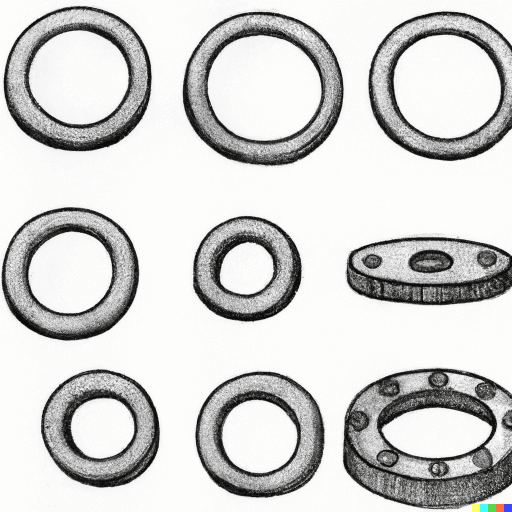
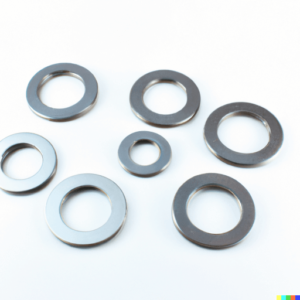
The seven types of washers you will encounter most often in fastening applications are: flat washers (plain washers), spring washers, lock washers, fender washers, split washers, tooth washers, and dock washers. Each one solves a specific mechanical problem — load distribution, vibration resistance, surface protection, or locking — and choosing the wrong type leads to joint failure, not just suboptimal performance.
A washer is the least expensive component in a bolted assembly. An M10 flat washer costs roughly USD 0.02–0.08. Yet that small disc can determine whether a highway guardrail bolt holds for 20 years or corrodes loose in 18 months, whether a CNC machine stays aligned between maintenance cycles, or whether a dock piling connection survives a hurricane season. The global flat washer market alone reached USD 3 billion in 2024. The lock washer market hit USD 1.25 billion in 2025. These numbers reflect how fundamental washers are to every industry that uses threaded fasteners.
This guide covers each type with its mechanical function, standard specifications, best-use scenarios, and material options. If you are an engineer specifying fasteners for a new design, a procurement manager building a bill of materials, or a contractor choosing hardware for a field installation, the comparison chart and selection tips at the end will save you time and prevent costly mistakes.
Purpose of Washers in Fastening
Washer Function
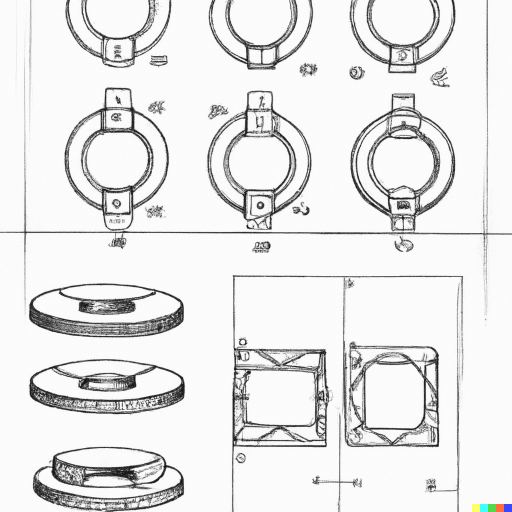
A washer performs four fundamental functions in a fastener assembly. First, it distributes the clamping load of the bolt or nut across a wider bearing area, reducing the stress concentration on the joint surface. Without a washer, a bolt’s clamping force — which can exceed 20,000 lb on a 1/2-inch Grade 8 bolt — is focused on the small area under the hex head, which can indent soft materials (aluminum, wood, plastic, thin sheet metal) and reduce effective clamp force over time. Second, a washer provides a smooth, consistent friction surface for the rotating element (bolt head or nut), improving torque-tension accuracy. A 2019 study by the Bolting Reliability Group found that torque-tension scatter decreased by 18 % when a hardened flat washer was added to a Grade 8.8 bolted joint on a machined steel surface. Third, specific washer types (spring, lock, tooth) resist loosening caused by vibration, thermal cycling, or dynamic loads. Fourth, washers protect the surface finish of the joint — preventing the rotating bolt head or nut from marring painted, plated, or anodized surfaces.
Importance in Applications
The consequences of omitting or misspecifying a washer are concrete. A packaging-line manufacturer in Guangzhou documented that M8 servo-motor mounting bolts, installed without flat washers on aluminum brackets, loosened every 90 days and required scheduled re-torquing at a labor cost of USD 180 per event. Adding DIN 125 flat washers eliminated the loosening entirely and saved USD 1,080 per year — from a USD 7.68 investment in 48 washers. On a highway overpass in Virginia, zinc-plated carbon steel washers corroded within 36 months, necessitating a USD 38,000 replacement operation across 4,200 bolted connections. Switching to 304 stainless flat washers resolved the problem for the remaining 20-year design life of the guardrail system.
Every fastener assembly should start with the question: Which washer type and material matches this joint’s load, environment, and service life? The seven types below give you the answer for nearly every scenario.
Types of Washers in Fastening
1. Flat Washers (Plain Washers)

Flat washers are the most common washer type, used in over 85 % of all bolted assemblies worldwide. They are simple discs with a central hole, designed to spread clamping load and protect the joint surface. Standards include ASME B18.21.1 (SAE and USS patterns in inch series) and DIN 125A / ISO 7089 (metric). USS washers have a larger OD than SAE washers for the same bolt size, making them better suited for soft substrates like wood or thin sheet metal.
A 3/8-inch USS flat washer has an OD of 1.000 inch and thickness of 0.083 inch. A 3/8-inch SAE flat washer has an OD of 0.812 inch and thickness of 0.065 inch. That difference in bearing area — roughly 50 % more for USS — can be the difference between a bolt embedding into a softwood ledger board or maintaining full clamp force for decades.
Best applications: General construction, machinery assembly, automotive, furniture, electrical panels, and any joint where surface protection and load distribution are the primary requirements. Prince Fastener’s flat washer catalog includes DIN 125, DIN 9021 (large OD), USS, and SAE patterns in carbon steel, 304 (A2), and 316 (A4) stainless steel.
2. Spring Washers
Spring washers (also called Belleville washers or conical disc springs when referring to the cupped variant) provide a continuous axial spring force that compensates for bolt relaxation, thermal expansion, and settlement of gasket or soft-surface joints. Unlike flat washers, which are passive, spring washers are active — they store elastic energy and push back against the nut or bolt head to maintain preload.
DIN 6796 conical spring washers are the standard in European machinery applications. They can maintain up to 15 % higher preload retention under thermal cycling compared to assemblies without spring washers, according to testing by Schnorr GmbH (a leading Belleville washer manufacturer). In a valve-flange assembly at a Texas petrochemical plant, replacing standard flat washers with DIN 6796 spring washers on M16 studs reduced gasket leak callbacks from 6 per year to 1 over a three-year period — a 83 % improvement tied directly to more consistent bolt preload under temperature fluctuations of 150–350 °F.
Best applications: Flanged pipe connections, heat exchangers, electric motor mounts, any assembly subject to thermal cycling or bolt relaxation. Prince Fastener’s washer assembly guide explains how to pair spring washers with flat washers for optimal preload retention.
3. Lock Washers
Lock washers resist rotational loosening of the bolt or nut. They work by creating friction or mechanical interference between the fastener and the joint surface. The two most common sub-types are helical spring lock washers (split lock washers) and serrated (tooth) lock washers. However, “lock washer” as a general category also includes wedge-lock washers (e.g., Nord-Lock), tab washers, and Keps (K-lock) washers with captive tooth rings.
A Junker vibration test conducted by a DIY engineering channel demonstrated that a standard split lock washer maintained 40–60 % of initial preload after 1,000 vibration cycles, compared to near-zero preload for a bare bolt-and-nut assembly. Wedge-lock washers (Nord-Lock type) performed even better, retaining 90 %+ preload under the same conditions.
Best applications: Machinery subject to vibration (conveyors, compressors, engines), structural connections requiring positive locking (safety-critical joints), and any assembly where periodic re-torquing is impractical.
4. Fender Washers
Fender washers are flat washers with an oversized outside diameter relative to their central hole and thickness. The name comes from their original use on automotive fender repairs, where a large bearing surface was needed to bridge sheet-metal damage. A 1/4-inch fender washer typically has an OD of 1 inch or more, compared to 0.625 inch for a standard SAE flat washer of the same bolt size.
The wider bearing area makes fender washers ideal for any scenario where the substrate is thin, soft, or damaged — fiberglass panels, drywall backing, plywood sheathing, thin-gauge sheet metal, and slotted or oversized holes. An HVAC ductwork installer in Atlanta documented a 35 % reduction in sheet-metal pullthrough failures after standardizing on 304 stainless fender washers for all duct-hanger strap connections. The old installation used standard SAE flat washers, which were too small to prevent the 26-gauge sheet metal from tearing under wind load.
Best applications: Auto body repair, HVAC ductwork, signage mounting, electrical panel backing, and any fastening through thin or soft material. For oversized-hole situations, Prince Fastener’s flange and fender washer range covers diameters up to 2 inches in both carbon steel and stainless grades.
5. Split Washers
Split washers (helical spring lock washers) are the most widely recognized locking washer type. They consist of a single coil of spring steel with a gap, forming a helical shape. When compressed by the bolt head or nut, the sharp edges of the split washer bite into both the fastener and the mating surface, creating frictional resistance to back-off rotation. The spring tension also maintains a small axial load on the fastener during minor relaxation events.
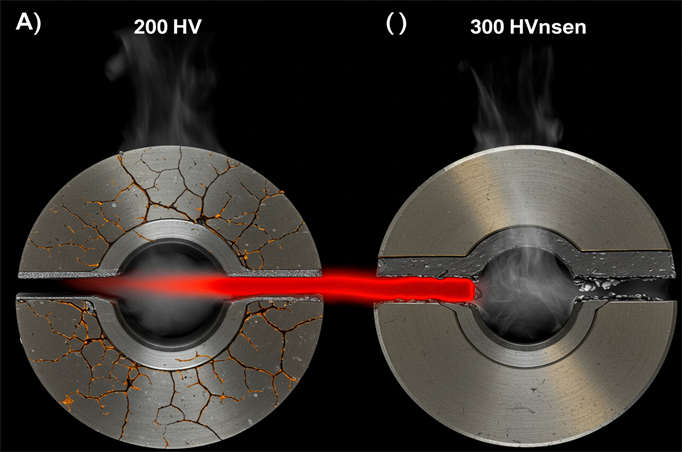
The governing standard is DIN 127 (metric) and ASME B18.21.1 (inch). Split washers are typically made from medium-carbon spring steel (hardened to 38–46 HRC) or stainless steel (302/304 SS). They are most effective in low-vibration applications. In high-vibration environments — a Junker test scenario — split washers underperform wedge-lock and prevailing-torque lock nuts. However, their low cost (USD 0.01–0.05 each), universal availability, and zero-setup installation make them the default locking method for general maintenance and light machinery.
Best applications: General-purpose locking on electrical panels, furniture, light machinery, agricultural equipment, and any joint where moderate vibration resistance is acceptable. Always pair with a flat washer to protect the joint surface.
6. Tooth Washers
Tooth washers (serrated lock washers) have multiple teeth stamped along the inner diameter (internal tooth), outer diameter (external tooth), or both (internal-external combo). The teeth bite into the mating surfaces when the fastener is tightened, providing multi-point friction locking. External tooth washers offer higher torsional resistance because the teeth are farther from the bolt axis, creating a longer moment arm. Internal tooth washers provide a cleaner appearance because the teeth are hidden under the bolt head.
Tooth washers also serve a critical role in electrical grounding. The teeth abrade through paint, anodizing, or oxide layers on the mating surface, establishing a low-resistance metal-to-metal electrical path. In switchgear and control-panel assemblies, internal tooth washers under grounding lugs are required by NEC Article 250 to ensure effective grounding continuity. A panel builder in Houston measured contact resistance of 0.5 milliohms with a tooth washer versus 12 milliohms without — a 24× improvement that prevented nuisance ground-fault trips on sensitive instrumentation circuits.
Best applications: Electrical grounding connections, soft-material assemblies (plastic housings, printed circuit boards), light machinery, and small-diameter fastener applications where split washers would be too bulky.
7. Dock Washers
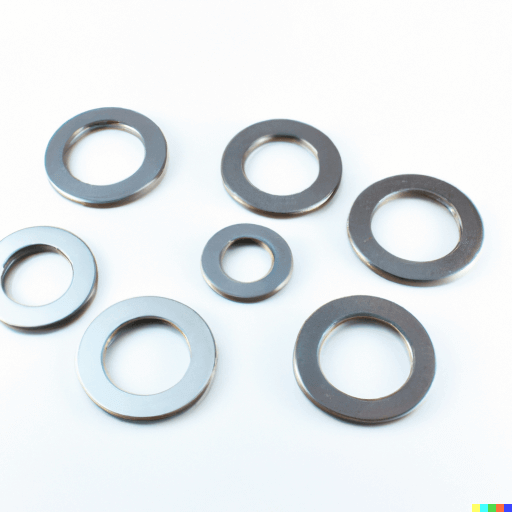
Dock washers are the heaviest-duty flat washers in the fastener catalog. They feature a significantly larger outside diameter and thickness than standard flat washers — a 3/4-inch dock washer measures 13/16-inch ID × 3-inch OD × 1/4-inch thick, compared to a USS flat washer at 13/16-inch ID × 1.750-inch OD × 0.134-inch thick. That extra mass and bearing area prevents the washer from deforming under high preload and distributes the bolt’s clamping force across a wide footprint on rough, uneven, or pressure-treated wood surfaces.
Dock washers are almost always supplied in hot-dip galvanized (HDG) carbon steel or 316 stainless steel for marine environments. They are specified on dock pilings, bridge timber connections, retaining-wall tie-backs, heavy-timber trusses, and utility pole hardware. A marina contractor in Chesapeake Bay reported that switching from standard USS flat washers to dock washers on 1/2-inch through-bolts connecting dock stringers to pilings eliminated bolt pull-through entirely across 340 connections over five years. The standard washers had been pulling into the pressure-treated Southern yellow pine under wave-induced cyclic loading.
Best applications: Marine docks, piers, bridge timber connections, utility poles, heavy outdoor timber construction, and any bolted joint in rough wood or masonry where high bearing area and corrosion resistance are both critical.
Bar Chart — Global Market Size by Washer Type (2024–2025, USD Millions)
Washer Market Size by Type (USD Millions)
Sources: Credence Research 2024, Allied Market Research 2025, Dataintelo 2023
Washer Materials and Selection Tips
Common Washer Materials
The material of a washer must match both the bolt grade and the service environment. Mismatching materials leads to galvanic corrosion (dissimilar metals in a wet environment), premature wear (soft washer under high-strength bolt), or unnecessary cost (316 stainless where zinc-plated carbon steel would suffice).
炭素鋼 is the default for indoor, dry, and cost-sensitive applications. It is typically zinc-plated (electro-galvanized) for mild corrosion resistance or hot-dip galvanized (HDG) for outdoor use. Carbon steel washers are available in low-carbon (unhardened, ASTM F844), medium-carbon (Grade 5, tempered), and high-carbon (hardened, ASTM F436 for structural bolting) variants. A zinc-plated M10 flat washer costs approximately USD 0.02–0.04.
ステンレス (304/A2 for general corrosion resistance, 316/A4 for marine and chemical exposure) eliminates the corrosion risk entirely in most environments. In ASTM B117 salt-spray testing, 304 SS washers show no red rust for 500–1,000 hours versus 96–200 hours for zinc-plated steel. A 316 SS washer exceeds 2,000 hours. The cost premium is 3–5× per unit, but lifecycle cost consistently favors stainless in any wet or outdoor application. Prince Fastener’s washer material guide provides detailed comparisons across all common grades.
真鍮 is specified where electrical conductivity, non-sparking properties, or corrosion resistance to freshwater is needed — marine instruments, plumbing fittings, and hazardous (explosive atmosphere) environments.
Nylon (PA66) and other engineering plastics are used for electrical insulation, vibration damping, and prevention of galvanic corrosion between dissimilar metals. A nylon washer between a stainless steel bolt and an aluminum housing blocks the galvanic circuit that would otherwise cause corrosion of the aluminum.
Choosing the Right Washer
Follow a four-step selection process. First, identify the primary function needed: load distribution (flat/fender/dock), locking (split/tooth/lock), preload maintenance (spring), or a combination. Second, match the material to the environment: carbon steel for dry indoor, stainless for wet/outdoor/chemical, brass for electrical/non-sparking, nylon for insulation. Third, match the standard to the bolt system: DIN 125 for metric bolts, SAE for automotive, USS for construction, ASTM F436 for structural (A325/A490 bolts). Fourth, verify hardness compatibility: a soft washer under a high-strength bolt will deform and lose preload; a hardened F436 washer is required under A325 and A490 structural bolts.
Pie Chart — Washer Material Market Share (2024)
Global Washer Market by Material (2024)
Carbon Steel (Zinc/HDG) — 26 %
Hardened Steel (F436) — 12 %
Brass & Copper Alloys — 9 %
Nylon & Plastics — 7 %
Source: Credence Research Flat Washers Market 2024
Quick Reference: Washer Types and Uses
Washer Comparison Chart
| 洗濯機タイプ | Primary Function | Common Standards | Typical Materials | Best Applications | 耐振動性 | Cost Range (USD/unit) |
|---|---|---|---|---|---|---|
| Flat (Plain) | Load distribution, surface protection | DIN 125, SAE, USS, ASTM F844 | Carbon steel, SS 304/316, brass, nylon | General construction, machinery, automotive | None (passive) | $0.02–$0.12 |
| Spring (Belleville) | Preload maintenance, bolt relaxation compensation | DIN 6796, DIN 2093 | Spring steel, SS 301/304 | Flanges, motor mounts, thermal-cycling joints | Moderate (axial spring force) | $0.05–$0.30 |
| Lock (General) | Rotation resistance, positive locking | DIN 25201 (wedge), DIN 127 (split) | Hardened carbon steel, SS 304 | Vibrating machinery, safety-critical joints | High (wedge-lock: 90 %+ preload retention) | $0.08–$0.50 |
| Fender | Wide-area load distribution on thin/soft materials | SAE, custom OD | Carbon steel, SS 304/316 | Auto body, HVAC, signage, sheet metal | None (passive) | $0.03–$0.15 |
| Split | Helical spring lock, edge-bite locking | DIN 127, ASME B18.21.1 | Medium-carbon spring steel, SS 302/304 | General maintenance, light machinery, electrical | Low–Moderate (40–60 % preload at 1,000 cycles) | $0.01–$0.05 |
| Tooth (Serrated) | Multi-point friction lock, electrical grounding | DIN 6797 (internal/external) | Spring steel, zinc-plated steel, SS 304 | Electrical panels, soft housings, PCB mounts | Moderate (multi-tooth grip) | $0.02–$0.08 |
| Dock | Heavy-duty load distribution, pull-through prevention | No single DIN; per manufacturer spec | Low-carbon steel HDG, SS 316 | Docks, piers, bridges, utility poles, heavy timber | None (passive, high-mass) | $0.15–$0.80 |
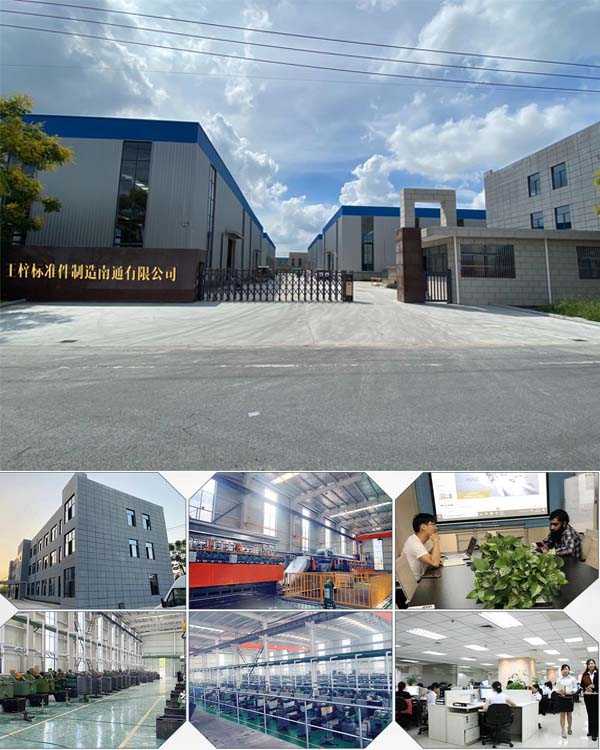
For custom washer requirements — non-standard OD, thickness, or material combinations — Prince Fastener’s custom washer program accepts OEM specifications with flexible MOQs. Each production lot ships with a mill test certificate verifying chemical composition and hardness, a standard practice from their 30-year fastener manufacturing operation.
Watch: All About Washers — Types, Materials, USS vs SAE
Video: Albany County Fasteners explains flat, lock, spring, fender, and specialty washers — including USS vs SAE sizing and material options.
Selecting the right washer is a three-variable decision: type (what mechanical function do you need?), material (what environment will the joint face?), and standard (what bolt system are you using?). Flat washers handle 85 % of all applications by distributing load and protecting surfaces. Spring washers maintain preload in thermal-cycling and gasket joints. Lock and split washers resist vibration-induced loosening. Fender washers cover soft and thin substrates. Tooth washers lock and ground electrical connections. Dock washers withstand the harshest marine and heavy-timber environments.
The cost of any washer — even a 316 stainless dock washer at USD 0.80 — is trivial compared to the cost of the failure it prevents. A USD 0.04 flat washer saved a factory USD 1,080 per year in re-torquing labor. A USD 38,000 guardrail replacement was caused by the wrong washer material, not the wrong bolt. Match the washer to the joint, verify with a mill test report from a reliable manufacturer like プリンスファスナー, and the smallest component in the assembly becomes the one you never have to think about again.
Frequently Asked Questions
1. What are the 7 most common types of washers?
The seven most common types are flat washers (plain washers), spring washers (Belleville/conical), lock washers (wedge-lock, Keps), fender washers, split washers (helical spring lock), tooth washers (internal/external serrated), and dock washers (heavy-duty oversize). Flat washers are used in over 85 % of bolted assemblies for load distribution and surface protection.
2. What is the difference between a flat washer and a fender washer?
Both are passive load-distribution washers, but a fender washer has a much larger outside diameter relative to its bolt hole. For a 1/4-inch bolt, a standard SAE flat washer has an OD of 0.625 inch, while a fender washer can reach 1.000 inch or more. Fender washers are designed for thin sheet metal, soft substrates, or oversized holes where a standard flat washer would not provide enough bearing area.
3. When should I use a spring washer instead of a flat washer?
Use a spring washer (Belleville or DIN 6796 conical disc) when the bolted joint is subject to thermal cycling, bolt relaxation, or gasket compression that reduces preload over time. Spring washers store elastic energy and push back against the fastener to maintain clamping force. In a Texas petrochemical plant, replacing flat washers with DIN 6796 spring washers on valve-flange studs reduced gasket leak callbacks by 83 % over three years.
4. Are split lock washers effective against vibration?
Split lock washers provide moderate vibration resistance — they retain roughly 40–60 % of initial preload after 1,000 cycles in Junker-type vibration testing. For severe vibration, they are less effective than wedge-lock washers (Nord-Lock type), which retain 90 %+ preload, or prevailing-torque lock nuts (Stover, nylon-insert). Split washers are best for general maintenance and light machinery where moderate locking is acceptable.
5. What washer material should I use for outdoor applications?
For mild outdoor exposure (no salt or chemicals), hot-dip galvanized (HDG) carbon steel washers provide 15–25 years of service. For coastal, marine, or chemical environments, 316 stainless steel (A4) is the standard — it resists red rust for 2,000–3,000 hours in ASTM B117 salt-spray testing. For contact with pressure-treated wood (ACQ, CA-C), the IBC requires HDG or stainless steel fasteners. Prince Fastener supplies both grades with full material traceability.
6. What is a dock washer and when do I need one?
A dock washer is a heavy-duty flat washer with a significantly larger OD and thickness than standard flat washers. A typical 3/4-inch dock washer measures 3 inches OD and 1/4 inch thick. They are used on docks, piers, bridges, utility poles, and heavy-timber connections where the bolt must distribute high loads over rough or soft surfaces without pull-through. Dock washers are typically supplied in HDG carbon steel or 316 stainless for marine corrosion resistance.
7. Do tooth washers help with electrical grounding?
Yes. Internal and external tooth washers are one of the primary methods for establishing low-resistance grounding connections in electrical panels and switchgear. The teeth abrade through paint, anodizing, or oxide layers, creating direct metal-to-metal contact. In one documented case, adding a tooth washer reduced ground-lug contact resistance from 12 milliohms to 0.5 milliohms — a 24× improvement that eliminated nuisance ground-fault trips.
8. What is the difference between USS and SAE flat washers?
Both are inch-series standards under ASME B18.21.1, but USS washers have a larger OD than SAE washers for the same bolt size. A 1/2-inch USS washer has an OD of 1.375 inches, while a 1/2-inch SAE washer has an OD of 1.062 inches. USS washers are preferred for wood, soft material, or rough-surface applications. SAE washers are standard in automotive and machinery where tighter clearances require a smaller footprint.
9. Can I stack multiple washers instead of using one thick washer?
Stacking is generally discouraged in structural applications. Multiple stacked washers introduce additional friction interfaces and increase the risk of uneven load distribution and relative sliding under vibration. If the bolt is too long for the grip length, use a single thicker washer (or dock washer) rather than stacking two or three thin washers. For non-structural applications with low preload, a two-washer stack is acceptable but still less reliable than a single washer of the correct thickness.
10. Where can I buy all 7 washer types in bulk?
プリンスファスナー manufactures and supplies flat, spring, lock, fender, split, tooth, and dock washers in carbon steel, stainless steel (304 and 316), brass, and nylon. Their factory-direct pricing, flexible MOQs, and 30-year production track record make them a reliable source for OEM and wholesale buyers. Each lot includes a mill test certificate. For inquiries, visit the Prince Fastener contact page.




 日本語
日本語  English
  Español
  Português do Brasil
  Русский
  العربية