
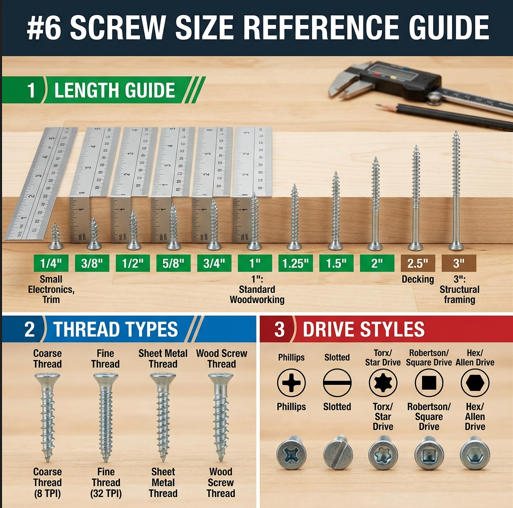
A framing crew in Austin, Texas billed a client $2,300 in extra labor after 600 drywall screws stripped out on the first day of hanging. The cause: someone ordered coarse-thread #6 screws for 25-gauge metal studs instead of fine-thread. The coarse threads couldn’t grip the thin metal, the Phillips heads cammed out under torque, and two apprentices spent an entire shift extracting and replacing every single one.
That kind of failure does not happen because #6 screws are flawed. It happens because #6 covers dozens of combinations—wood thread, machine thread, self-tapping, self-drilling, coarse, fine, Phillips, Torx, Robertson, zinc-plated, black phosphate, stainless—and choosing the wrong combination for your substrate turns a $14 box of fasteners into a four-figure rework cost.
This guide walks through every specification that matters when selecting a #6 screw: gauge dimensions, available lengths, thread types, head and drive styles, materials, coatings, pilot-hole sizing, and real withdrawal-force data. Whether you are hanging ½″ drywall on wood studs, fastening 22-gauge ductwork, or assembling oak cabinet face frames, the tables and charts below will eliminate guesswork.
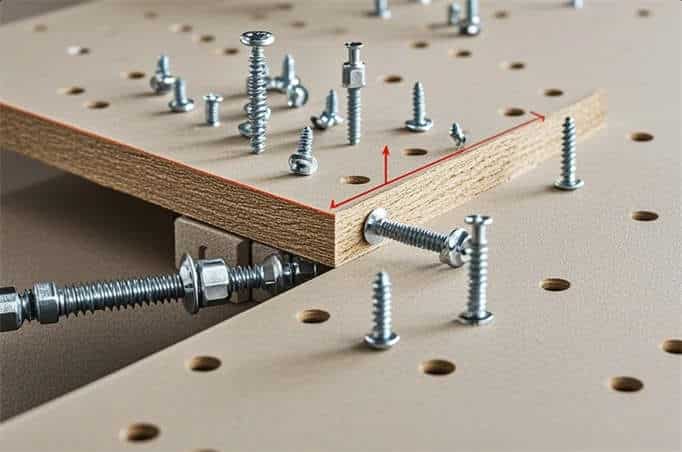
1. What “#6” Actually Means — Diameter, Gauge & Metric Equivalent
The number “6” is not a measurement unit. It is a gauge designation from the American Screw Wire Gauge (ASWG) system, where each gauge number corresponds to a specific major thread diameter—the widest point measured across the outside of the threads. A #6 screw has a major thread diameter of 0.138 inches (3.51 mm). The shank (unthreaded portion, if present) measures the same 0.138″. The root diameter—the narrowest point at the bottom of the thread valleys—is approximately 0.092″ (2.34 mm) for wood-thread variants.
In metric-centric markets, a #6 is closest to an M3.5 screw (3.5 mm nominal diameter), though the two are not interchangeable because thread pitch and profile differ. If your BOM calls for M3.5 × 0.6 and you substitute a #6-32 UNC machine screw (32 threads per inch = 0.794 mm pitch), the threads will cross and the joint will fail. Always verify whether a specification is imperial gauge or metric before ordering.
2. Where #6 Sits in the Screw-Size Spectrum
Understanding where #6 falls relative to neighboring gauges prevents the over-engineering trap (using a #10 where a #6 suffices) and the under-engineering trap (using a #4 that cannot carry the load). The table below compares common gauges from #4 to #12:
| Indicador | Major Dia. (in) | Major Dia. (mm) | Nearest Fraction | Metric Approx. | Typical Use |
|---|---|---|---|---|---|
| #4 | 0.112 | 2.84 | 7/64″ | M3 | Electrical cover plates, light trim |
| #5 | 0.125 | 3.18 | 1/8″ | M3 | Small hinges, drawer pulls |
| #6 | 0.138 | 3.51 | 9/64″ | M3.5 | Drywall, cabinets, light sheet metal, trim |
| #7 | 0.151 | 3.84 | 5/32″ | M4 | Mid-duty cabinetry, sub-fascia |
| #8 | 0.164 | 4.17 | 5/32″ | M4 | General woodworking, furniture, decking |
| #10 | 0.190 | 4.83 | 3/16″ | M5 | Structural woodwork, ledger boards |
| #12 | 0.216 | 5.49 | 7/32″ | M5.5 | Heavy-duty framing, lag-bolt pilot |
#6 is the workhorse gauge for drywall-to-stud connections in residential construction and for mounting lightweight hardware (switch plates, cable clips, small brackets) in both wood and sheet metal. It is thinner than a #8—which means it displaces less material and is less likely to split narrow trim stock—but thick enough to develop meaningful withdrawal resistance in properly piloted holes.
3. Length Selection — Rules, Formulas & Application Table
Length determines how much thread engages the receiving member, and engagement drives holding power. Two rules govern #6 screw length selection:
Rule 1 — Minimum Penetration: The screw must penetrate the receiving member by at least ⅝″ (16 mm) for wood studs and at least three full thread pitches for sheet metal. For drywall, the screw tip must emerge at least ½″ past the back face of the stud (per ASTM C1002).
Rule 2 — Maximum Length: The screw should not protrude through the back side of the assembly unless the design allows it. In blind installations (cabinet backs, concealed trim), the screw must stop at least 1/16″ before the exit face to avoid blow-out dimples.
The formula for required screw length is:
Example: ½″ drywall + 0″ gap + ⅝″ penetration into wood stud = 1⅛″ → round up to 1¼″ (the nearest standard length).
| Solicitud | Top Material | Receiving Member | Recommended #6 Length | Tipo de hilo |
|---|---|---|---|---|
| ½″ drywall to wood stud | ½″ gypsum | SPF or Douglas fir | 1¼″ | Coarse (W-type) |
| ⅝″ drywall to wood stud | ⅝″ gypsum | SPF or Douglas fir | 1⅝″ | Coarse (W-type) |
| ½″ drywall to 25-ga metal stud | ½″ gypsum | 25-gauge steel | 1″ or 1¼″ | Fine (S-type) |
| Double-layer drywall to wood | 2 × ½″ gypsum | SPF or Douglas fir | 1⅝″ (face layer only) | Coarse (W-type) |
| Hardwood trim to jamb | ½″ oak | ¾″ pine jamb | 1¼″ | Wood thread |
| Switch-plate cover | N/A | Electrical box | ¾″ or 1″ | Machine thread (6-32) |
| 22-ga HVAC duct | 22-gauge steel | 22-gauge steel | ½″ | Self-tapping, Type AB |
| Cabinet hinge to MDF | N/A | ¾″ MDF | ⅝″ | Wood thread or tornillo para aglomerado |
4. Thread Types — Coarse, Fine, Self-Tapping & Self-Drilling
Thread geometry is where most #6 screw mistakes happen. Four thread families are commonly available in #6 gauge, and each one is engineered for a specific substrate:
4a. Coarse Thread (Wood / W-Type Drywall)
Wide thread spacing (approximately 18–20 TPI for #6 wood screws) grips soft, fibrous materials—SPF framing lumber, plywood, OSB, MDF—by cutting between wood fibers and wedging them apart. Coarse-thread drywall screws (W-type) are the default choice for attaching gypsum board to wood studs. The aggressive pitch pulls the screw into the stud quickly, reducing installation time on high-volume hanging jobs.
4b. Fine Thread (Metal / S-Type Drywall)
Tighter thread spacing (approximately 32 TPI for #6-32 machine pitch) is designed for thin sheet metal (20–25 gauge steel studs). The closely spaced threads create more engagement points per inch, preventing the screw from stripping out of the thin metal. Using coarse-thread screws on metal studs is the exact mistake that cost the Austin crew $2,300: the wide-spaced threads could not cut enough grooves into the steel to develop meaningful pull-out resistance.
4c. Self-Tapping (Type A, AB, B)
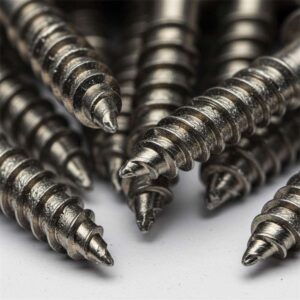
Tornillos autorroscantes have a sharp or gimlet point and hardened threads that cut their own mating thread in a pre-drilled pilot hole. They do not need a tap. Type A has a wider thread spacing for sheet metal; Type AB has a finer pitch for thinner gauges; Type B has a blunt (non-tapered) starting thread for precision metal assemblies.
4d. Self-Drilling (TEK Screws)
Tornillos autoperforantes integrate a drill-bit tip that bores its own pilot hole, then the thread cuts and fastens in a single operation. Available in #6 gauge for light-gauge steel framing (up to about 14-gauge steel), they eliminate the separate drilling step and cut installation time by roughly 40% on metal-stud jobs.
Thread-Type Usage Share in Residential Construction (US, 2024)
Source: Aggregated distributor sales data, US residential segment, 2024. Coarse-thread dominance reflects the prevalence of wood-stud framing.
5. Head Styles & Drive Types
The head determines how the screw sits in the finished surface, and the drive determines how much torque you can apply before the bit slips. For #6 screws, five head/drive combinations cover 95% of applications:
| Estilo de cabeza | Profile | Tipo de unidad | Cam-Out Risk | Lo mejor para |
|---|---|---|---|---|
| Bugle (drywall) | Concave underside, sits flush in gypsum without tearing paper | Phillips #2 | Moderado | Drywall hanging |
| Flat (countersunk) | 82° cone, sits flush in countersunk or countersunk-drilled hole | Phillips #1 or Robertson #1 | Low–Moderate | Trim, cabinetry, furniture |
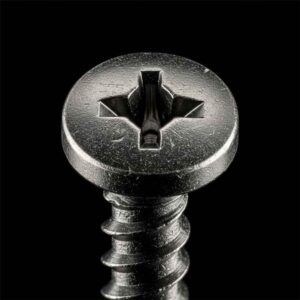
| Cacerola | Low dome, sits on surface | Phillips #2 or Torx T10 | Bajo | Sheet-metal joints, electrical boxes |
| Braguero | Extra-wide, low dome | Phillips #2 | Moderado | HVAC ductwork, lath |
| Hex washer | Hex head with integrated washer | ¼″ hex driver | Ninguno | Roofing, metal siding |
6. Materials — Carbon Steel, Stainless Steel, Brass & Nylon
The screw’s base metal determines its tensile strength, corrosion resistance, and compatibility with treated lumber and dissimilar metals. Four materials account for virtually all #6 screws sold:
| Propiedad | Acero carbono | Stainless 304 (18-8) | Stainless 316 | Latón | Nylon |
|---|---|---|---|---|---|
| Resistencia a la tracción (psi) | 60,000–120,000 | 85,000 | 90,000 | 55,000–65,000 | 10,000–12,000 |
| Resistencia a la corrosión | Low (needs coating) | Alta | Very High (marine) | Moderado | Excellent (non-metallic) |
| ACQ-Treated Lumber Safe? | No (copper corrodes zinc) | Sí | Sí | No (dezincification risk) | N/A (insufficient strength) |
| Magnetic? | Sí | Slightly (work-hardened) | No | No | No |
| Cost Index (carbon = 1×) | 1× | 2.5–3× | 4–5× | 3–4× | 1.5–2× |
| Dureza típica | HRC 25–39 | HRB 80–92 | HRB 79–90 | HRB 55–75 | Shore D 80 |
For outdoor decking, fencing, and any contact with ACQ (alkaline copper quaternary) pressure-treated lumber, tornillos de acero inoxidable are the only safe choice. The copper in ACQ reacts electrochemically with zinc coatings and carbon steel, causing accelerated corrosion that can destroy a fastener in 2–5 years. SFS Group’s carbon vs. stainless comparison documents this failure mode in detail.
#6 Screw Material Market Share (North America, 2024)
Carbon Steel 65%
Stainless 304 20%
Brass 6%
Stainless 316 5%
Nylon 4%
Estimated North American distribution across all #6 SKUs, 2024.

7. Coatings & Finishes — Salt-Spray Performance Compared
A coating adds corrosion life to carbon-steel screws and can improve lubricity (reducing drive torque) or aesthetics (matching hardware color). The table below ranks common #6 screw finishes by ASTM B117 salt-spray hours—a standard accelerated-corrosion test:
| Finalizar | Salt-Spray Hours | Coating Thickness | Indoor Use | Outdoor Use | Notas |
|---|---|---|---|---|---|
| Black Phosphate | 2–5 hr | 0.5–1.5 µm | ✔ Primary | ✘ | Standard drywall screw finish; needs paint or sealant outdoors |
| Zinc Plated (clear) | 8–12 hr | 5–8 µm | ✔ | Limitado | Bright silver; adequate for dry, covered exterior |
| Yellow Zinc Chromate | 72–96 hr | 5–12 µm | ✔ | ✔ Moderate | Gold color; superior to clear zinc for humid climates |
| Galvanizado en caliente | 300–500 hr | 45–85 µm | ✔ | ✔ Heavy-duty | Thick coating; may affect thread fit—needs matching nuts |
| Ceramic / Epoxy Coating | 500–1,000 hr | 10–25 µm | ✔ | ✔ Extreme | Best for coastal, chemical, or ACQ-treated wood exposure |
Black phosphate is the default for interior drywall screws because it accepts paint and joint compound well, and its thin profile does not change the screw’s thread fit. For exterior yellow-zinc chipboard screws, the thicker chromate layer provides meaningful protection without the thread-fit issues of hot-dip galvanizing. DMS Fasteners’ zinc comparison provides additional performance data for Australian and North American conditions.
8. Pilot-Hole Sizing Chart for #6 Screws
Pilot holes serve two purposes: they prevent splitting in dense or narrow stock, and they reduce driving torque so the head seats without camming out. The correct pilot diameter depends on the wood species density and the drill-bit geometry. Data sourced from Bolt Depot’s pilot-hole reference:
| Substrate | Tapered Bit | Straight Bit | Metric Equivalent | Countersink Size |
|---|---|---|---|---|
| Hardwood (oak, maple, cherry) | 9/64″ | 7/64″ | 3.6 mm tapered / 2.8 mm straight | 5/16″ |
| Softwood (pine, spruce, fir) | 1/8″ | 3/32″ | 3.2 mm tapered / 2.4 mm straight | 5/16″ |
| MDF / Particleboard | 7/64″ | 3/32″ | 2.8 mm tapered / 2.4 mm straight | 5/16″ |
| Sheet Metal (22–25 ga) | 7/64″ (straight only) | 2.8 mm | N/A | |
| Sheet Metal (18–20 ga) | 1/8″ (straight only) | 3.2 mm | N/A | |
9. Real-World Withdrawal Force Data
The USDA Forest Products Laboratory’s Wood Handbook, Chapter 8 provides the standard formula for wood-screw withdrawal resistance into side grain: F = 2,850 × SG² × D, where F = allowable withdrawal load in lb per inch of thread penetration, SG = oven-dry specific gravity, and D = screw shank diameter in inches.
For a #6 screw (D = 0.138″), the calculated withdrawal resistance per inch of penetration in common species is:
#6 Screw Withdrawal Resistance (lb per inch of penetration)
Calculated using F = 2,850 × SG² × 0.138. Values represent allowable load per inch of thread penetration, side grain, seasoned dry wood.
In practical terms, a #6 × 1¼″ coarse drywall screw driven through ½″ gypsum into an SPF stud has roughly ¾″ of thread penetration, yielding an allowable withdrawal load of approximately 69 × 0.75 = 52 lb per screw. That is why drywall specifications call for screws every 12″ on ceilings and every 16″ on walls—the distributed screw pattern ensures no single fastener is overloaded. For cabinetry in hard maple, the same screw with 1″ of thread engagement delivers about 156 lb of withdrawal resistance—more than enough for a Euro-style cup hinge.

10. Seven Costly Mistakes to Avoid with #6 Screws
Mistake 1 — No pilot hole in hardwood. A #6 screw driven into white oak without a 9/64″ pilot hole will split the grain 70–80% of the time if the fastener is within 2″ of the board edge. The split may not be visible immediately but will propagate under load.
Mistake 2 — Coarse thread into metal studs. Coarse-thread #6 drywall screws (W-type) cannot grip sheet metal thinner than 18-gauge. The wide thread spacing strips the hole before the head seats. Use fine-thread (S-type) for 20–25 gauge studs.
Mistake 3 — Black-phosphate screws outdoors. Black phosphate provides only 2–5 hours of salt-spray protection. On an exposed deck rail, that coating fails in weeks. Use acero inoxidable or ceramic-coated fasteners for any exterior application.
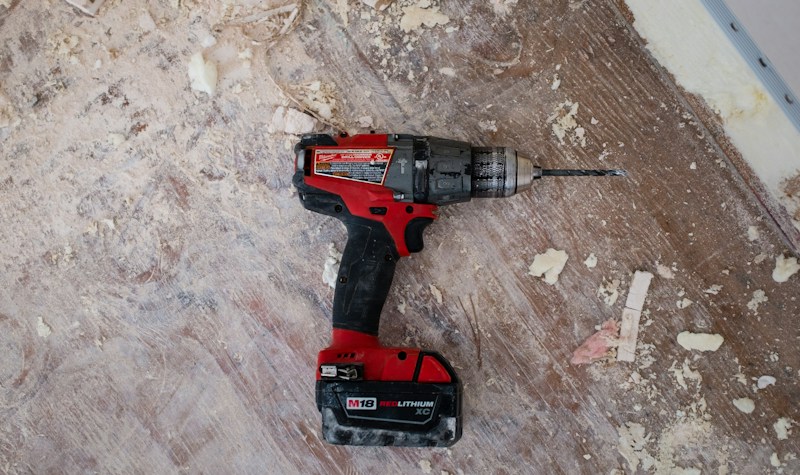
Mistake 4 — Over-driving with an impact driver. Impact drivers deliver 1,500+ in-lb of torque in short bursts. A #6 drywall screw’s bugle head is designed to seat just below the paper surface. Over-driving punches the head through the paper, destroying the drywall’s holding mechanism. Use a drywall-specific screw gun with a depth-stop clutch.
Mistake 5 — Using drywall screws for structural loads. Drywall screws are case-hardened (hard exterior, soft core) to HRC 50–58 on the surface. Under lateral shear, they snap instead of bending. A single #6 drywall screw has roughly 100–120 lb of shear capacity, but it fails catastrophically without warning. For structural connections, use proper wood screws or construction screws rated for the load.
Mistake 6 — Mixing stainless screws with galvanized hardware. When 304 stainless and hot-dip galvanized steel contact in the presence of moisture, galvanic corrosion eats the zinc coating at an accelerated rate. Use identical metals or isolate with a nylon washer.
Mistake 7 — Ignoring screw length in double-layer drywall. A #6 × 1¼″ screw that works perfectly for single-layer ½″ drywall only penetrates ¼″ into the stud through double-layer—well below the ⅝″ minimum. You need at least a 1⅝″ screw for the face layer of a double-layer assembly.
11. Video Guide: How to Choose the Right Screw Size and Type
This video covers the fundamentals of screw sizing—including gauge, length, thread type, and drive style—for beginners and experienced builders alike.
12. Quick-Selection Checklist
Before placing your next #6 screw order, confirm these six parameters in sequence:
| Paso | Parameter | Question to Answer | Example |
|---|---|---|---|
| 1 | Substrate | What am I fastening into? | ¾″ SPF wood stud |
| 2 | Longitud | Top material + gap + minimum penetration? | ½″ drywall + 0 + ⅝″ = 1⅛″ → 1¼″ |
| 3 | Hilo | Coarse (wood), fine (metal), self-tapping, or self-drilling? | Coarse (W-type) |
| 4 | Head & Drive | Flush, surface, or recessed? Phillips, Robertson, Torx? | Bugle head, Phillips #2 |
| 5 | Material | Indoor carbon steel or outdoor stainless? | Acero carbono |
| 6 | Revestimiento | Interior (black phosphate), moderate exterior (yellow zinc), heavy exterior (ceramic)? | fosfato negro |
For bulk procurement or custom fastener manufacturing, Sujetador Príncipe offers OEM/ODM services with over 30 years of production experience. Their Shanghai and Nantong facilities produce drywall, chipboard, self-tapping, and self-drilling screws across all common gauges, with the ability to customize head style, drive type, material, and coating to match your project specifications. Contact their engineering team through the Prince Fastener inquiry page for technical support on non-standard configurations.
13. Downloadable Reference: #6 Screw Specification Summary
The table below consolidates every specification into a single reference. Copy it into Excel or Google Sheets for your next project bid:
| Especificación | Valor | Notas |
|---|---|---|
| Gauge Number | #6 | ASWG system |
| Major Thread Diameter | 0.138″ / 3.51 mm | Measured across thread crests |
| Root Diameter (wood thread) | ~0.092″ / 2.34 mm | Bottom of thread valley |
| Machine Thread Pitch | 6-32 UNC (32 TPI = 0.794 mm) | For machine-thread variants |
| Standard Lengths | ½″ to 3″ | In ¼″ increments above 1″ |
| Common Drywall Lengths | 1″, 1¼″, 1⅝″, 2″ | Matches ½″ and ⅝″ gypsum |
| Pilot Hole — Hardwood | 9/64″ tapered / 7/64″ straight | Mandatory for splitting prevention |
| Pilot Hole — Softwood | 1/8″ tapered / 3/32″ straight | Recommended but not always required |
| Countersink Size | 5/16″ | For flat-head flush seating |
| Withdrawal — SPF (SG 0.42) | 69 lb/in | Side grain, seasoned dry |
| Withdrawal — White Oak (SG 0.68) | 182 lb/in | Side grain, seasoned dry |
| Phillips Driver | #1 (flat head) or #2 (bugle/pan) | Match driver to recess size |
| Torx Driver | T10 | Lower cam-out, higher torque |
| Robertson Driver | #1 (green) | Best for hardwood applications |
| Metric Approximate | M3.5 (not interchangeable) | Different pitch and profile |
Frequently Asked Questions
1. What is the actual diameter of a #6 screw?
A #6 screw has a major thread diameter of 0.138 inches (3.51 mm), equivalent to 9/64 of an inch. This measurement is taken across the outermost points of the thread crests. The root diameter (bottom of the thread valley) is approximately 0.092 inches (2.34 mm) for wood-thread variants. In metric-dominant markets, #6 is closest to M3.5, although the two use different thread profiles and are not interchangeable.
2. Should I use coarse-thread or fine-thread #6 drywall screws?
Use coarse-thread (W-type) for wood studs and fine-thread (S-type) for metal studs. Coarse threads have wider spacing (roughly 18–20 TPI) that grips wood fibers aggressively. Fine threads (approximately 32 TPI) create multiple engagement points in thin sheet metal (20–25 gauge). Using coarse-thread screws on metal studs causes stripping because the wide threads cannot cut sufficient grooves into the steel.
3. What pilot hole do I need for a #6 wood screw?
For hardwood (oak, maple, cherry), use a 9/64″ tapered bit or a 7/64″ straight bit. For softwood (pine, spruce, fir), use a 1/8″ tapered bit or a 3/32″ straight bit. In MDF or particleboard, a 7/64″ tapered or 3/32″ straight bit works well. For sheet metal (22–25 gauge), drill a 7/64″ straight hole. Always countersink to 5/16″ when using flat-head screws for flush seating.
4. How much weight can a single #6 screw hold in wood?
Withdrawal resistance depends on wood species and penetration depth. In SPF framing lumber (SG 0.42), a #6 screw develops approximately 69 lb of withdrawal resistance per inch of thread penetration. In white oak (SG 0.68), that figure rises to 182 lb per inch. A typical #6 × 1¼″ drywall screw through ½″ gypsum into SPF achieves about 52 lb of allowable pull-out per fastener. For lateral (shear) loads, combine screws with wood glue for a stronger joint.
5. Can I use #6 drywall screws for hanging cabinets?
No. Drywall screws are case-hardened and will snap under the sustained shear loads a loaded cabinet generates. Instead, use #8 or #10 wood screws, cabinet screws, or dedicated structural screws that bend rather than break. Drywall screws also have bugle heads that may not mate correctly with cabinet-mounting hardware. For cabinetry fastening into MDF or particleboard, tornillos para aglomerado with their wider thread pitch provide better pull-out resistance in engineered wood.
6. What is the difference between a #6 and a #8 screw?
A #6 screw has a 0.138″ (3.51 mm) diameter; a #8 has a 0.164″ (4.17 mm) diameter. The #8 displaces more material, which means higher withdrawal resistance but also a greater risk of splitting narrow trim stock. Use #6 for light-duty fastening—drywall, electrical covers, small hinges, thin sheet metal. Step up to #8 for general woodworking, furniture joints, and medium-duty structural connections.
7. Are #6 screws available in stainless steel for outdoor use?
Yes. Both 304 (18-8) and 316 stainless #6 screws are widely available. 304 stainless handles most outdoor and damp-environment applications. 316 stainless is necessary for marine, coastal, or chemical-exposure settings. For contact with ACQ-treated lumber, stainless is mandatory because the copper in the treatment corrodes standard zinc coatings within a few years.
8. What Phillips bit size do I use for a #6 screw?
Most #6 bugle-head and pan-head screws use a #2 Phillips recess. Smaller #6 flat-head screws—especially in brass or for electrical cover plates—often use a #1 Phillips. The screw packaging usually indicates the recess size. To reduce cam-out, switch to a Robertson #1 (green) or Torx T10 driver if the screw head supports it.
9. What does 6-32 mean on a machine screw?
“6-32” indicates a #6 gauge (0.138″ diameter) with 32 threads per inch (UNC—Unified National Coarse). This is the standard machine-thread designation for #6 screws used in tapped holes, threaded inserts, and mating nuts. The metric-pitch equivalent is approximately 0.794 mm per thread, which does not match any standard metric pitch, so #6-32 screws cannot be substituted with M3.5 × 0.6 fasteners.
10. Where can I buy #6 screws in bulk with custom specifications?
For standard off-the-shelf #6 screws, major distributors such as Fastenal, Grainger, and McMaster-Carr carry extensive inventories. For custom head styles, non-standard lengths, special coatings, or OEM branding, Sujetador Príncipe manufactures #6 screws in drywall, chipboard, self-tapping, and self-drilling configurations with full customization (material, finish, drive type, packaging). Their Guía de selección de tornillos para paneles de yeso is a good starting point for specifying your order.
This article was published on April 6, 2026. Withdrawal-force calculations follow the USDA Forest Products Laboratory’s Wood Handbook (FPL-GTR-190, Chapter 8). Pilot-hole data is sourced from Bolt Depot. Salt-spray hours are based on ASTM B117 testing. For project-specific engineering, consult a licensed structural engineer or the Engineering Toolbox withdrawal calculator.



 Español
  English
  Português do Brasil
  Русский
  日本語
日本語  العربية