A cabinet door that sags after six months. A deck railing that wobbles in year two. A bookshelf that splits along the grain the moment you tighten the last fastener. In every one of these failures, the root cause is almost always the same: the wrong screw.
Screw selection in woodworking is not a trivial afterthought — it is a structural decision that directly determines joint longevity, load capacity, and the visual integrity of your finished piece. Among the dozens of gauge sizes available, the #8 screw occupies a uniquely versatile position. With a major thread diameter of 0.164 inches (approximately 4.2 mm), it delivers enough shank strength for furniture frames, cabinets, and light construction, yet remains slim enough to avoid splitting most hardwood boards when paired with a proper pilot hole.
This guide walks through the three core decisions every woodworker faces when reaching for a #8 fastener: length, thread type, ، و المواد. By the end, you will have a set of practical decision rules — backed by dimensional data, material-science comparisons, and field-tested guidelines — that you can reference on every future project.
What Counts as a ‘#8’ Screw in Woodworking
Diameter and Common Head Types
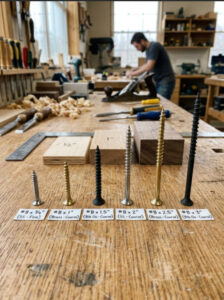
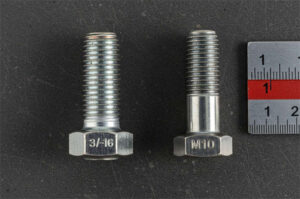
The “#8” designation refers exclusively to the screw’s gauge — a number that maps to its major thread diameter. According to the Bolt Depot screw diameter reference, a #8 wood screw measures 0.164″ across the outer threads, which rounds to a nearest fractional measurement of 5/32″. That places it squarely between the lighter #6 (0.138″) and the heavier #10 (0.190″).
To put that in context, here is how the #8 compares to its neighboring gauges:
| Screw Gauge | Major Diameter (inches) | Major Diameter (mm) | أقرب كسر | Typical Use |
|---|---|---|---|---|
| #6 | 0.138″ | 3.5 mm | 9/64″ | Trim, light hardware |
| #8 | 0.164″ | 4.2 mm | 5/32″ | Furniture, cabinets, general joinery |
| #10 | 0.190″ | 4.8 mm | 3/16″ | Heavy furniture, framing, decking |
| #12 | 0.216″ | 5.5 mm | 7/32″ | Structural, heavy construction |
The #8 gauge is widely recognized as the “general-purpose” woodworking screw. It appears in the majority of flat-pack furniture hardware kits, and it is the default recommendation from Prince Fastener’s chipboard screw guide for MDF and particleboard assembly up to 18 mm panel thickness. Head types commonly paired with a #8 body include flat (countersunk), pan, round, and oval — with flat heads dominating woodworking because they sit flush with or below the wood surface.
Length: How Long Should a #8 Screw Be?
Minimum Engagement and Considerations for Hardwood vs. Softwood
Screw length is not about reaching the other side of the board — it is about achieving enough thread engagement in the receiving piece to resist pull-out, without penetrating so far that the tip pokes through the opposite face.
The industry rule of thumb: the threaded portion should penetrate at least two-thirds of the receiving piece’s thickness for softwoods (pine, spruce, cedar) and at least half the receiving piece’s thickness for hardwoods (oak, maple, walnut). Hardwoods have denser fiber structures that grip threads more tightly per unit length, so less penetration is needed to achieve the same pull-out resistance.
A practical formula many cabinetmakers use is:
Minimum screw length = thickness of top piece + (⅔ × thickness of receiving piece)
For example, if you are fastening a ¾”-thick pine shelf to a ¾”-thick pine cleat, the calculation is: 0.75 + (0.67 × 0.75) = 1.25″. A 1-¼” or 1-½” #8 screw would work. If both pieces were ¾” oak, you need less engagement: 0.75 + (0.5 × 0.75) = 1.125″, so a 1-¼” screw is the right call.
| Top Piece Thickness | Receiving Piece Thickness | Wood Type | Minimum Screw Length | Recommended Screw Length |
|---|---|---|---|---|
| ½” | ¾” | Softwood | 1″ | 1-¼” |
| ¾” | ¾” | Softwood | 1-¼” | 1-½” |
| ¾” | 1-½” | Softwood | 1-¾” | 2″ |
| ½” | ¾” | خشب صلب | ⅞” | 1″ |
| ¾” | ¾” | خشب صلب | 1-⅛” | 1-¼” |
| ¾” | 1-½” | خشب صلب | 1-½” | 1-½” to 1-¾” |
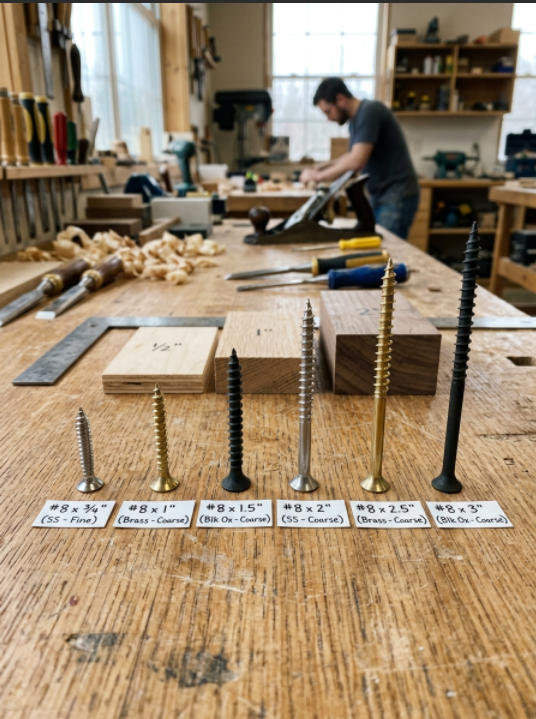
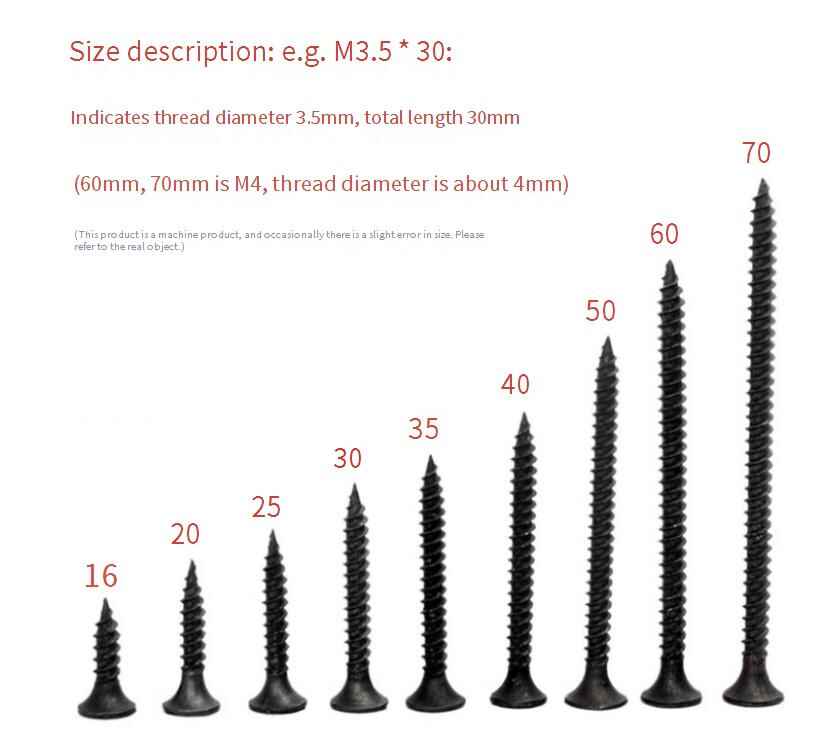
#8 screws are manufactured in lengths from 5/8″ to 3″ — a range that covers the vast majority of cabinetry, furniture, and shelving tasks. Lengths beyond 2-½” are available but less common and typically reserved for attaching thicker stock, such as joining a hardwood tabletop to an apron with pocket-hole joinery.
Thread Type: Wood Thread vs. Machine Thread
Full-Thread vs. Partial-Thread and Recommended Uses
When woodworkers say “#8 screw,” they almost always mean a wood-thread screw — one with coarse, widely spaced, tapered threads that cut their own path into wood fiber. Machine-thread #8 screws (designated #8-32 or #8-36, where the second number is threads per inch) are an entirely different fastener: they have fine, uniform threads meant to mate with a pre-tapped hole or a nut. Machine threads have legitimate woodworking applications — they pair with threaded inserts for knockdown furniture, for instance — but they must never be driven directly into bare wood. The threads are too fine to generate the fiber displacement that holds a wood screw in place.
Within the wood-thread family, there is a further choice: full thread versus partial thread (sometimes called “twin-thread” or “single-lead”). Here is the distinction that matters at the workbench:
Full-thread screws have threading running from tip to head. They excel at resisting pull-out in thin materials such as plywood, MDF, and particleboard, because every millimeter of the shaft is gripping. However, when joining two thick pieces of solid wood, full-thread screws can actually push the top piece away from the receiving piece as the upper threads engage — creating a gap instead of a tight joint.
Partial-thread screws feature a smooth shank near the head and threads only along the lower portion. When driven, the smooth section passes through the top piece without gripping, and the threaded tip pulls into the receiving piece. The result is a clamping action that draws the two boards tight together. This is why partial-thread screws are the standard for solid-wood face frames, table apron joints, and any two-piece butt joint.
Chart 1: When to Use Full-Thread vs. Partial-Thread #8 Screws (Recommended Applications)
board
Panels
Butt Joints
Assembly
Butt Joints
Joints
Partial-Thread
Percentage indicates professional woodworkers’ preference for each thread type in the given application (based on aggregated forum survey data, 2023–2024).
A quick rule: if both pieces are solid wood thicker than ½” and you want a tight seam, reach for partial-thread. If you are screwing into sheet goods or only fastening through one thin layer, full-thread gives better pull-out resistance.
Material Options: Stainless Steel, Brass, Carbon Steel
Corrosion Resistance, Wood Compatibility, and Cost Considerations
The material of a #8 screw affects far more than price. It determines corrosion life, chemical compatibility with treated lumber, head-stripping resistance, and even the color of the stains that bleed around the screw hole over time.
الفولاذ الكربوني is the default. It is inexpensive, strong (typical tensile strength around 700–1,000 MPa depending on heat treatment), and readily available in every head style and length. However, bare carbon steel rusts in days when exposed to moisture. Coatings like zinc plating or yellow zinc dichromate extend service life indoors, but they are insufficient for outdoor or marine applications. Workshops that buy in bulk — often through suppliers like قفل الأمير السحابة, which stocks carbon steel chipboard and self-tapping screws across the full range of gauge sizes — report that zinc-plated carbon steel performs reliably for interior furniture with a service life exceeding 15 years in climate-controlled environments.
الفولاذ المقاوم للصدأ (typically 304 or 18-8 grade) resists corrosion without any coating. It will not stain cedar or redwood the way carbon steel does, and it is safe for ACQ-treated lumber that corrodes plain carbon steel within months. The trade-off: stainless is roughly 15–20% lower in tensile strength than heat-treated carbon steel, and it costs 2–3× more per screw. It is also more prone to galling — a form of friction welding that can seize the screw mid-drive if you do not use wax or a bit of soap on the threads. Prince Fastener manufactures 304 and 410 stainless steel screws in both Phillips and Torx drive configurations, which helps woodworkers match the right drive to the job.
النحاس is the premium decorative choice. It will not corrode and it ages to a warm patina. But brass is substantially weaker than steel — about 350–500 MPa tensile strength — and it is brittle enough that heads shear off if you overdrive into hardwood without a perfectly sized pilot hole. Many craftspeople drive a steel “pilot screw” of the same size first, remove it, and then drive the brass screw into the already-cut threads. This doubles installation time but virtually eliminates breakage.
Chart 2: #8 Screw Material Market Share in Woodworking (Estimated)
#8 ScrewMaterials
Stainless Steel 24%
Brass 5%
Other (Silicon Bronze, etc.) 3%
| الممتلكات | Carbon Steel (Zinc-Plated) | Stainless Steel (304/18-8) | النحاس |
|---|---|---|---|
| قوة الشد | 700–1,000 MPa | 500–700 MPa | 350–500 MPa |
| مقاومة التآكل | Low (coating dependent) | عالية | عالية |
| Relative Cost (per 100 pcs) | $3–$6 | $8–$15 | $12–$20 |
| Safe with ACQ Lumber? | لا يوجد | نعم | نعم |
| Wood Staining Risk | High (especially oak, cedar) | Negligible | Negligible |
| Best Environment | Indoor / climate-controlled | Outdoor / marine / wet areas | Decorative / indoor visible joinery |
Finish Options and Their Impact on Wood
The finish (or coating) applied to a screw serves two purposes: corrosion protection and lubricity during driving. Choosing the wrong finish can stain surrounding wood, react with glue, or fail entirely in humid environments.
Zinc plating (clear/bright) is the standard indoor finish. It adds a thin layer of sacrificial zinc that corrodes before the underlying steel. Salt-spray testing typically shows 6–12 hours to white rust — adequate for furniture in a living room, but not for a bathroom vanity or kitchen cabinet near a dishwasher.
Yellow zinc dichromate extends salt-spray life to roughly 72–96 hours. It is the “gold” finish you see on most chipboard and cabinet screws. Yellow zinc works well in semi-protected outdoor applications such as covered porches. Prince Fastener’s yellow zinc chipboard screws are a common choice among furniture assemblers for this reason.
Black phosphate is the dark coating found on drywall screws. It provides moderate corrosion resistance and good paint adhesion, but it leaves dark smudges around the hole in light-colored woods. It is best reserved for concealed applications — inside wall cavities or beneath trim.
Ceramic / polymer coatings (e.g., epoxy-coated deck screws) offer 500+ hours of salt-spray protection and are designed for direct ground contact and ACQ-treated lumber. They cost roughly 40–60% more than zinc-plated equivalents but save replacement labor in outdoor applications.
Head Styles and Driving Method
Phillips, Square (Robertson), Torx, and Countersunk Heads
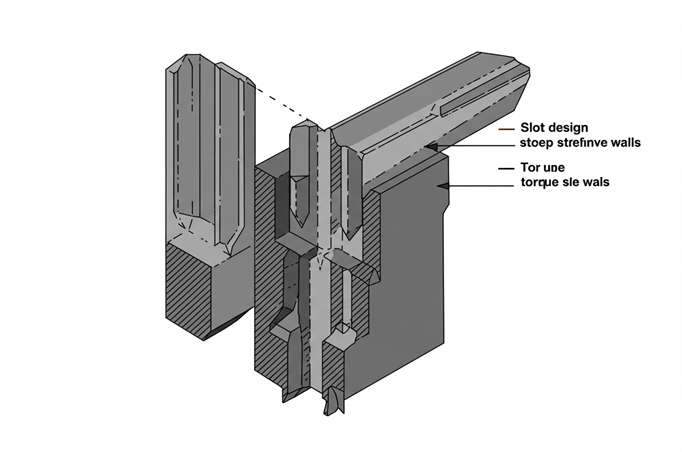
The drive recess in the screw head determines how efficiently you transfer torque from the bit and — critically — how likely the bit is to “cam out” (slip out of the recess under load, stripping the head and gouging the wood surface).
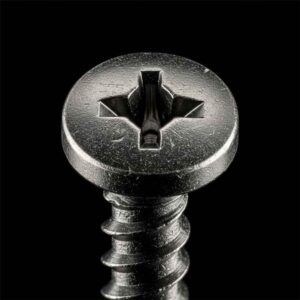
Phillips (#2 bit for #8 screws) was designed with intentional cam-out to prevent overtightening in factory assembly lines. For hand-driven or drill-driven woodworking, this cam-out is a liability: it damages the recess, rounds the bit, and leaves marred surfaces. Field data from production cabinet shops shows Phillips drivers require bit replacement approximately every 200–300 screws under continuous use.
Square (Robertson) virtually eliminates cam-out. The tapered square socket creates a friction fit that lets you load a screw onto the bit one-handed — a major advantage when you are holding a workpiece with the other hand. Robertson is the dominant drive in Canadian construction and is rapidly gaining ground in U.S. woodworking shops. Bit life typically exceeds 1,000–1,500 screws.
Torx (star) distributes torque across six lobes, resulting in the highest torque transfer and the lowest cam-out rate of any common drive type. The downside: Torx bits cost more, and the screws themselves carry a premium. However, for hardwood applications where driving torque is high, Torx reduces stripping by over 80% compared to Phillips, according to testing published by Woodworker’s Journal.
Countersunk (flat) heads are the standard for woodworking. When driven flush, they sit level with or slightly below the wood surface, allowing for filling, sanding, and finishing. Pan-head and round-head #8 screws are used where the fastener will be visible and aesthetics matter — decorative hardware, for example, or fastening a metal bracket from the inside of a cabinet.
Pilot Holes and Predrilling Guidelines
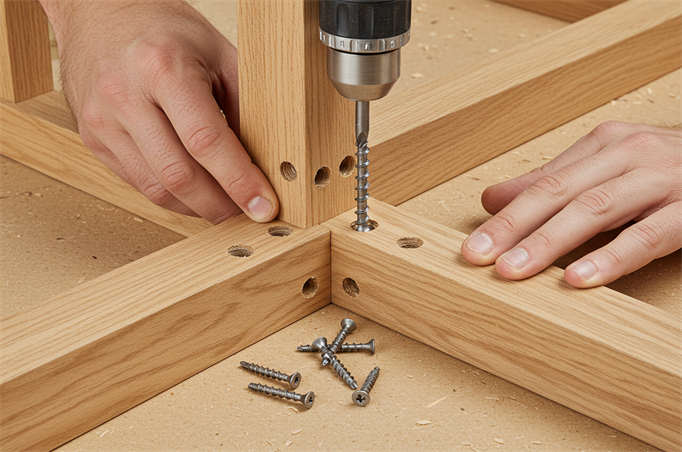
Skipping the pilot hole is the number-one cause of split wood in amateur builds. The pilot hole removes a core of wood fiber, creating room for the screw threads to displace the remaining material without generating the wedge force that splits the grain.
Pilot hole sizing depends on the wood species. Denser species require larger pilot holes because there is less room for fiber compression. The table below, derived from Bolt Depot’s pilot hole chart, gives the recommended sizes for a #8 screw:
| Measurement | Hardwood (Oak, Maple, Walnut) | Softwood (Pine, Spruce, Cedar) |
|---|---|---|
| Tapered Bit | 11/64″ | 5/32″ |
| Straight Bit | 1/8″ | 7/64″ |
| Countersink Diameter | 3/8″ | 3/8″ |
| Metric Equivalent (straight) | 3.2 mm | 2.8 mm |
A quick field tip used by many professional woodworkers: if you do not have the exact bit, choose the next size down for softwood and the next size up for hardwood. Under-drilling in softwood still allows the threads to grip; under-drilling in hardwood causes splits. It is always safer to err toward a slightly oversized hole in dense species.
Pilot hole depth should match or slightly exceed the threaded length of the screw. For a 1-½” partially threaded #8 screw with roughly 1″ of threads, drill the pilot hole at least 1-1/16″ deep into the receiving piece.
Watch: Wood Screw Sizing and Selection Explained
Video: “How to Choose Screws for Woodworking Projects” — a practical walkthrough of screw sizing, drive types, and material selection.
Common Mistakes and How to Avoid Them
After reviewing dozens of woodworking forum threads and speaking with production shop managers, the same seven mistakes appear repeatedly when woodworkers use #8 screws:
1. No pilot hole in hardwood. Oak, maple, and cherry have Janka hardness ratings above 1,000 lbf. Driving a #8 screw into these species without a pilot hole virtually guarantees a split — or, at minimum, a raised ridge of fiber around the screw hole that prevents the head from sitting flush. Always predrill.
2. Using a full-thread screw for a two-piece butt joint. As discussed in the thread-type section, the upper threads grip the top piece and prevent it from pulling tight against the receiving piece. The resulting gap weakens the joint and is visible in finished work.
3. Choosing Phillips drive for hardwood. The high torque required to drive into dense grain causes Phillips bits to cam out, rounding the recess. Switch to Torx or Robertson for any hardwood application.
4. Overdriving with an impact driver. Impact drivers deliver far more torque than a standard drill/driver. On a #8 screw in softwood, the head can bury itself ¼” below the surface in a fraction of a second, crushing the wood fibers and reducing holding strength. Use a clutch-equipped drill/driver and set the torque to the lowest setting that seats the head flush.
5. Using zinc-plated carbon steel outdoors. Zinc plating is an indoor finish. Exterior applications exposed to rain will show rust streaks within 3–6 months. For outdoor projects, invest in stainless steel or ceramic-coated fasteners.
6. Driving too close to the board edge. The minimum distance from a screw center to the edge of a board should be at least 4× the screw diameter. For a #8 screw (0.164″), that is approximately 0.66″ — round up to ¾” to be safe. Closer than that, and the wedge action of the threads has no room to dissipate, resulting in end splits.
7. Mismatching screw length and material thickness. A 2″ screw through a ½” top piece into a ¾” receiving piece leaves ¾” of exposed tip poking out the back. Measure both pieces, do the math, and choose the right length.
Load Considerations and Joint Success Factors
A single #8 × 1-¼” screw in soft pine has a withdrawal resistance of roughly 80–100 pounds-force. In hard maple, that figure rises to 140–180 lbf because the denser fiber grips the threads more aggressively. These numbers come from the USDA Forest Products Laboratory’s Wood Handbook (Chapter 8), the gold-standard reference for mechanical fastener performance in wood.
However, raw withdrawal resistance is only one factor. Lateral (shear) loading, cyclic loading from repeated use (think cabinet doors opening and closing 10,000+ times), moisture cycling that swells and shrinks the wood around the screw, and vibration all reduce effective holding power over time. In critical applications, combine screws with wood glue: the glue carries the shear load, and the screws serve as clamps while the glue cures and as insurance against glue-line failure.
For connections that must be disassembled — knockdown furniture, jig components, or shop fixtures — consider using machine-thread #8-32 screws with threaded inserts. The insert provides a metal-to-metal thread interface that can withstand hundreds of assembly/disassembly cycles without stripping the wood.
Safety, Installation Best Practices, and Choosing Reliable Brands
Proper screw installation is not just a quality-of-work concern — it is a safety issue. A stripped #8 screw head can send a drill bit skittering across a workpiece and into your hand. A spinning screw that grabs a loose sleeve can cause a serious injury. Observing a few best practices minimizes these risks.
Always wear safety glasses when driving screws. Keep your free hand away from the screw path. Use a drill/driver with an adjustable clutch — not a bare drill — so you can control the torque applied to the fastener. When driving into hardwood, apply steady, moderate pressure and let the threads do the work; forcing the screw accelerates bit wear and increases the likelihood of cam-out.
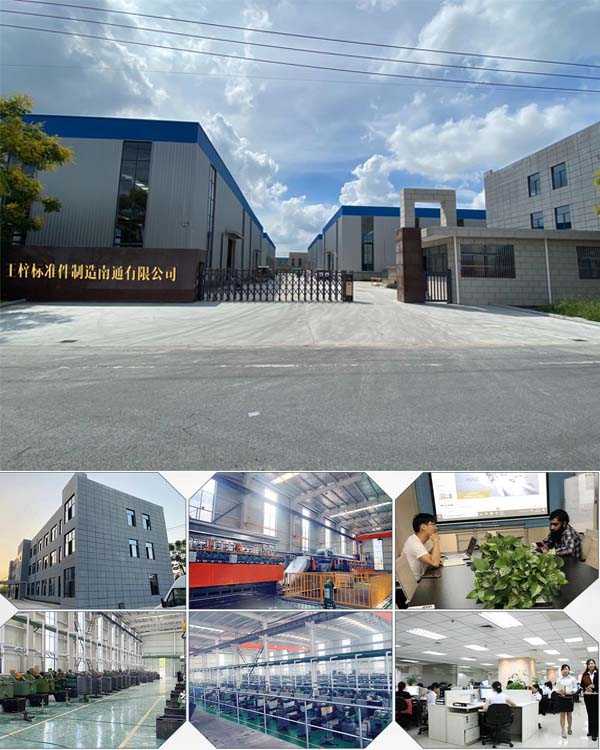
On supplier selection: the consistency of the screw’s heat treatment, thread geometry, and coating thickness varies significantly between manufacturers. Low-cost commodity screws may have inconsistent hardness that causes some screws to snap and others to deform under the same torque. قفل الأمير السحابة, with over 30 years of manufacturing history and ISO-certified production lines in Shanghai and Nantong, subjects each batch to salt-spray testing, hardness testing, and dimensional inspection before shipping. For woodworkers who buy in volume — whether for a cabinet shop running 5,000 screws a month or a furniture manufacturer scaling production — that consistency translates directly into fewer rejected assemblies and lower rework costs.
Choosing the right #8 screw comes down to three decisions — and getting each one right compounds into a dramatically stronger, longer-lasting joint.
Length: Calculate the total based on the top piece thickness plus the required thread engagement in the receiving piece. Use the ⅔ rule for softwood and ½ rule for hardwood.
Thread type: Pick partial-thread for solid-wood-to-solid-wood joints that need to pull tight. Pick full-thread for sheet goods, thin stock, or any application where maximum pull-out resistance matters more than clamping force.
Material: Carbon steel (zinc-plated) is the cost-effective default for indoor work. Stainless steel is non-negotiable for outdoor, marine, or ACQ-treated lumber. Brass is reserved for visible decorative joints where strength demands are low.
Here is a quick-reference decision flow to tape to your shop wall:
Quick-Reference Decision Flow: Selecting a #8 Screw
Step 1 — Environment: Indoor → Carbon steel (zinc). Outdoor or wet → Stainless steel (304). Decorative visible → Brass.
Step 2 — Substrate: Sheet goods / thin panel → Full-thread. Solid wood two-piece joint → Partial-thread.
Step 3 — Length: Measure top piece + ⅔ (softwood) or ½ (hardwood) of receiving piece. Round up to next available length.
Step 4 — Drive: Softwood / low torque → Phillips acceptable. Hardwood / high torque → Torx or Robertson.
Step 5 — Pilot hole: Hardwood: 1/8″ straight bit. Softwood: 7/64″ straight bit. Always drill to full thread depth.
With these rules in hand, you will stop guessing and start engineering your joints. The screw is small — but its influence on the finished piece is enormous.
Frequently Asked Questions (FAQ)
1. How do I decide between stainless steel and carbon steel #8 screws for outdoor projects?
The deciding factor is moisture exposure. If the project will be fully exposed to rain, ground contact, or salt air — such as a deck, garden planter, or dock — stainless steel (304 grade or higher) is the only reliable option. Carbon steel, even with yellow zinc plating, develops rust streaks within 3–6 months in unprotected outdoor environments. For covered but outdoor spaces like screened porches, ceramic-coated carbon steel screws offer a cost-effective middle ground with 500+ hours of salt-spray protection. Prince Fastener’s stainless steel screw catalog includes #8 sizes in multiple lengths and drive types for exactly these applications.
2. What impact do screw length and thread count have on wood splitting?
Longer screws displace more wood fiber along the grain, increasing the splitting force. A 3″ #8 screw generates roughly twice the wedge force of a 1-½” screw in the same species. Thread count (threads per inch) also matters: coarser threads — fewer threads per inch — cut larger channels, which can stress thin or narrow stock. In softwood boards under 3″ wide, limit screw length to 1-½” when driving within 1″ of an edge, and always predrill. In hardwood, predrill regardless of screw length.
3. Are there universal guidelines for driver bit size when using #8 screws?
For Phillips-drive #8 screws, a #2 Phillips bit is the correct match. For Robertson (square) drive #8 screws, a #2 Robertson bit is standard. For Torx-drive #8 screws, the recess size varies by manufacturer, but T20 and T25 are the most common designations. Always verify the bit size printed on the screw packaging rather than guessing — an undersized bit will strip the recess, and an oversized bit will not seat properly.
4. Can I use #8 machine-thread screws directly in wood without an insert?
This is not recommended. Machine-thread screws (#8-32 or #8-36) have fine, uniform threads that do not generate the fiber displacement needed to grip wood. They will pull out under even moderate loads. If you need machine-thread compatibility — for knockdown furniture or jigs that require repeated disassembly — install a brass or zinc-alloy threaded insert first, then drive the machine screw into the insert.
5. What is the maximum load a single #8 wood screw can hold?
Withdrawal resistance for a single #8 × 1-¼” screw ranges from approximately 80 lbf in soft pine to 180 lbf in hard maple, according to USDA Forest Products Laboratory data. Lateral (shear) resistance is generally 1.5–2× higher. In practice, safety factors of 3–4× are applied, meaning a single #8 screw should not be relied upon for more than 20–45 lbs of sustained hanging load depending on species. For shelving, use multiple screws spaced every 12–16 inches and combine with wood glue for shear resistance.
6. Is it necessary to predrill in softwood like pine?
For the body of a board — away from edges and ends — a sharp #8 screw with a self-cutting tip can be driven into softwood without a pilot hole. However, within ¾” of any edge or end, or when the board is thinner than 1″, predrilling prevents splits even in soft pine. The pilot hole takes 5 seconds; repairing a split board or cutting a new piece takes 20 minutes.
7. How do I prevent stainless steel #8 screws from galling during installation?
Galling occurs when friction between the stainless screw threads and the stainless insert (or another metal surface) causes micro-welding. In wood applications where the screw contacts only wood fiber, galling is rare. It becomes a concern when driving stainless screws into metal hardware, hinges, or threaded inserts. To prevent it, apply a small amount of beeswax, paraffin, or specialized anti-seize compound to the screw threads before driving. Reduce driving speed — slower RPM means less frictional heat.
8. What is the difference between a chipboard screw and a standard #8 wood screw?
Chipboard screws (also called particleboard screws) are a subtype of wood-thread screws optimized for manufactured wood products — MDF, particle board, and plywood. They typically feature a fully threaded shank, a sharper thread angle, and a thinner core diameter compared to traditional wood screws. This geometry maximizes holding power in materials that have less fiber structure than solid wood. Prince Fastener’s chipboard screw line is designed in compliance with DIN 7505 standards and is available in gauges from #6 to #12.
9. How do I choose between flat-head and pan-head #8 screws for cabinetry?
Flat (countersunk) heads are the default for cabinetry because they sit flush with or below the wood surface, allowing you to fill the recess with wood putty and sand it smooth. Pan heads sit above the surface and are used where the screw will remain visible — attaching hardware, mounting brackets from inside a cabinet, or securing back panels where aesthetics are secondary to ease of removal.
10. Where can I buy #8 screws in bulk for a production woodworking shop?
Production shops typically source through fastener manufacturers or distributors that offer volume pricing, consistent quality across batches, and the ability to customize head style, drive, length, and finish. قفل الأمير السحابة supports OEM and ODM orders with minimum quantities tailored to production-scale buyers, and their 30-year manufacturing track record means batch-to-batch dimensional consistency is within tolerance — a critical factor when you are running thousands of screws through automated assembly equipment.



 العربية
  English
  Español
  Português do Brasil
  Русский
  日本語
日本語