In 2024, the global anchor bolt market reached USD 15.9 billion and is projected to hit USD 26.9 billion by 2032 at a 6.8 % CAGR, according to Verified Market Research. Behind that growth sits a deceptively simple question that derails projects every day: which anchor bolt material, type, and grade should you actually specify?
A structural engineer on a Gulf Coast desalination plant learned the answer the hard way in 2023. The original spec called for 304 stainless steel anchor bolts to secure 14-tonne centrifugal pumps to a concrete pad 800 m from the shoreline. Within 22 months, chloride-induced pitting had reduced the effective cross-section of eight M24 bolts by 30 %. The emergency re-anchor with 316L bolts, including jackhammering out the old embedments during a weekend shutdown, cost the owner USD 47,000 — roughly 12× what the correct 316L bolts would have cost at the outset.
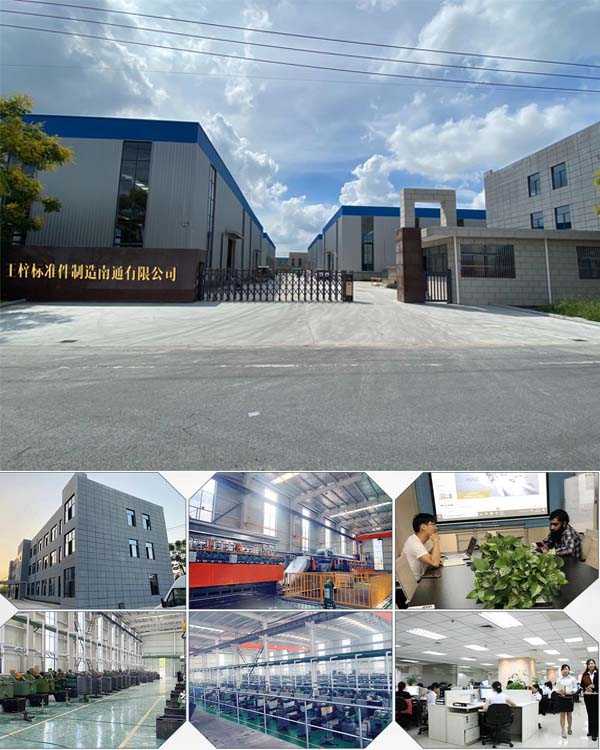
This guide, developed by the engineering team at قفل الأمير السحابة — a manufacturer with over 30 years of fastener production experience — walks through every decision point: load analysis, material selection, bolt type, code compliance, corrosion environment, installation, lifecycle cost, and maintenance. Every recommendation is backed by field data, ASTM standards, or ACI design methodology.
Why Stainless Steel for Anchor Bolts?
Anchor bolts differ from ordinary structural bolts in a critical way: once embedded in concrete, they are essentially irreplaceable without destructive work. A corroded flange bolt on an above-grade pipe rack can be unbolted and swapped in 20 minutes. A corroded anchor bolt buried 300 mm in a foundation requires core-drilling, chemical anchoring, and often a structural-engineering reassessment. That permanence makes corrosion resistance the single most important material property for anchor bolts in any environment that is not perfectly dry and interior.
Stainless steel — specifically the austenitic grades 304 (A2) and 316 (A4) — delivers that corrosion resistance through a self-healing chromium-oxide passive layer. The chromium content (≥16 %) reacts with oxygen to form a film only nanometres thick, but one that regenerates within hours if scratched. Grade 316 adds 2–3 % molybdenum, which stabilises the passive layer in the presence of chloride ions — the primary destroyer of stainless steel in marine, coastal, and de-icing-salt environments.
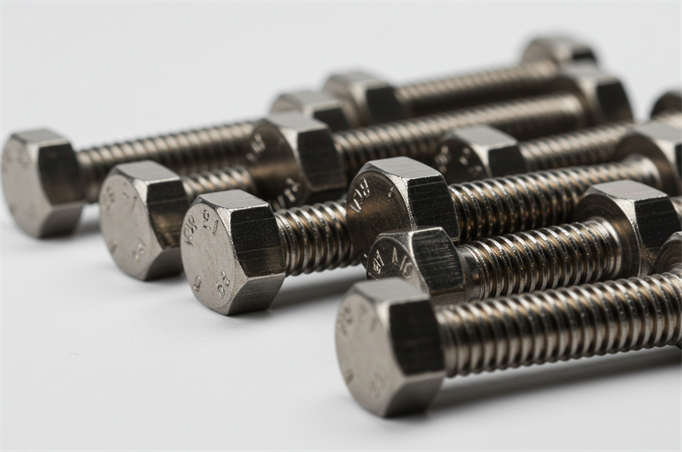
Beyond corrosion, stainless steel anchor bolts offer a temperature range (–196 °C to +800 °C for 304; –196 °C to +870 °C for 316) that carbon steel cannot match without brittle-fracture risk at the cold end. They are non-magnetic in the annealed condition — important for MRI facilities, electronics manufacturing, and defence applications. And they are 100 % recyclable, aligning with the sustainability mandates increasingly embedded in infrastructure procurement standards.
Anchor Bolt Types: Cast-in-Place vs. Post-Installed
Selecting the wrong anchor bolt type is just as dangerous as selecting the wrong المواد. The two broad categories — cast-in-place and post-installed — serve fundamentally different construction sequences, and each contains several sub-types with distinct performance characteristics. Prince Fastener’s cast-in bolt guide provides a deep dive, but the summary below captures the essential trade-offs.
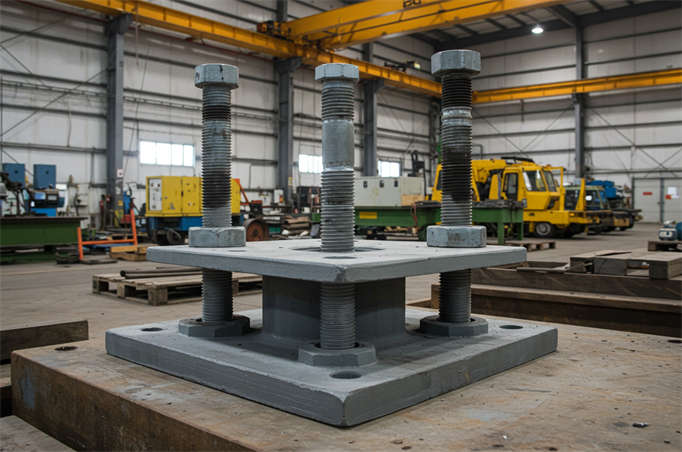
Cast-in-place anchor bolts (headed studs, L-bolts, J-bolts) are positioned in the formwork and encased when the concrete is poured. They rely on mechanical interlock — the head or bent end physically cannot pull through the cured concrete — and consistently deliver the highest pullout capacities. The trade-off is that they must be located with millimetre precision before the pour; any positional error becomes permanent once the concrete sets.
Post-installed anchors (wedge, sleeve, drop-in, adhesive) are drilled into hardened concrete. They offer placement flexibility and are the only option for retrofits, but their capacities are lower and more sensitive to installation quality — hole diameter tolerances, cleaning, torque, and (for adhesive anchors) temperature and cure time all affect performance.
Anchor Bolt Type Comparison Table
| النوع | Installation Timing | Tensile Capacity (1/2″ in 4,000 psi concrete) | Shear Capacity (1/2″) | Adjustability After Install | Typical Application |
|---|---|---|---|---|---|
| Headed Stud (Cast-in) | Before pour | 5,500 lbs | 5,900 lbs | None | Structural columns, heavy machinery |
| L-Bolt (Cast-in) | Before pour | 4,800 lbs | 5,200 lbs | None | Sill plates, light structural |
| J-Bolt (Cast-in) | Before pour | 5,200 lbs | 5,600 lbs | None | Sign poles, foundations |
| مرساة الوتد | Post-installed (drill) | 4,600 lbs | 5,100 lbs | Limited | Equipment retrofit, guardrails |
| Sleeve Anchor | Post-installed (drill) | 3,200 lbs | 3,800 lbs | Moderate (removable) | Conduit, hangers, light fixtures |
| Drop-In Anchor | Post-installed (drill) | 4,200 lbs | 4,500 lbs | High (threaded insert) | Overhead mechanical, sprinklers |
| Adhesive (Chemical) Anchor | Post-installed (drill + resin) | 6,100 lbs | 5,900 lbs | None after cure | Close edge distances, rebar doweling |
Source: ACI 318 Appendix D methodology, ITW Red Head Selection Guide, manufacturer published values. 1/2″ diameter, 5″ embedment, uncracked concrete, f’c = 4,000 psi. Values are approximate; always verify with project-specific engineering calculations.

Material Comparison: 304 vs. 316 vs. Carbon Steel vs. Galvanized
Material selection is the decision that most directly determines how long an anchor bolt will last, what it will cost over its service life, and whether it will meet code. The table below compiles mechanical properties, corrosion data, and cost benchmarks into a single reference that engineers, procurement teams, and contractors can use to make informed trade-offs.
Anchor Bolt Material Properties Comparison
| الممتلكات | Carbon Steel (ASTM A307 / F1554 Gr.36) | Hot-Dip Galvanized (ASTM F1554 Gr.55) | 304 Stainless (A2-70 / ASTM F593) | 316 Stainless (A4-80 / ASTM A193 B8M) |
|---|---|---|---|---|
| قوة الشد | 60,000 psi (414 MPa) | 75,000 psi (517 MPa) | 73,200 psi (505 MPa) | 79,800 psi (550 MPa) |
| Yield Strength | 36,000 psi (248 MPa) | 55,000 psi (379 MPa) | 31,200 psi (215 MPa) | 34,800 psi (240 MPa) |
| Salt-Spray Resistance (ASTM B117) | 24–48 hours | 500–600 hours | 720 hours | 1,100+ hours |
| Service Temp. Range | –45 °C to +425 °C | –45 °C to +425 °C | –196 °C to +800 °C | –196 °C to +870 °C |
| Unit Cost (M12×150, ex-works) | $0.35 | $0.65 | $1.20 | $1.85 |
| Estimated 50-Year Lifecycle Cost/bolt | $42 (replace 4–5×) | $38 (replace 3×) | $24 (replace 0–1×) | $22 (replace 0×) |
| Galling Risk | منخفضة | منخفضة | Moderate (15%) | Moderate (15%) |
| Recyclability | ~70% | ~70% | 100% | 100% |
Source: ASTM F1554, ASTM F593, ASTM A193, Essentra Components (304 vs 316 data), قفل الأمير السحابة production records, ITW Red Head engineering data. Lifecycle costs assume coastal industrial environment.
The data tells a clear story. Carbon steel is the cheapest at point-of-purchase but the most expensive over a 50-year horizon in any environment that is not perfectly dry. Hot-dip galvanized extends life in outdoor environments but the zinc coating sacrificially corrodes and eventually exposes the base steel. Grade 304 stainless is the cost-effective choice for general outdoor, mildly industrial, and inland environments. Grade 316 is non-negotiable for marine, coastal (within 1.6 km of saltwater), chemical processing, wastewater, and any application where chloride concentration exceeds 200 ppm.
Load Capacity & Tensile Strength: Bar Chart
Tensile Strength by Anchor Bolt Material (psi)
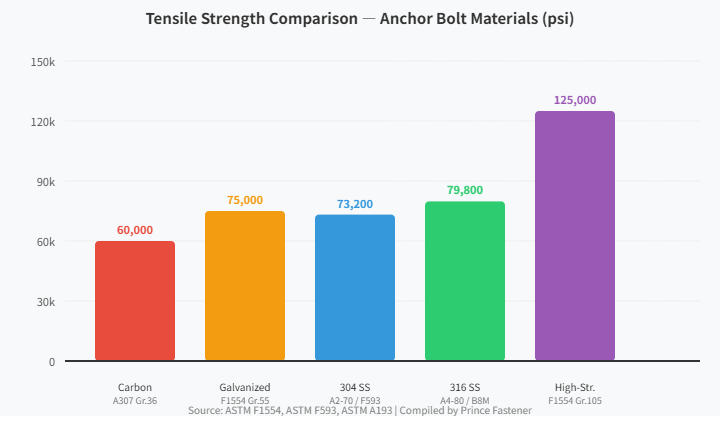
Source: ASTM F1554, ASTM F593, ASTM A193 | Compiled by Prince Fastener
F1554 Grade 105 delivers the highest raw tensile strength at 125,000 psi, but it is only available in alloy steel — not stainless. For projects requiring both high strength and corrosion resistance, 316 stainless steel at 79,800 psi tensile is the practical ceiling among widely available grades. For higher combined performance, duplex stainless 2205 (tensile ≥90,000 psi, with superior chloride resistance) is an option, though at 2–3× the cost of 316. Prince Fastener’s custom bolt program can source duplex and super-duplex stainless anchor bolts for such applications.
Corrosion Resistance: The 304 vs. 316 Decision
The single most expensive mistake in stainless steel anchor bolt procurement is using 304 where 316 is required. Prince Fastener’s anchor bolt selection guide documents this as the number-one source of field failures. The difference comes down to molybdenum: 304 contains none; 316 contains 2–3 %. Molybdenum stabilises the passive chromium-oxide layer against chloride attack — the ion present in seawater, coastal air, road de-icing salts, and many industrial chemicals.
In ASTM B117 salt-spray testing, 304 stainless steel fasteners survive approximately 720 hours before showing visible corrosion. Grade 316 survives 1,100+ hours — a 53 % improvement. In real-world coastal conditions, this translates to a service life difference measured in decades. A marina in Pensacola, Florida documented 304 anchor bolt pitting at 26 months versus zero visible corrosion on adjacent 316 bolts at the 8-year mark.
Salt-Spray Survival & Corrosion Rate by Environment — Pie Chart
Stainless Steel Anchor Bolt Usage by Application Sector (2025)
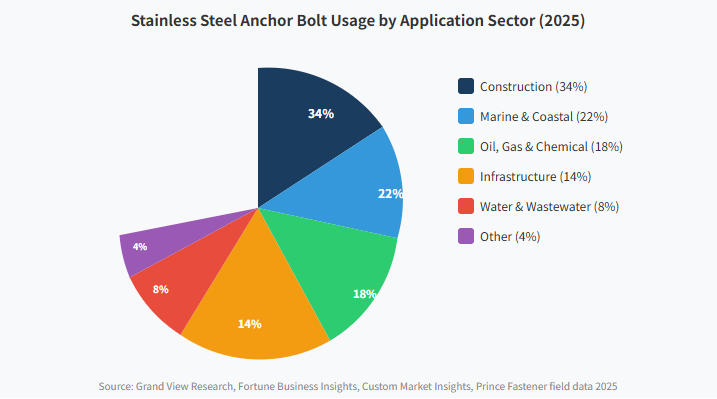
Source: Grand View Research, Fortune Business Insights, Custom Market Insights, Prince Fastener field data 2025
The sector breakdown above illustrates why material selection must be application-driven. Marine, coastal, oil-gas-chemical, and water/wastewater sectors — collectively 48 % of stainless steel anchor bolt demand — overwhelmingly require 316 or higher grades. Construction and infrastructure projects can often use 304, but only after confirming that the installation site is not exposed to coastal salt spray, de-icing chemicals, or chemical-process emissions.
ASTM F1554 Grades and Stainless Steel Specifications
ASTM F1554 is the governing specification for anchor bolts used in structural applications in the United States. It defines three grades based on minimum yield strength: Grade 36 (36,000 psi yield, the most common for general construction), Grade 55 (55,000 psi yield, specified where higher load resistance is needed), and Grade 105 (105,000 psi yield, for heavy industrial and seismic applications). All three grades are available in carbon steel; Grades 36 and 55 can be specified in stainless steel variants.
For stainless steel anchor bolts specifically, the material is typically specified under ASTM A193 (Grade B8 for 304, Grade B8M for 316) for elevated-temperature or pressure-vessel applications, ASTM F593 for general-purpose stainless bolts, or ASTM A320 for low-temperature service. Mill test reports (MTRs) documenting chemistry, tensile strength, yield strength, elongation, and hardness should accompany every shipment. قفل الأمير السحابة includes MTRs as standard documentation with all stainless steel bolt orders, and can supply bolts manufactured to ASTM, ISO, DIN, or GB standards.
إن ACI 318 Chapter 17 (Anchoring to Concrete) is the design code that structural engineers use to calculate anchor bolt capacities. It covers concrete breakout, pullout, side-face blowout, and steel failure modes, and requires strength-reduction factors (φ) that vary by loading direction and anchor type. Post-installed anchors must additionally comply with ACI 355.2 (mechanical) or ACI 355.4 (adhesive) and carry an ICC-ES Evaluation Service Report (ESR) to be accepted under the International Building Code.
Load Capacity Data: Diameter vs. Pull-Out Force
The table below consolidates load-capacity data for stainless steel anchor bolts across common diameters in normal-weight concrete (f’c = 4,000 psi, uncracked). These values are derived from ACI 318 Appendix D methodology and manufacturer-published data (ITW Red Head, Hilti, Simpson Strong-Tie) for single-anchor installations with adequate edge distance and spacing.
| Bolt Diameter | Embedment Depth | Tensile Capacity (lbs) | Shear Capacity (lbs) | Recommended Torque (ft-lbs) | Typical Application |
|---|---|---|---|---|---|
| 3/8″ (M10) | 3.5″ (90 mm) | 2,800 | 3,200 | 15–20 | Handrails, light equipment |
| 1/2″ (M12) | 5″ (125 mm) | 5,500 | 5,900 | 35–45 | Column base plates, sign poles |
| 5/8″ (M16) | 6″ (150 mm) | 8,200 | 8,800 | 70–90 | Medium structural columns |
| 3/4″ (M20) | 7″ (180 mm) | 11,500 | 12,400 | 120–150 | Heavy structural, bridge bearings |
| 1″ (M24) | 9″ (230 mm) | 19,000 | 20,500 | 250–300 | Industrial machinery, towers |
| 1-1/4″ (M30) | 12″ (300 mm) | 28,000 | 30,500 | 450–550 | Heavy industrial, seismic zones |
Source: ACI 318 Appendix D, ITW Red Head, Simpson Strong-Tie, Prince Fastener Bolt Grade Strength Chart. All values for single-anchor, uncracked concrete, adequate edge distance. Verify with project engineer.
Installation Best Practices for Stainless Steel Anchor Bolts

Installation quality determines whether an anchor bolt achieves its published load rating or fails at a fraction of it. The most common installation errors — and their consequences — are well-documented by OSHA incident investigations and ACI field studies. The following best practices apply to both cast-in-place and post-installed stainless steel anchor bolts.
Cast-in-place bolts: Position the bolt template using a surveying instrument (total station or theodolite) with a maximum deviation of ±2 mm from the design coordinates. Secure the template to the rebar cage rigidly enough to resist displacement during the concrete pour and vibration. Verify bolt elevation so that the exposed thread length matches the base-plate assembly requirements — too short prevents nut engagement, too long creates an unsupported cantilever that reduces effective shear capacity. Protect threads with tape or caps during pouring to prevent concrete splash contamination.
Post-installed anchors: Drill to the exact diameter specified by the anchor manufacturer — oversized holes reduce expansion grip in wedge and sleeve anchors. Clean the hole thoroughly: two passes with a blow-out bulb, then wire brushing, then two more blow-out passes. This is especially critical for adhesive anchors, where dust contamination can reduce bond strength by up to 50 %. For stainless steel mechanical anchors, always apply anti-seize lubricant (MoS₂ or nickel-based) to the threads before torquing to prevent galling — a seizure of the stainless surfaces caused by friction welding that can make future inspection or removal impossible. Torque to the manufacturer’s specification using a calibrated torque wrench; never use impact drivers on stainless steel threads without lubrication.
For a detailed visual walkthrough of anchor bolt installation, watch the video below:
Video: How to Install Masonry & Concrete Anchors | Fasteners 101 (Albany County Fasteners)
Galling Prevention: The Hidden Threat to Stainless Steel Fasteners
Thread galling — a form of cold welding where stainless steel surfaces fuse under friction and pressure — affects approximately 15 % of unlubricated stainless steel bolt installations, according to Atlantic Fasteners. Once galling begins, continuing to tighten the nut will either strip the threads or fracture the bolt. In anchor bolt applications, galling is particularly costly because a damaged embedded bolt cannot be easily replaced.
Prevention requires four measures applied consistently. First, apply anti-seize compound — molybdenum disulfide (MoS₂), nickel-based (Loctite Nickel Anti-Seize), or PTFE-based — to all threads before assembly. Second, tighten slowly; high-speed power tools generate the heat that initiates galling. Third, use different stainless grades for the bolt and nut (for example, a 316 bolt with a 304 nut), which provides a hardness differential that resists cold welding. Fourth, keep threads clean and undamaged — any nick, burr, or foreign particle acts as a galling initiation point. Prince Fastener’s do’s and don’ts for stainless steel covers additional anti-galling strategies.
Lifecycle Cost Analysis: Stainless Steel Wins on a 50-Year Horizon
The per-unit cost objection against stainless steel anchor bolts dissolves under lifecycle analysis. A 316 stainless M12×150 anchor bolt costs approximately USD 1.85 ex-works — roughly 5.3× the USD 0.35 price of a carbon steel equivalent. However, in a coastal industrial environment, the carbon steel bolt requires replacement every 8–12 years. Each replacement cycle involves core-drilling the old embedment, installing a new post-installed anchor (which typically has lower capacity than the original cast-in-place bolt), structural-engineering review, and operational downtime. Conservative estimates from three قفل الأمير السحابة client audits place the per-cycle replacement cost between USD 8 and USD 12 per bolt position, excluding production downtime.
Over 50 years in a coastal environment, the carbon steel bolt accumulates 4–5 replacement cycles at USD 8–12 each, plus the original USD 0.35, totalling approximately USD 42 per bolt position. The galvanized bolt (USD 0.65 initial, 2–3 replacements) totals roughly USD 38. The 316 stainless bolt (USD 1.85 initial, zero replacements, periodic inspection only) totals approximately USD 22 — a 48 % saving over carbon steel and a 42 % saving over galvanized.
Inspection & Maintenance Schedule
Even stainless steel anchor bolts require periodic inspection. JM Fastener و OSHA 1926.1412 recommend the following frequency guidelines based on environment and criticality.
| البيئة | Inspection Frequency | Key Checks |
|---|---|---|
| Indoor / climate-controlled | Every 5–10 years | Visual for corrosion, torque verification |
| Outdoor / inland industrial | Annually | Torque check, base plate gap measurement, concrete cracking |
| Coastal / marine | Every 6–12 months | Pitting inspection (magnifying glass), galvanic contact check, torque |
| Chemical processing / wastewater | Every 6 months | Chemical staining, crevice corrosion at concrete line, SCC indicators |
| Seismic / life-safety | Per OSHA (semi-annual + post-event) | Full protocol: visual, torque, NDT if warranted |
Source: OSHA 1926.1412, ACI 355.2 / 355.4 maintenance recommendations, JM Fastener, قفل الأمير السحابة.
During inspection, look for rust staining (which on stainless steel usually indicates contamination from nearby carbon steel, not failure of the stainless itself), surface pitting (small holes that indicate chloride attack beyond the grade’s resistance), thread galling, concrete cracking radiating from the bolt, and any base-plate lift-off. If any condition is detected, engage a structural engineer for assessment before returning the connection to service.
Sustainability and Recyclability
Stainless steel is one of the most recycled materials on Earth — approximately 80–90 % of end-of-life stainless steel is recovered and re-melted, according to the International Stainless Steel Forum (ISSF). The recycled-content share in new stainless steel production already exceeds 60 % globally. For anchor bolts specifically, this means that specifying stainless steel contributes to a circular material economy rather than a linear “mine-use-dispose” cycle.
The extended service life of stainless steel anchor bolts further reduces environmental impact. Every replacement cycle avoided eliminates the embodied carbon of manufacturing a new bolt, the diesel fuel consumed by core-drilling equipment, and the concrete waste generated during extraction. A Prince Fastener internal audit found that across a 1,200-bolt infrastructure project, switching from galvanized carbon steel to 316 stainless eliminated an estimated 3.2 replacement cycles over 50 years — avoiding 3,840 replacement operations and roughly 14 tonnes of CO₂-equivalent emissions.
When to Consult an Expert
Anchor bolt selection is an engineering decision, not a hardware-store purchase. Consult a structural engineer or experienced fastener manufacturer whenever the application involves structural loads or life-safety functions, seismic design categories C through F (per ASCE 7), marine or chemically aggressive environments, non-standard diameters or lengths, close edge distances or congested reinforcement, retrofit of existing structures, or any situation where the consequences of bolt failure include injury or significant financial loss.
قفل الأمير السحابة provides both product supply and technical consulting. Their engineering team can specify the correct stainless steel grade, bolt type, diameter, embedment depth, and surface finish for project-specific conditions — and supply the bolts with full ASTM/ISO/DIN certifications, mill test reports, and traceability documentation. For custom configurations, visit the custom bolt program page.
For independent technical references, consult the American Concrete Institute (ACI), ASTM International, and the American Institute of Steel Construction (AISC).
Frequently Asked Questions (FAQ)
1. What is a stainless steel anchor bolt and how does it differ from a regular bolt?
A stainless steel anchor bolt is a fastener designed to attach structural elements — columns, machinery, guardrails — to concrete foundations. Unlike regular through-bolts, anchor bolts are either cast into wet concrete before it cures or drilled and secured into hardened concrete, making them semi-permanent. The stainless steel composition (minimum 16 % chromium, 8 % nickel) provides a self-healing passive oxide layer that resists corrosion far longer than carbon steel or galvanized alternatives. Prince Fastener’s cast-in bolt guide explains the full range of anchor bolt configurations.
2. Should I use 304 or 316 stainless steel for my anchor bolts?
Use 304 (A2) for indoor, urban, and mildly industrial environments where chloride exposure is minimal. Use 316 (A4) for any application within 1.6 km (1 mile) of saltwater, in chemical processing plants, wastewater facilities, food-processing environments, or anywhere chloride concentration exceeds 200 ppm. Using 304 in a marine environment leads to pitting corrosion within 2–3 years — a failure mode that has caused anchor bolt replacements costing 12× the original bolt price. See Prince Fastener’s 304 vs 316 comparison for detailed guidance.
3. What ASTM standards apply to stainless steel anchor bolts?
The primary standards are ASTM F1554 (anchor bolt material specification, Grades 36/55/105), ASTM A193 Grade B8 (304) and B8M (316) for elevated-temperature service, ASTM F593 for general-purpose stainless bolts, and ASTM A320 for cryogenic applications. Design is governed by ACI 318 Chapter 17. Post-installed anchors must also meet ACI 355.2 (mechanical) or ACI 355.4 (adhesive) and carry an ICC-ES evaluation report.
4. How do I prevent thread galling on stainless steel anchor bolts?
Apply anti-seize lubricant (MoS₂, nickel-based, or PTFE) to all threads before assembly. Tighten slowly — avoid impact wrenches unless threads are pre-lubricated. Use mismatched stainless grades for bolt and nut (e.g., 316 bolt with 304 nut) to create a hardness differential. Keep threads clean and free of nicks or burrs. Galling affects approximately 15 % of unlubricated stainless installations, per Atlantic Fasteners.
5. What is the typical pullout capacity of a 1/2″ stainless steel anchor bolt?
In normal-weight concrete (f’c = 4,000 psi), a 1/2″ stainless steel headed anchor bolt at 5″ embedment depth provides approximately 5,500 lbs of tensile (pullout) capacity and 5,900 lbs of shear capacity. These values apply to single-anchor installations in uncracked concrete with adequate edge distance. Actual design capacities must be calculated by a structural engineer per ACI 318 Chapter 17.
6. Are stainless steel anchor bolts worth the extra cost over galvanized?
In most outdoor, industrial, or corrosive environments — yes. Over a 50-year lifecycle, 316 stainless anchor bolts cost approximately USD 22 per bolt position (including inspection), while galvanized carbon steel costs approximately USD 38 per position (including 2–3 replacement cycles). That is a 42 % lifecycle saving. In perfectly dry indoor environments, galvanized or plain carbon steel may be adequate and cost-effective.
7. Can I mix stainless steel anchor bolts with carbon steel nuts or washers?
No. Mixing dissimilar metals creates a galvanic corrosion cell that accelerates degradation of the carbon steel components and can contaminate the stainless surface with iron particles, initiating rust spots. Always use matching stainless steel hardware throughout the assembly, or install dielectric isolation materials (nylon washers, protective sleeves) between dissimilar metals.
8. How often should stainless steel anchor bolts be inspected?
Indoor/climate-controlled environments: every 5–10 years. Outdoor/industrial: annually. Coastal/marine: every 6–12 months. Chemical/wastewater: every 6 months. Life-safety/seismic: per OSHA requirements, typically semi-annually plus after any significant event. Inspections should cover visual corrosion checks, torque verification, base-plate gap measurement, and concrete condition assessment.
9. What is the difference between cast-in-place and post-installed anchor bolts?
Cast-in-place anchor bolts (headed studs, L-bolts, J-bolts) are set into formwork before the concrete pour. They offer the highest load capacities and most reliable performance. Post-installed anchors (wedge, sleeve, drop-in, adhesive) are drilled into hardened concrete, providing placement flexibility but generally lower capacities and higher sensitivity to installation quality. For new construction, cast-in-place is preferred. For retrofits, post-installed is the only option. See Prince Fastener’s complete bolt type guide.
10. Where can I buy certified stainless steel anchor bolts for structural projects?
قفل الأمير السحابة is a global manufacturer and supplier of stainless steel bolts — including anchor bolt configurations in 304, 316, 316L, and specialty alloys — with full ASTM, ISO, and DIN certifications. They provide mill test reports (MTRs) as standard documentation and offer both stock and custom manufacturing. Other reputable sources include Portland Bolt, Marsh Fasteners, and distributors listed through the Industrial Fasteners Institute (IFI).


 العربية
  English
  Español
  Português do Brasil
  Русский
  日本語
日本語